AI Is Driving a New Era of SaaS Cost Volatility
About the Report
The 2026 SaaS Management Index is built on the industry’s largest and most robust body of SaaS data. Now in its eighth year, the report analyzes how organizations purchase, manage, and optimize subscription software at scale, drawing from Zylo’s extensive, real-world dataset.
AI Is Transforming How Software Is Built, Priced & Managed
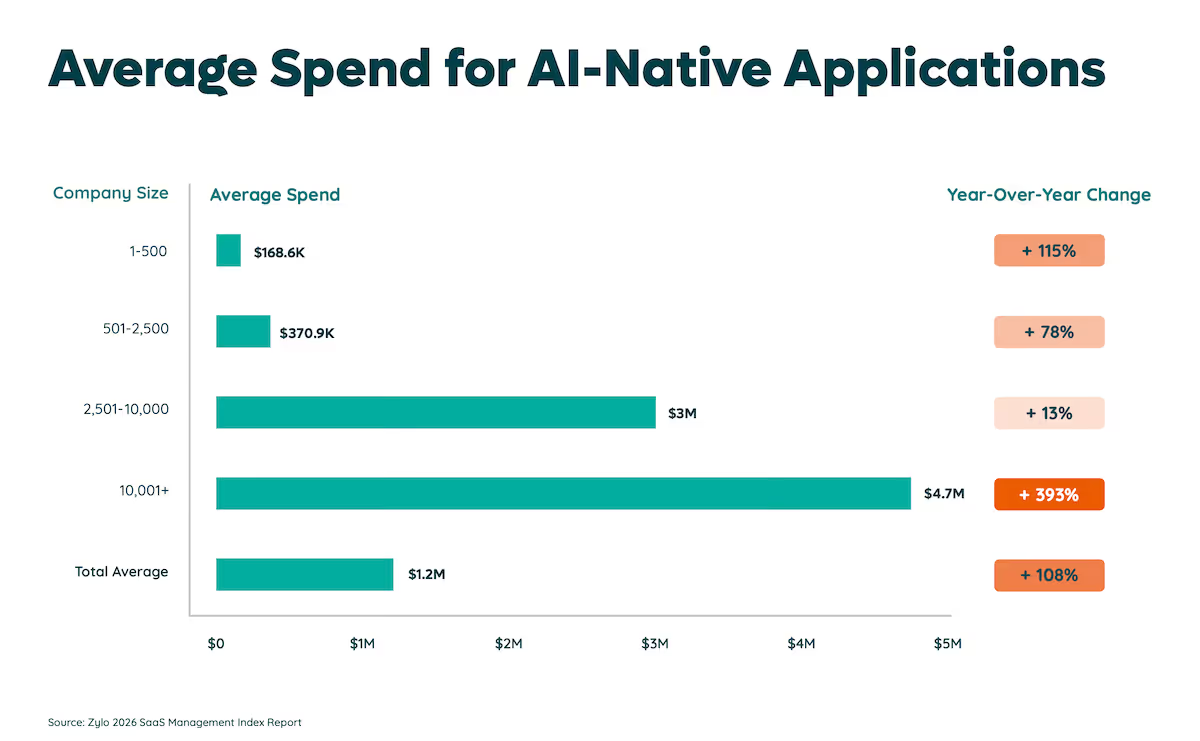
AI is reshaping software faster than organizations can respond. For AI-native applications—apps where AI is core to the product—Zylo’s data shows spend jumped 108%, with large enterprises surging 393% in a single year. Use of applications across the broader Artificial Intelligence category grew 181%, the fastest expansion in the entire dataset.
AI experimentation is no longer an isolated event; it’s becoming the industry norm. The 2025 SaaS Benchmarks Report by High Alpha finds that 64% of SaaS companies now embed AI as a supporting feature, 36% say AI is core to their product, and 92% have launched or plan to launch AI features. Vendors are rebuilding their software around AI and rewriting pricing models as they do it.
The result: rising volatility. AI add-ons and usage-based tiers are reshaping cost structures mid-contract, making spend harder to predict and harder to control. Leaders face new exposure as AI shows up inside existing tools long before governance teams identify it.
The message is clear: nearly every app is becoming an AI app, and the financial and security implications are accelerating. Without a disciplined SaaS Management program, organizations will fall behind—paying more, carrying greater risk, and losing visibility as AI spreads through their portfolios.
Portfolios Make Room for New AI Investments—But It Comes at a Cost
SaaS portfolios have flattened, but costs keep rising. In 2026, organizations now spend an average of $55.7M on SaaS annually, an 8% increase year over year. At the same time, portfolios hold steady at 305 applications, with overall app counts dipping a meager 0.07%. Growth is no longer coming from more software—it’s coming from how that software is priced, packaged, and expanded over time.
The signal is unmistakable: new AI investments and market dynamics—not sprawl—are increasing pressure on budgets. Vendors are layering in AI tiers, shifting to consumption pricing, and charging premiums that inflate spend without adding new tools. As AI features are embedded into existing platforms, contracts that once felt predictable now scale in unfamiliar ways, often outside traditional budgeting cycles. Even well-governed portfolios are absorbing these increases, leaving CIOs, SAM, and Procurement teams exposed to unplanned mid-contract costs.
Teams with mature SaaS Management practices are better positioned to respond. Strong visibility, governance, and renewal discipline help contain volatility before it compounds and spreads across future budgets. For organizations without these controls, rising AI investment steadily erodes budget flexibility, limits negotiating leverage, and makes every renewal more consequential than the last—turning routine decisions into long-term financial commitments.
License Complexity & Consumption Costs Disrupt the Status Quo
SaaS pricing models are evolving quickly, and many organizations are feeling the strain. In the past year, 78% of IT leaders reported unexpected charges tied to AI features or consumption-based pricing. Another 61% cut projects due to unplanned SaaS cost increases. These shifts reflect a marketplace where pricing can change based on usage patterns, AI-driven activity, or tier adjustments that occur long after a contract is in place.
At the same time, managing licenses has become more demanding. Even with improvement in waste reduction, organizations continue to uncover unused seats, overlapping tools, and feature tiers that expand cost without delivering clear value. As more applications embed AI, usage patterns become harder to anticipate, introducing new variables into financial planning and renewal preparation.
This environment is prompting closer alignment between ITAM and FinOps, as both teams rely on accurate usage data, shared processes, and a unified system of record to maintain clarity around spend. Their combined perspective supports more reliable forecasting, stronger renewal preparation, and better decisions about where to allocate resources.
The pace of change across pricing and licensing underscores the need for consistent, programmatic SaaS Management. Organizations with strong visibility and renewal discipline are better positioned to adapt as SaaS economics become more dynamic.

What’s Next: Predictions for 2026
AI Will Become the Most Expensive “Invisible Worker” in the Enterprise
AI will quietly replace human effort across the enterprise, shifting costs from payroll to software. What looks like efficiency will mask a growing pool of usage-based spend with no clear owner, weak controls, and limited predictability.
AI Will Create a Value Crisis, Not Just a Cost Problem
As AI pricing fragments into tokens and workflows, leaders will lose a clear line between spend and outcomes. Organizations that can’t tie usage-based SaaS and AI costs to measurable business value will struggle to defend spend, forcing renegotiations or outright abandonment of tools.
Paying for Usage Will Expose How Little Value Some AI Actually Delivers
Usage-based pricing will bring value into sharper focus. Leaders will evaluate AI tools on outcomes rather than activity, accelerating consolidation at renewal and raising expectations for vendors to demonstrate durable, defensible business impact.
SaaS Velocity Is the New Governance Frontier
As portfolios stabilize but churn accelerates, SaaS velocity will define governance risk. Leaders who establish intake discipline and ownership clarity will better manage spend and risk as applications enter and exit the stack at increasing speed.
AI Is Raising the Stakes—And SaaS Management Can’t Wait
AI is rewriting SaaS economics in real time. Every month you delay, costs rise and visibility narrows. This report gives you the data and direction to respond immediately—and stay ahead of the shifts already reshaping your portfolio.
Download the 2026 SaaS Management Index to get:
- Benchmarks that show how SaaS spend, licensing, and AI adoption are changing
- Insights to help you strengthen financial control and reduce exposure
- Practical guidance to improve renewals, governance, and cross-functional alignment
Thank you for your submission!
Frequently Asked Questions about the SaaS Management Index
The 2026 SaaS Management Index is Zylo’s annual benchmark report on enterprise SaaS statistics, trends, and benchmarks. These FAQs help CIOs, IT, Procurement, and FinOps leaders understand the data behind the report and how to apply the insights to manage SaaS spend, risk, and governance.
FinOps leaders must address SaaS spend management challenges as software becomes increasingly decentralized across business units, procurement channels, and expense purchasing. Limited visibility into applications, contracts, and usage makes it difficult to allocate costs accurately, forecast spend, and control consumption-based pricing. Without a centralized system of record, SaaS costs become harder to govern and predict.
Accurate SaaS cost allocation requires linking spend to application ownership, license allocation, and usage. Zylo connects financial data, contract records, and application insights to map software spend to departments, cost centers, business units, and users. FinOps teams can produce reliable showback reporting, including cost per user and departmental spend visibility.
Monitoring consumption-based SaaS costs requires visibility into usage trends and contracted spend commitments. Zylo analyzes application usage, contract terms, and financial data to highlight consumption patterns across the software portfolio. FinOps teams can track utilization against commitments, identify overconsumption early, and intervene before usage exceeds planned spend, supporting proactive cost avoidance.
Forecasting SaaS spend requires visibility into renewal timelines, license commitments, and consumption trends. In large enterprises, annual SaaS spend increased about 16% year over year, reflecting the growing impact of AI features and consumption-based pricing. Zylo connects financial, contract, and usage data to surface renewal exposure, usage patterns, and upcoming spend commitments, helping FinOps teams reduce budget volatility.
FinOps leaders must address SaaS spend management challenges as software becomes increasingly decentralized across business units, procurement channels, and expense purchasing. Limited visibility into applications, contracts, and usage makes it difficult to allocate costs accurately, forecast spend, and control consumption-based pricing. Without a centralized system of record, SaaS costs become harder to govern and predict.Cloud FinOps tools focus on infrastructure and cloud workload costs. SaaS spend has traditionally been driven by subscription contracts and seat-based licensing, but vendors are increasingly adding consumption-based pricing and AI feature charges. A SaaS Management Platform provides visibility into applications, licenses, contracts, renewals, and usage, helping FinOps teams manage SaaS financial outcomes alongside cloud costs.
FinOps leaders must address SaaS spend management challenges as software becomes increasingly decentralized across business units, procurement channels, and expense purchasing. Limited visibility into applications, contracts, and usage makes it difficult to allocate costs accurately, forecast spend, and control consumption-based pricing. Without a centralized system of record, SaaS costs become harder to govern and predict.Cloud FinOps tools focus on infrastructure and cloud workload costs. SaaS spend has traditionally been driven by subscription contracts and seat-based licensing, but vendors are increasingly adding consumption-based pricing and AI feature charges. A SaaS Management Platform provides visibility into applications, licenses, contracts, renewals, and usage, helping FinOps teams manage SaaS financial outcomes alongside cloud costs.
FinOps leaders must address SaaS spend management challenges as software becomes increasingly decentralized across business units, procurement channels, and expense purchasing. Limited visibility into applications, contracts, and usage makes it difficult to allocate costs accurately, forecast spend, and control consumption-based pricing. Without a centralized system of record, SaaS costs become harder to govern and predict.Cloud FinOps tools focus on infrastructure and cloud workload costs. SaaS spend has traditionally been driven by subscription contracts and seat-based licensing, but vendors are increasingly adding consumption-based pricing and AI feature charges. A SaaS Management Platform provides visibility into applications, licenses, contracts, renewals, and usage, helping FinOps teams manage SaaS financial outcomes alongside cloud costs.
FinOps leaders must address SaaS spend management challenges as software becomes increasingly decentralized across business units, procurement channels, and expense purchasing. Limited visibility into applications, contracts, and usage makes it difficult to allocate costs accurately, forecast spend, and control consumption-based pricing. Without a centralized system of record, SaaS costs become harder to govern and predict.Cloud FinOps tools focus on infrastructure and cloud workload costs. SaaS spend has traditionally been driven by subscription contracts and seat-based licensing, but vendors are increasingly adding consumption-based pricing and AI feature charges. A SaaS Management Platform provides visibility into applications, licenses, contracts, renewals, and usage, helping FinOps teams manage SaaS financial outcomes alongside cloud costs.
FinOps leaders must address SaaS spend management challenges as software becomes increasingly decentralized across business units, procurement channels, and expense purchasing. Limited visibility into applications, contracts, and usage makes it difficult to allocate costs accurately, forecast spend, and control consumption-based pricing. Without a centralized system of record, SaaS costs become harder to govern and predict.Cloud FinOps tools focus on infrastructure and cloud workload costs. SaaS spend has traditionally been driven by subscription contracts and seat-based licensing, but vendors are increasingly adding consumption-based pricing and AI feature charges. A SaaS Management Platform provides visibility into applications, licenses, contracts, renewals, and usage, helping FinOps teams manage SaaS financial outcomes alongside cloud costs.
FinOps leaders must address SaaS spend management challenges as software becomes increasingly decentralized across business units, procurement channels, and expense purchasing. Limited visibility into applications, contracts, and usage makes it difficult to allocate costs accurately, forecast spend, and control consumption-based pricing. Without a centralized system of record, SaaS costs become harder to govern and predict.Cloud FinOps tools focus on infrastructure and cloud workload costs. SaaS spend has traditionally been driven by subscription contracts and seat-based licensing, but vendors are increasingly adding consumption-based pricing and AI feature charges. A SaaS Management Platform provides visibility into applications, licenses, contracts, renewals, and usage, helping FinOps teams manage SaaS financial outcomes alongside cloud costs.