Follow the Money: Why Financial Discovery for SaaS Reigns Supreme


Shadow IT costs businesses in many ways — from making an organization more vulnerable to data breaches to the time it takes to process employee expense reports. Bringing shadow IT out of the dark and discovering all of the SaaS applications in use throughout a company allows organizations to rationalize and optimize their tech stack, realizing cost savings and enhanced efficiencies.
While there are many ways to uncover SaaS applications, financial discovery reigns supreme. During Zylo's flagship industry event SaaSMe 2023, Jon Alves, Technology Category Manager at Momentive, discussed how Momentive, experience management company and makers of SurveyMonkey, used financial data as a guiding force to create deep visibility across its tech stack, ultimately reducing SaaS spend.
Read on for key takeaways from the session.
1. Align Technology Category Management Strategy with Company Objectives
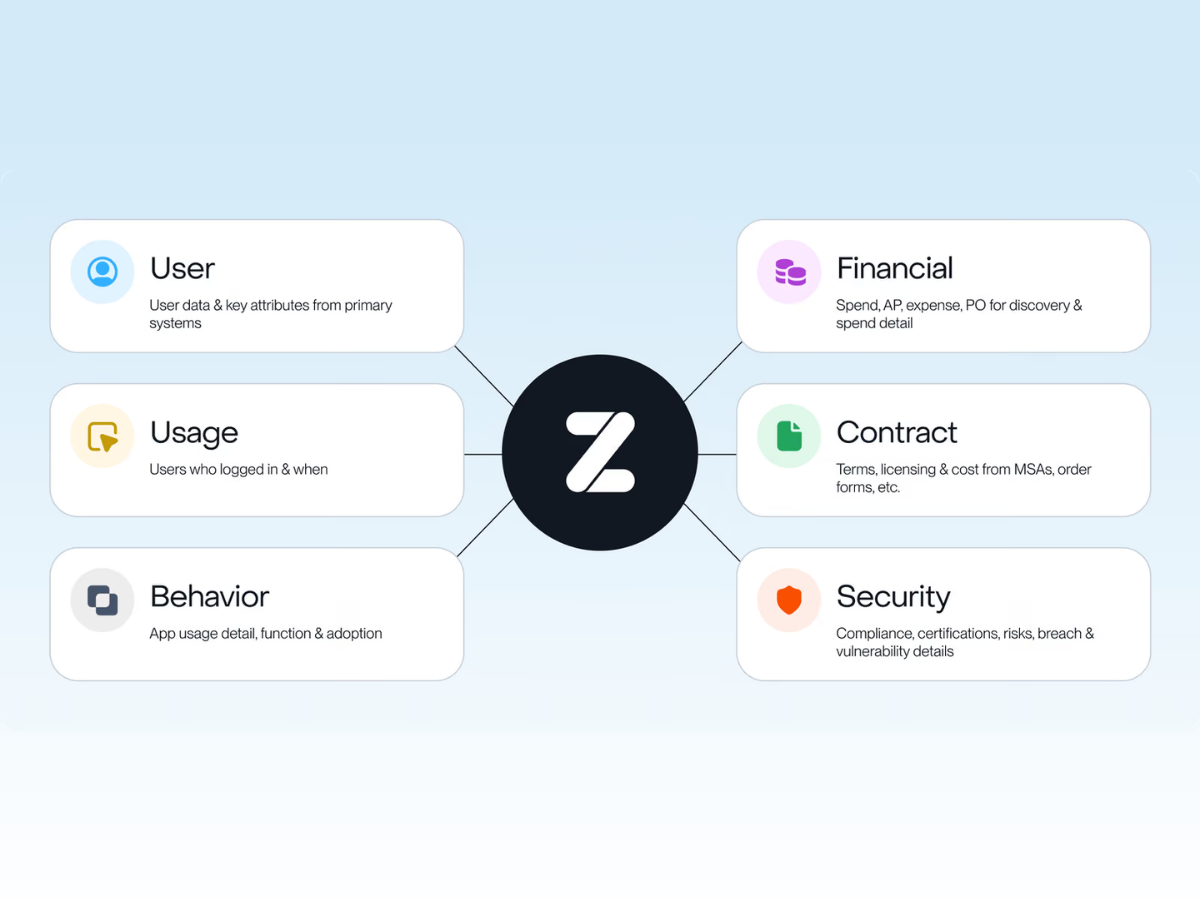
Whether your business is growing, contracting, or maintaining, technology category management should align with company objectives. “At the heart of financial discovery is assigning values to applications, not just suppliers,” Alves said. “Zylo’s enrichment of that data with categories and functions enables you to create the blueprint for action. Combining the usage data and the financial data, you’re able to see where you’re getting value out of your tools and where there’s room for improvement.”Before Zylo, Momentive tracked Saas in a living spreadsheet.
“There was no automation and each category manager updated their own deals,” Alves said. “If we had extra time after updating the sheet, we'd use manual filters and sorting to figure out what our renewal pipeline actually looked like. Usually this was just in time and rarely gave us enough runway to have a true impact on the [renewal] deal.”
Through Zylo’s financial discovery, Momentive redirected their efforts away from updating columns and mining spreadsheets for nuggets of information to taking decisive actions that produced results. “The first change we saw was from a reactive to a proactive posture,” Alves said. “We enabled strategic category management, and we were planning in advance for renewals and prioritizing new solutions appropriately. The key outcome here was facilitating the renewal diligence.”
2. Rationalize Effort and Resource Allocation to Deliver Results
Working with tech spend proactively allowed Momentive to unlock responsible growth.“This is centered around the concept of ongoing optimization,” Alves said. “This cycle can be modified to match where you are in your company’s journey. For Momentive, we’ve shifted toward responsible spending.” Momentive’s optimization cycle looks like:
- Identify redundancy: Provides insights into which solutions are candidates for consolidation or termination.
- Fuel rationalization: Decision-making phase, in which companies rationalize effort and resource allocation to standardize and centralize their applications.
- Leverage economies of scale: Engage with partners to negotiate better deals.
With data in hand, companies gain the ability to pivot as business needs arise, rationalizing effort and resource allocation to drive greater ROI. “As you find opportunities in SaaS spend, you have the financial data to propose persuasive and data-driven options that will have an impact,” Alves said. “Put this into action: Consider consolidating five applications with a $10,000 annual contract value each, or one $50,000 ACV tool. They'll both yield the same results, but to do one or five might be a much greater effort. So you can prioritize them accordingly.”
3. Measure Impact and Share Results
Lastly, measure your impact and share the results with your business leaders. With financial discovery, Momentive found savings opportunities, built renewal strategies with enough runway to scope out alternative options, and maximized current investments. “This is probably the most exciting part about getting savings and completing the financial discovery for SaaS,” Alves said.
Become an Expert on Your Tech Stack
To sum it up, financial discovery helps businesses align their technology category management strategy with company objectives, find savings opportunities in SaaS spend, and ultimately operate from a more informed perspective.“We’re going into renewal discussions, monthly leadership syncs, and prepping for annual portfolio reviews informed and empowered,” Alves said. “Having this data available allowed us to build better relationships with stakeholders, business partners, and executives, and really become experts on our tech stack.”