The Art of the Possible: A Four-Phase Guide to Agentic SaaS Management


In my last article, I explained how agentic SaaS management works and how to get started. That’s the foundation for what comes next: AI agents managing your SaaS portfolio.
As a Strategic Account Executive at Zylo, I work closely with enterprise organizations to identify opportunities to get more from their SaaS management programs. What excites me most is that the automation and scale once reserved for enterprises with large technical teams are now within reach for scrappy IT teams, too. Imagine agents managing license reclamation from start to finish or preparing renewal negotiations months in advance, with your team making the decisions.
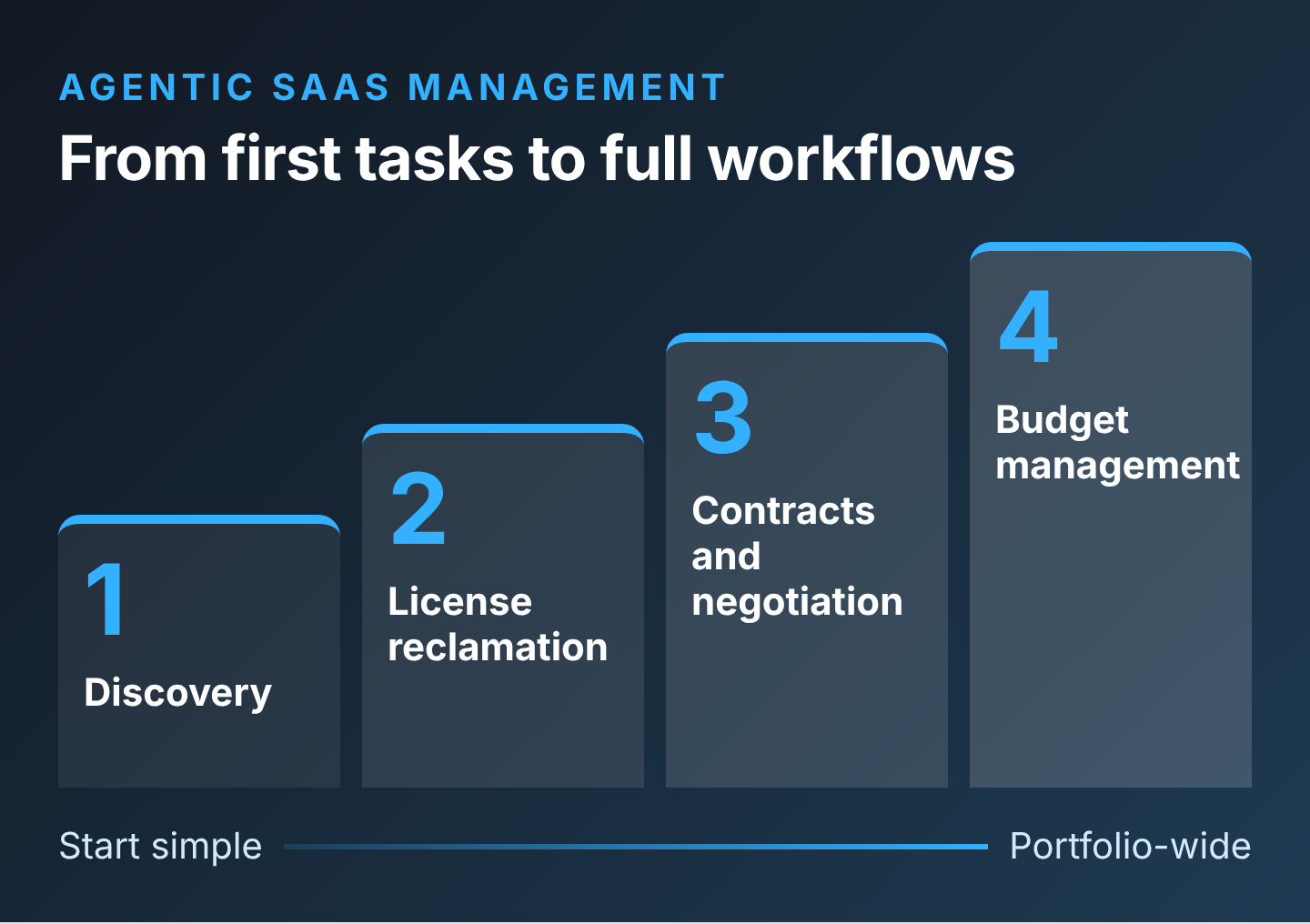
With the Zylo MCP Server, organizations can begin putting these possibilities to work. I’ll share a four-phase approach I recommend to clients, starting with straightforward tasks and progressing to more sophisticated workflows across the SaaS portfolio.
Phase 1: Start with Application Discovery and Triage
Let’s say you open Zylo on Monday morning and find several newly discovered applications that need owners.
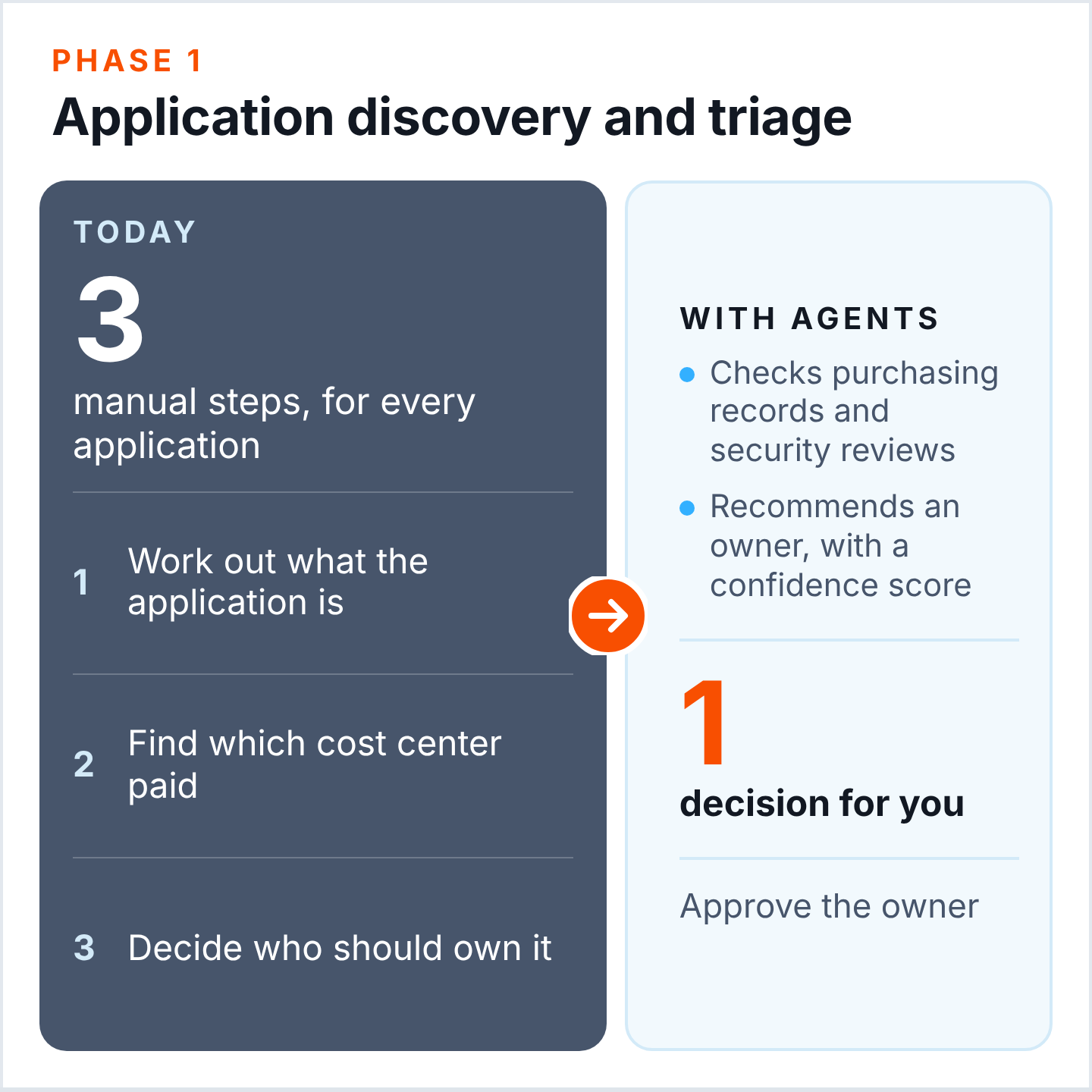
I often recommend starting with this kind of investigation because the steps are familiar and the results are easy to verify. You already know how to identify a likely owner using purchasing information. But an agent can do the research and prepare a recommendation.
Example use case: How agents identify SaaS application owners
Suppose an application was purchased by platform engineering. The agent starts by checking for a purchase order to identify who requested it, then looks for a matching security review. From there, it checks the cost center and organizational chart to identify potential owners, taking into account who already owns other applications in the department.
The agent combines all this information to recommend a likely owner, assigns a confidence score, and drafts an email requesting confirmation. By the time you open Zylo, the research is done and the recommendation is ready for your review. Once you’ve approved the assignment, the agent continues monitoring for newly discovered applications.
Put agents to work across your SaaS portfolio for recurring tasks
Once an agent can investigate newly discovered applications, you can extend the same approach to other recurring SaaS management tasks:
- Maintain application ownership. When an owner leaves the company, an agent compares ownership records against employee data and recommends a replacement.
- Answer portfolio questions. Authorized stakeholders can use connected AI assistants to ask about software spend or upcoming renewals without requesting a report.
- Automate reporting. Agents prepare recurring reports, answer ad hoc questions, or consolidate authorized portfolio data across business units.
- Identify unused licenses. An agent reviews utilization weekly and identifies applications with significant unused license spend before renewal.
These workflows give agents responsibility for investigating information and preparing results for review.
Once agents can identify opportunities like unused licenses, you can take things a step further: have them coordinate the reclamation process, too.
Phase 2: Automate License Reclamation
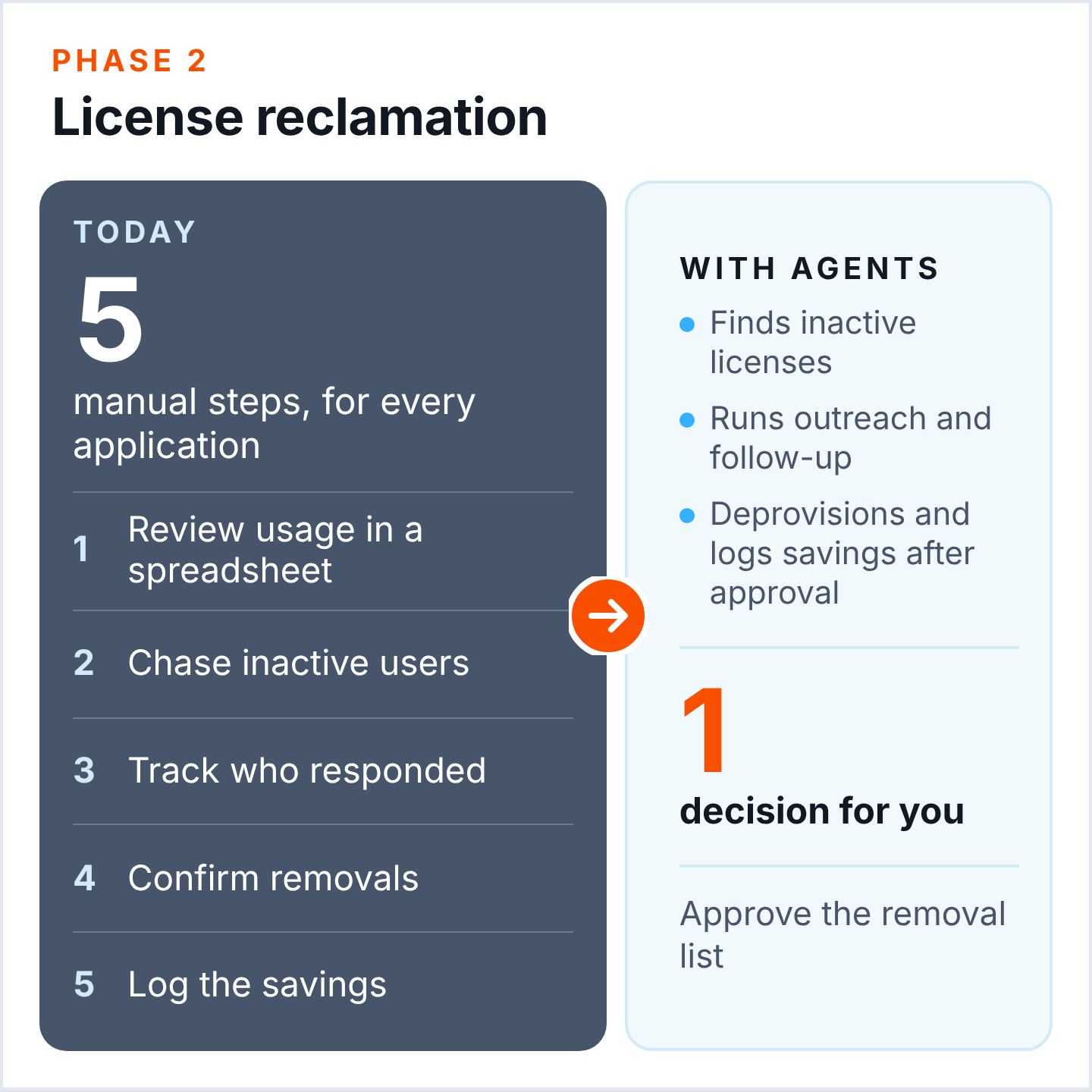
Suppose an agent identifies hundreds of unused licenses for an application renewing in four months. With a potential savings opportunity identified, you can put multiple agents to work coordinating the reclamation process, from employee outreach through approved deprovisioning.
How agents coordinate reclamation from start to finish
- A program agent identifies candidates. It reviews license entitlements and usage data in Zylo, prioritizing applications with upcoming renewals or true-up dates.
- A communications agent handles outreach. It contacts inactive users and their managers, tracks responses, and follows up with nonresponders. Cases requiring judgment are referred to your team.
- Your team approves removals. You review the proposed removal list and decide which employees should retain access.
- The program agent completes the workflow. Following approval, it coordinates deprovisioning through the available systems and records the savings in Zylo. It also updates license information for the next negotiation.
Agents can repeat this process across applications, prioritizing those with upcoming renewals.
I encourage teams to think about the entire reclamation process. Identifying unused licenses is useful, but completing reclamation before renewal is what can reduce the next contract commitment.
And once agents are coordinating license reclamation, you can give them an even bigger responsibility: preparing for the renewal itself.
Phase 3: Automate Contract Intake and Negotiation Preparation
Imagine an agent beginning renewal preparation four months before a contract expires, without anyone having to initiate the process. It could gather the information procurement needs and prepare a negotiation strategy while there’s still time to act on potential savings opportunities.
How agents turn contract data into a ready-to-review negotiation brief
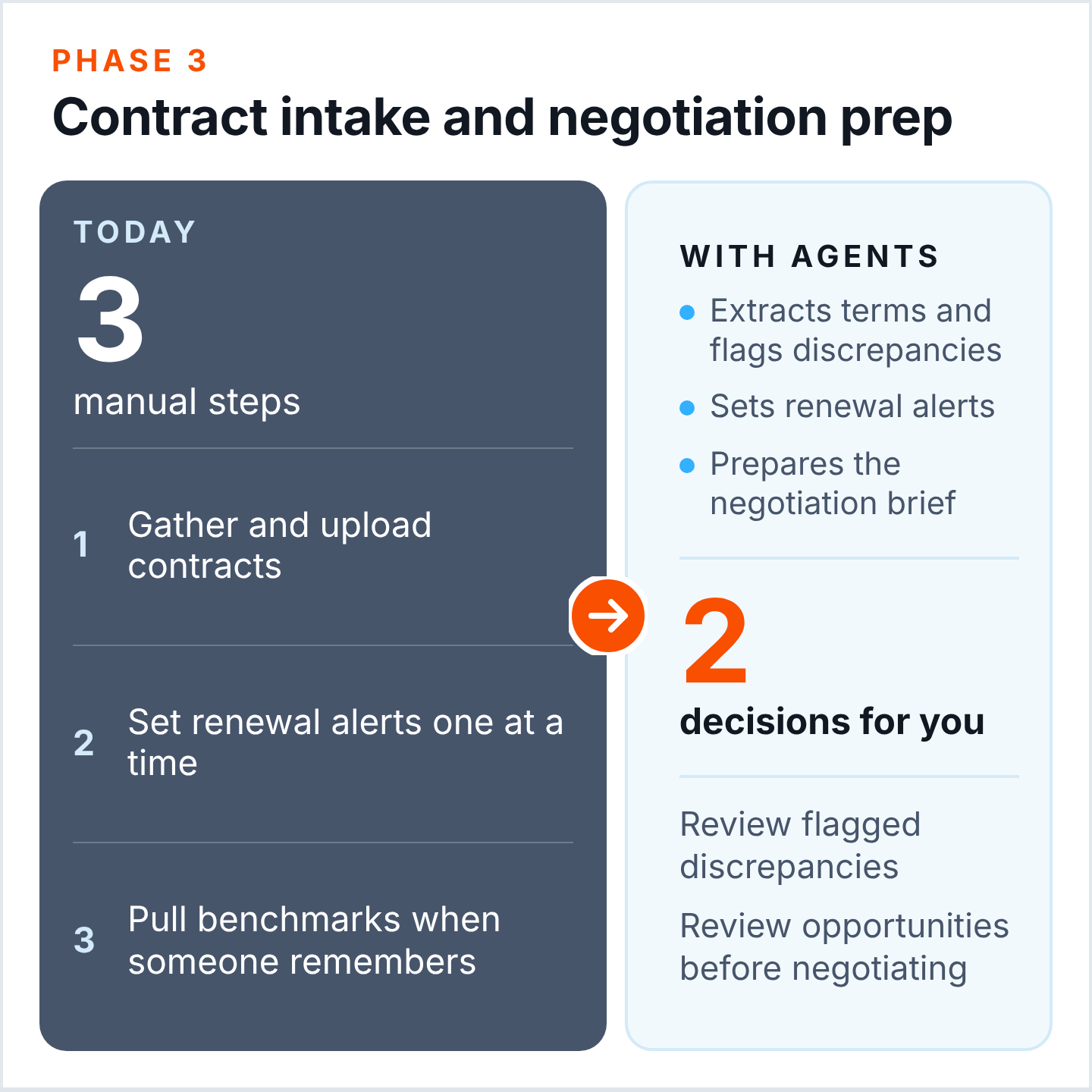
When an application enters its 120-day renewal window, the agent first checks Zylo for the contract. If the document hasn't been processed, an intake agent retrieves it from an approved source and extracts the relevant terms, including auto-renewal clauses and notice deadlines.
Before that information can be used, a validation agent compares it against existing records and flags discrepancies for your team to review.
Once the contract details are verified, renewal preparation can begin. Using Zylo’s utilization data, an agent evaluates opportunities to reduce the license commitment and flags when a pricing benchmark is available in Zylo.
Procurement receives a negotiation brief with the supporting information already assembled, so your team can review the opportunities and consult the benchmark before negotiating. Meanwhile, the workflow maintains renewal alerts at 120, 90, 60, and 30 days, along with any applicable auto-renewal notice deadlines.
After the negotiation concludes, an authorized workflow records the resulting savings in Zylo.
What if the usage data is missing?
Suppose the agent begins preparing a negotiation brief but discovers that Zylo lacks detailed usage information for the application. Without that data, procurement may have difficulty determining how many licenses the organization needs.
A more advanced agentic workflow could coordinate the investigation:
- Program agent: Reviews the contract to determine what usage information would help evaluate the license commitment.
- Research agent: Investigates the vendor’s reporting options and identifies an available API or administrative report.
- Technical agent: With the appropriate tools and permissions, prepares a supervised data retrieval and formats the results for Zylo Usage Connect.
- Your team: Validates the information and approves the proposed connection.
With access to the vendor’s reporting systems and the necessary integration tools, the program agent can determine whether to establish a recurring data feed or use a one-time upload for the upcoming renewal.
One important thing I emphasize with clients is that the agent should understand what information is needed before attempting to retrieve it. For usage data, that means checking how the application is licensed and determining which data would help evaluate the renewal.
Find opportunities to consolidate software before renewal
Agents could also review overlapping applications each quarter, focusing on those renewing six months out. For each potential consolidation opportunity, the agent identifies shared users and estimates the savings, giving your team time to evaluate alternatives before committing to another contract term.
And with agents already maintaining contract and usage information for renewal decisions, you can put that same data to work in another area: financial reporting.
Phase 4: Expand into Proactive Budget Management
By this stage, agents are already identifying savings opportunities and helping your team prepare for renewals. Now imagine using that intelligence to make spending decisions across your entire SaaS portfolio.
Identify budget risks and free up planned spend
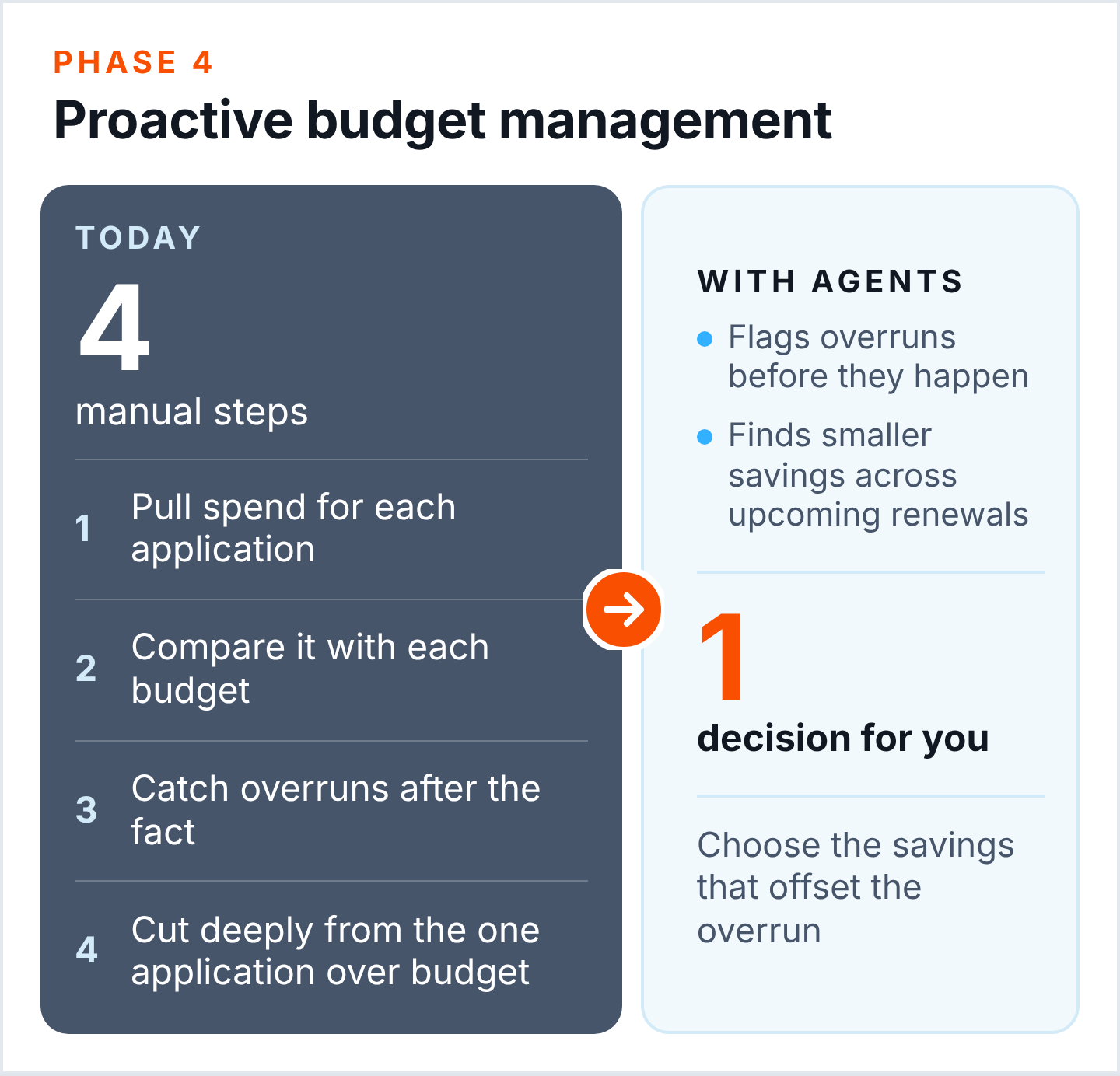
An agent could continuously monitor application spend against established budgets, flagging potential overruns before they happen. The earlier your team can intervene, the less you may need to cut to bring spending back on track.
Suppose an application is projected to exceed its budget. Using the license optimization insights gathered in earlier phases, the agent could look across upcoming renewals for opportunities to reduce planned spending.
Rather than making significant cuts to a single application, your team could evaluate smaller savings opportunities across the portfolio that, together, may be enough to offset the projected overrun.
How Zylo MCP Supports These Workflows
The Zylo MCP Server gives AI agents access to your live SaaS portfolio data, along with a decade of Zylo’s SaaS management expertise.
That expertise helps agents understand what information they need and how to use it to complete SaaS management tasks. Whether they’re evaluating license reclamation opportunities or preparing for a renewal, agents can draw on the strategies and best practices Zylo has developed through years of helping enterprises manage their software portfolios.
And with access to Zylo MCP’s supported tools, agents can take authorized actions, such as configuring renewal alerts or recording savings. More advanced workflows can extend across other enterprise systems through additional integrations.
The result is a way to put Zylo’s SaaS intelligence and expertise to work across your portfolio, with agents coordinating more of the execution.
Start with One Workflow, Then Expand
My advice is to start with one recurring task that takes too much manual effort. Once you're comfortable with the results, give agents more responsibility.
Now imagine extending that across your entire SaaS portfolio. With agents continuously identifying opportunities and coordinating the work, your team could manage hundreds of applications with a level of attention that would be impossible to sustain manually.
SaaS management could become a continuous, proactive operation, where opportunities are identified and acted on as they arise, rather than waiting until someone has time to investigate.
With Zylo MCP, you can start building toward that future today.
Ready to see what’s possible for your organization? Request a demo to explore how Zylo can support your agentic SaaS management journey.