Missed Zylo’s 2026 AI Spend Summit? These Takeaways Are Your Compass to Managing AI Costs

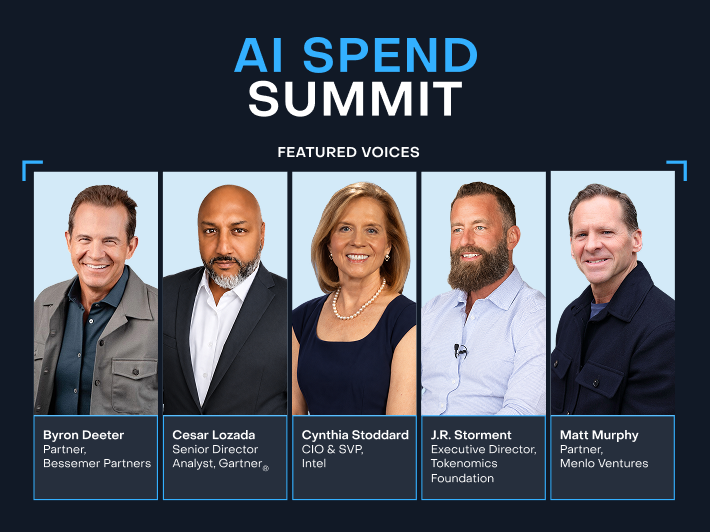
AI spend now comes from every team in the business, and the pressure to manage it keeps climbing. Gartner’s Cesar Lozada shared that AI spending is forecast to rise 44% by the end of 2026, and 53% of Chief Financial Officers (CFOs) look to IT for cost cuts. Yet no settled playbook exists.
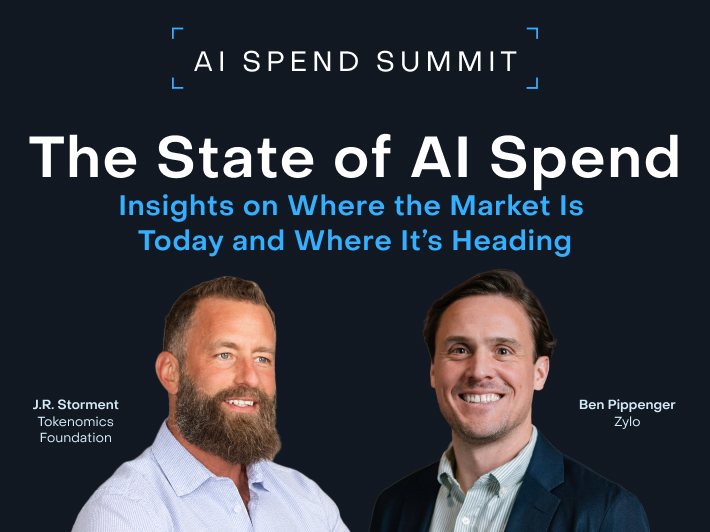
That’s why Zylo hosted its first-ever AI Spend Summit on October 29, 2026, bringing together CIOs, CFOs, analysts, and investors from Intel, Trimble, Barracuda, ModMed, Cox Automotive, Seismic, Huntress, Gartner, Menlo Ventures, Bessemer Venture Partners, and the Tokenomics Foundation.
While we’re still in the early days of defining AI spend management, these leaders shared early lessons they’ve learned and what approaches are working for them.
Missed the summit or couldn’t attend every session? Here are the most important takeaways. You can also watch the sessions on demand here.
6 Key Takeaways to Start Building Your AI Spend Management Practice
At the AI Spend Summit, speakers covered a gamut of AI topics—spend visibility, forecasting, cost attribution and accountability, governance, and adoption. Treat these six takeaways as points of view to test in your own organization.
- Expect AI spend from every team, on usage-based terms
- Forecast workloads, and plan for headcount tradeoff
- Start with one view of who spends what
- Set guardrails that speed teams up
- Bring your people along, and redesign the work
- Tie spend to business outcomes, and define what ROI means
1. Expect AI Spend from Every Team, on Usage-Based Terms
Today, AI is used enterprise-wide, from finance and legal to HR and go-to-market teams—a fast-growing expansion from AI for coding and personal productivity. Gartner research shows that 57% of AI purchases are funded outside IT, as shared by Cesar Lozada, Senior Director Analyst in his session "How CIOs Can Strategically Manage Unpredictable AI Costs." CIOs need a single pane of glass—reiterated by all speakers—to understand how teams are spending and using AI.
As individuals and teams at your organization expand their use of AI, keep these things in mind:
- Heavier users translate to higher spend. AI costs scale with usage. Set budgets for owners and guardrails in every function, not only IT.
- Vendors layer usage charges on top of per-user fees. You’ll find a mix of traditional subscription models, committed consumption, pay as you go, and hybrid (seat + usage).
- Read each contract for fixed fees and usage charges. You can’t sign a contract and pay the invoice at year-end.
- Keep your architecture flexible. Nearly every month, new models are introduced and pricing changes. Your approach must remain agile as market dynamics shift.
- Track adoption, economics, and value over time. Usage is a good metric to measure adoption, but it cannot be the only measure of success.
“A heavy user in the land of AI is a very, very expensive user.” — Matt Murphy, Partner at Menlo Ventures
2. Forecast Workloads, and Plan for the Headcount Tradeoff
Forecasting AI spend is one of the biggest challenges enterprise organizations are facing today. According to Zylo’s October 2026 survey of 200 IT leaders, 93% expect to exceed their AI budget or forecast next year.
For the last 20+ years, software costs were tied to headcount. One hundred people, one hundred licenses, one predictable cost. With AI, seats account for a fraction of total spend (hybrid models), or are completely absent (consumption models).
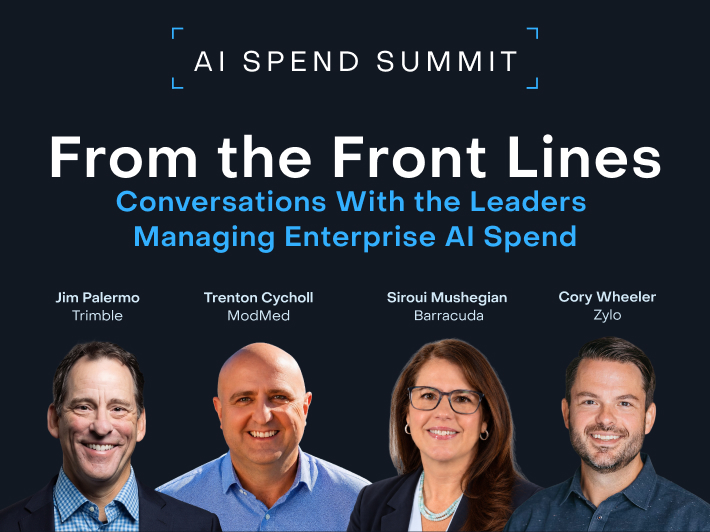
The new challenge is that you’re forecasting use cases and agents that haven’t launched yet. And demand follows how people use them, shared Trenton Cycholl, VP Digital Business & Enterprise Technology at ModMed during the session "From the Front Lines with the Leaders Managing Enterprise AI Spend."
“We’re moving from forecasting licenses to forecasting work, workloads, transactions, digital workforce capacity.” — Trenton Cycholl, VP Digital Business & Enterprise Technology at ModMed
In addition, productivity gains from AI spend come at the expense of headcount. According to Matthew Puljiz, CFO at Huntress, “Seventy percent of the cost structure is people. With AI as a new line item, headcount could easily come down to 60%.”
In some cases, organizations like Huntress have paused hiring to see how AI use will play out. Huntress has since resumed hiring but in areas where AI cannot automate the work.
To work through this AI-to-headcount-spend tradeoff, several speakers shared what they’ve tried and what they want to be able to do in the future.
- Set a baseline first to understand what is normal use vs abnormal use.
- Annualize recent months as a starting point to forecast.
- Revisit budgets mid-year or quarterly, and keep a close eye on usage costs at least weekly.
- Model prototypes at production scale (future state).
3. Start with One View of Who Spends What
All AI Spend Summit speakers agree: organizations need to build a single view of their software and AI spend. But that’s easier said than done. In fact, 51% of respondents in Zylo’s survey of IT leaders said they need four or more systems to see a complete picture of AI spend.
Similar to SaaS management, knowing what AI you have is table stakes. That includes AI subscriptions, AI inside applications, API usage, and agents. Marrying your AI tools with financial data then reveals what individuals and teams are spending on AI.
“You know what’s in your investment portfolio. You should know what’s in your software catalog.” — Cindy Stoddard, Senior Vice President and CIO at Intel
Attribute AI Spend the Way Your Teams Work
Once you have visibility, attribute spend to the people, teams, and projects that drive it. Viewing spend by the way your teams work is important, because HR hierarchies typically do not illustrate cross-functional workflows.
Decide how granular you want to go. Tracking every individual AI purchase across the company is impractical, at least to start. Instead, focus on your largest spending points and your renewals, and add detail, down to the individual user, where spend is high.
Use a “Decoder Ring”
Vendor data makes it difficult to understand your overall spend and usage meters across providers. Because companies buy AI in multiple places, it requires you to normalize the costs before doing anything else. Then, as Trenton Cycholl at ModMed describes it, you need a “decoder ring” to compare vendors.
4. Set Guardrails for AI Use and Hold Teams Accountable for Their Share of Spend
According to Siroui Mushegian, CIO at Barracuda, “Governance is how we enable innovation.” There are multiple ways to go about AI governance, depending on your company's goals and appetite for risk. Below are a variety of measures Summit speakers are putting in place to govern AI spend:
- Establish an AI council. The council helps spread safe operating standards and ensures they’re followed.
- Roll out safe tools and frameworks. Support employees with resources as they explore AI to enable innovation.
- Reduce friction for AI tool requests. Answer new-tool requests fast, with a reason and an alternative when the answer is no.
- Set spend caps. Consider caps by role, monthly caps, and spend ceilings for routine productivity, experimentation, and high-value workflows. Match limits to the type of work, and loosen them for proven value.
- Govern AI agents like you would a human actor (employee). Provide them an identity, owner, role, and permissions.
- Review usage often. Huntress CFO Matthew Puljiz shared that he checks dashboards a couple times a week.
“All of our employees have a constraint, and that constraint can be loosened with leadership approval if it’s something that is deemed worthwhile.” — Matthew Puljiz, CFO at Huntress
IT captures and reports spend and deploys the guardrails the business wants, such as a budget or a per-person limit. Business units own their budget and the return. Most organizations build toward that in stages: capture spend by team, show it back to owners, and then charge it back. For example:
- Trimble already runs showback and chargeback for much of its software, so it starts with a baseline to extend to AI.
- Huntress’s financial planning and analysis team tracks usage by individual, department, day, and week.
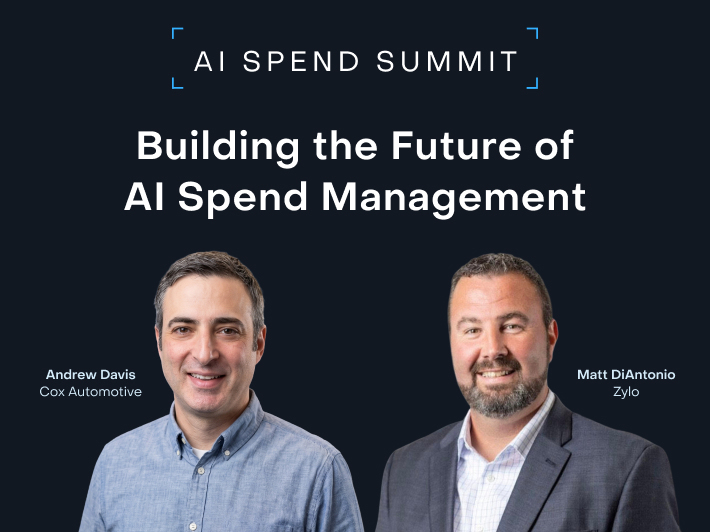
- Cox Automotive will charge all Anthropic costs back to the budgets that incur them starting January 1, 2027, after a period of showback and a partnership with finance. Hear more in "Building the Future of AI Spend Management."
“Chargeback has been instrumental to our success in managing a very large portfolio of technology spend.” — Andrew Davis, Senior Director, Cloud and AI Business Office at Cox Automotive
5. Bring Your People Along, and Redesign the Work
AI on its own does not auto-magically accelerate your business. In her session, "Patterns, Not a Playbook: Leading Through the AI Era," Cindy Stoddard, CIO at Intel and previously Adobe, the right processes need to be in place for it to work. That means simplifying business processes before applying AI. Then add trusted data, connected systems, secure infrastructure, redesigned workflows, and clear ownership.
“Being AI enabled is not about how many pilots you can run.” — Cindy Stoddard, Senior Vice President and CIO at Intel
Two paths to adoption were shared at the AI Spend Summit: a mandate backed by enablement and support that meets people where they are. A mandate moves fast when your teams respond to clear direction. Support that starts with people’s daily problems can ease fear and/or boost engagement.
- Mandate: Byron Deeter of Bessemer Venture Partners describes ServiceTitan, a Bessemer portfolio company that paused development for a week, trained everyone, ran a hackathon, and made AI use mandatory the next week.
- Meet people where they are: Among Trimble’s back-office team, CIO Jim Palermo sees fear of adopting AI and falling engagement scores. He starts from the problems people have today and shows how AI changes the approach.
Keep your company culture in mind as you determine the right approach for your organization.
6. Tie Spend to Business Outcomes, and Define What ROI Means
IT and finance leaders must align on the definition of return on investment and how they will measure the impact of AI on business outcomes. CFOs Evan Goldstein (Seismic) and Matthew Puljiz (Huntress) expand on this concept during their session "AI Spend Is Now a CFO Issue" with Zylo CFO Jason Leet.
In 2026, most organizations are still figuring out how to get visibility, so CFOs like Puljiz are giving AI the benefit of the doubt while overall spending stays modest. However, by 2028, Puljiz expects teams to have more conviction on the value the company gets back and make AI earn its place in the budget.
- Treat return on investment as a business question first. Start with the problem, decision, or bottleneck.
- Determine how you want to measure value. Cycle time, capacity, revenue per employee, support tickets resolved, or financial impact. Each function should have its own ROI measure.
- Categorize metrics based on the type of ROI. Treat efficiency as a defend case (return on employee), and value creation as an extend (financial return) or upend (return on future) case.
- Learn what work isn’t getting done that needs to get done. There may be other opportunities to drive value that are lying untapped.
“Every function is going to define success a little differently.” — Evan Goldstein, CFO at Seismic
Act Now: Your Blueprint for AI Spend Management
AI spend management is an emerging discipline with no settled playbook. But this is not a wait-and-see moment. Spend will continue to grow whether you do nothing or build the playbook as you go.
The overall sentiment of the day? Start now. Get a complete view of your AI spend so you can accurately forecast, drive accountability, and govern use and adoption.
ModMed’s Trenton Cycholl said it best. “Start now with visibility. Named ownership. And get focused on a few outcome measures. Don’t wait for the perfect dashboard or for spend to become a crisis.”
Take the next step and watch the AI Spend Summit sessions on demand for deeper insights.