You Can Finally See Who's Behind Your Claude Bill


One of the biggest blind spots in enterprise AI just disappeared.
Last week Anthropic introduced its new Enterprise Analytics API, surfacing engagement, usage, and cost data across Claude Code, Cowork, and other products. It’s the most visible signal yet that AI vendors are prioritizing cost governance as a core enterprise requirement, delivering the transparency required to manage AI at scale.
With this update, organizations finally have the granular data needed to connect Claude adoption and spend to specific users.
Until now, that view has been limited to aggregate data like models and API costs. But those numbers only tell part of the story. Companies had little visibility into how Claude was actually being used across the business, who was driving adoption, or what their Anthropic exposure looked like.
At Zylo, we’ve been hearing the same pain everywhere we listened:
"We suspect some users are just going full bore — huge context window, spending more money every time they hit enter. We can't prove it yet because the data isn't there."
"Everyone wanted Claude access, but outside of Engineering we have no visibility into how Claude is being used by other departments like Sales and Marketing. There's no way to charge costs back to the right team right now."
Same pattern, different organizations. Because the data was incomplete, the resulting conversations with leadership were inevitably uncomfortable. And the questions the CFO actually wants answered — who, why, what should we do about it? — sat unresolved.
Now, enterprises can start getting much clearer answers to those questions.
4 Enterprise AI Questions That Just Got Easier to Answer
Who's actually driving the spend?
This is the headline unlock. The updates to the Enterprise Analytics API attach Claude cost to named people. Every Claude Code session, every Cowork action, every conversation now maps back to a human. For the first time, the person closest to the spend can be part of the conversation about it.
But there's a more significant unlock inside this one that people may overlook: the data isn't just about cost attribution. It's about cost-to-behavior attribution. Cost-per-commit. Cost-per-pull-request. Cost-per-conversation. AI spend stops being an undifferentiated bucket and becomes a productivity conversation.
For example, two users can generate similar usage patterns on paper while driving very different kinds of outcomes. An engineer using Claude Code to accelerate incident resolution and another using it primarily for experimentation may consume similar resources, but attribution adds the context needed to understand the difference.
Are we on track against what we committed?
If your organization signed a Claude Enterprise commit — and a growing number have — the next question is whether you're going to use it, exceed it, or leave money on the table. Until now, that question was answerable for the Anthropic API but not for Claude Enterprise. Most enterprises run Claude Enterprise without the API at all, which meant the commit-pacing conversation was running on incomplete data. Teams finally have a way to close that gap.
For organizations mid-signing a major commit — and we know of more than one in the middle of a $500K-plus decision — the difference between defending the commit and guessing about the commit is exactly this data layer.
Are we about to exceed a threshold?
The hardest version of this conversation is the one that happens after the fact, when the bill lands and someone has to explain it. The better version is the one that happens with enough runway to do something about it. Set the alert, see the trend, act before the leverage is gone.
With per-user spend visible alongside the total, alerting can finally go beyond "You're at 75% of your commit" to "You're at 75% of your commit and these 100 users and these two departments are driving most of the acceleration." That's the difference between a generic warning and an actionable one.
What should we budget for next year?
This is the question the CFO actually wants the answer to. The historical pattern matters. The current adoption curve matters more. The planned changes — new teams onboarding, new use cases rolling out — matter most. AI adoption doesn't run in a straight line; it tends to bend sharply once an organization decides to lean in. A forecast that doesn't reflect that will be wrong in expensive ways.
The new data makes forecasting possible. Whether it makes forecasting credible depends on whether the tools doing the projection understand that early-stage AI spend follows a bell curve, not a trend line.
Anthropic Is Just the Beginning
Anthropic won’t be the last vendor to prioritize this level of transparency. As enterprise AI adoption scales, providers across the market will face growing pressure to deliver better cost visibility and spend governance alongside their models. They are working out, in something close to real time, what enterprise cost visibility for AI needs to look like.
And it's not just the AI-native vendors. The software your enterprise has been buying for years is quietly migrating into the same territory. Salesforce Agentforce. Adobe AI features. Asana AI Studio. Figma credit consumption. GitHub Copilot premium requests. Each one is bolting AI capabilities onto an established SaaS product and pricing the new pieces on consumption. Each one creates a version of the same four questions above, on a vendor your organization may have been managing comfortably for years.
What just became possible for Anthropic is going to be expected, eventually, for every modern enterprise vendor. The question isn't whether the data will be there. It's whether the tooling that sits between the data and the decision is ready.
Zylo Is Building Toward Unified AI Spend Visibility
We've been listening to where this goes, and we're building toward it.
Over the coming weeks, Claude Enterprise will join Zylo's existing Anthropic integration as a unified view. Clients running Claude Enterprise — the majority of our Anthropic-using clients — will get full cost-management coverage for the first time: per-user attribution, alerts, forecasts, and exportable data for renewal conversations. Clients running both Claude Enterprise and the Anthropic API will see one unified view instead of two they have to reconcile.
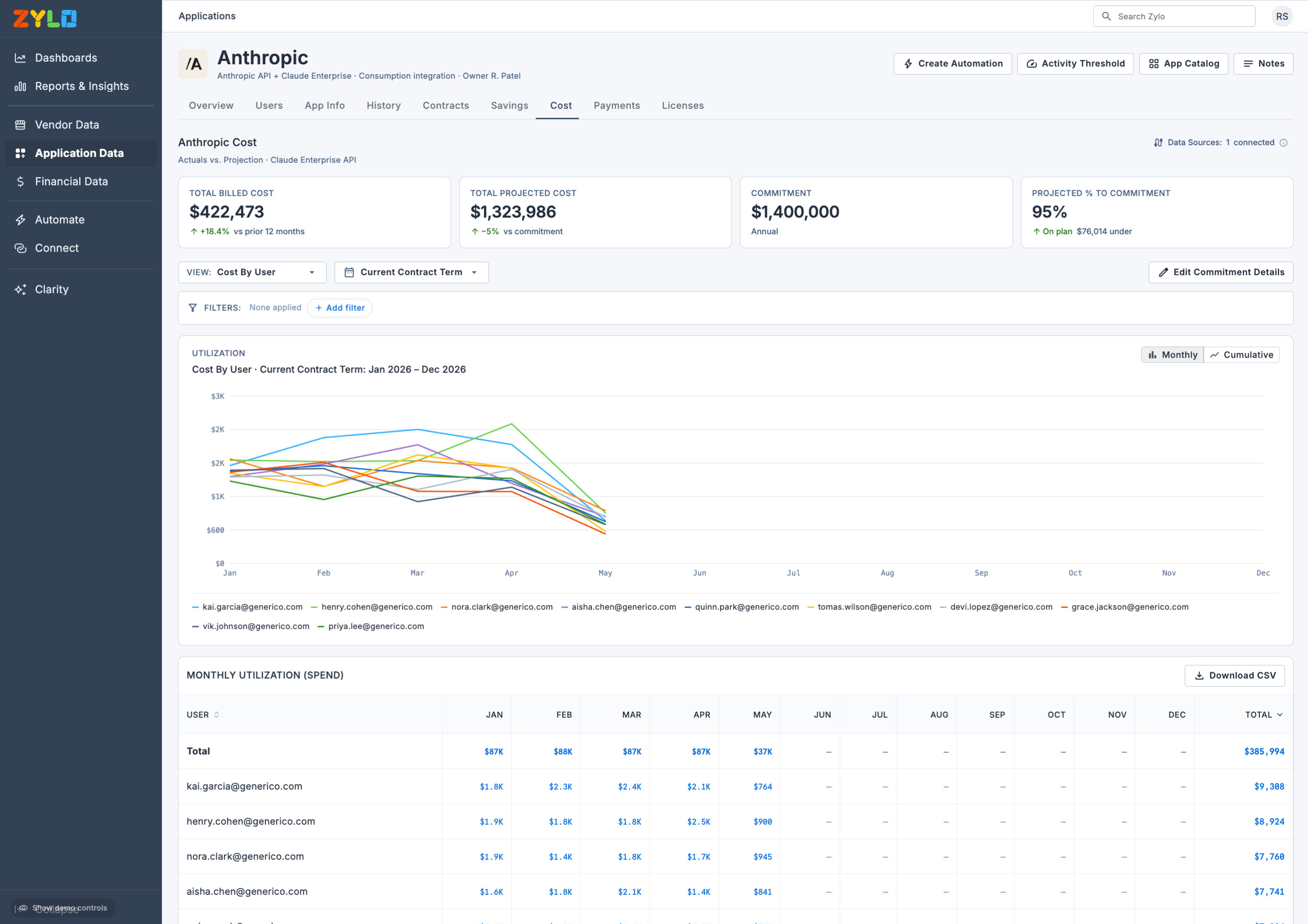

A focused private preview cohort is helping us get this right — clients with active Claude commits, clients piloting Anthropic at scale, clients whose finance teams are watching the spend curve closely. The work is shaped around their actual pain, not around what's easy to build.

One honest note: the data getting better doesn't solve everything. The harder question — who inside an enterprise actually owns AI spend governance? — is still open at most organizations. The role doesn't have a name yet. The people doing the work were conscripted from other functions. Better data makes the conversations easier; it doesn't, by itself, decide who should be having them. That part is still being worked out, and we're listening for it.
Driving a New Conversation Forward
For a long time, enterprise AI cost management has been a story about what couldn't be seen. Workspaces, API keys, blended invoices, no clean way to get from the bill to the people. That story just ended.
What replaces it depends on what gets built on top of the new visibility — by AI vendors, by enterprises themselves, and by the tools that connect them. At last, the data is here. The conversations it enables are the ones enterprises have been trying to have all along.
We'd like to be part of how those conversations go from here. If you're navigating Claude spend at scale — what's hard, what's working, what you wish you had — we'd genuinely like to hear from you.