What Is Model Context Protocol? MCP Explained for Enterprise IT Teams


Model Context Protocol (MCP) is gaining momentum because enterprises want AI that can securely interact with business systems, retrieve live data, and orchestrate workflows across the SaaS stack.
For IT, SAM, and Procurement leaders, MCP introduces a new opportunity: enabling AI innovation without losing visibility into application usage, spend, governance, and risk.
The companies that operationalize SaaS and AI spend optimization early will be in a much stronger position to scale AI safely, control costs, and avoid another wave of shadow IT—this time driven by AI agents instead of employees.
What Is Model Context Protocol?
Model Context Protocol (MCP) is an open standard that enables AI models like Claude, ChatGPT, and Gemini to securely connect with an enterprise’s SaaS applications, APIs, and databases through a consistent communication framework. It was developed by Anthropic and is currently maintained by the Linux Foundation.
An MCP standardizes how large language models (LLMs) discover available tools, retrieve business context, access enterprise data, and interact with internal systems. Instead of requiring separate custom integrations for every AI model and software platform, MCP provides a shared protocol for AI connectivity across enterprise environments.
This matters because enterprise AI increasingly depends on current operational context rather than training data alone. AI assistants, AI agents, and workflow automation tools become more effective when they can securely interact with live systems across the SaaS stack.
What Enterprise Systems Can MCP Connect To?
MCP frameworks connect AI applications to a wide range of enterprise systems, including SaaS applications, internal operational platforms, APIs, databases, business intelligence systems, identity providers, procurement workflows, cloud storage environments, and knowledge management tools.
These connections allow AI systems to retrieve operational context, execute workflows, surface insights, and support automation across fragmented technology environments.
SaaS Applications
SaaS applications connected to an MCP often contain operational, collaboration, ticketing, workflow, and application usage data used across enterprise environments. Examples include:
- Salesforce
- Slack
- Microsoft 365
- Google Workspace
- ServiceNow
- Jira
- Zendesk
- Workday
- GitHub
- Okta
Internal Enterprise Systems
Internal enterprise systems frequently contain operational, financial, compliance, and organizational context used in enterprise decision-making workflows. Examples include:
- Identity and access management platforms
- Procurement systems
- Employee onboarding and offboarding workflows
- Internal ticketing systems
- Knowledge repositories
- Governance and compliance documentation
- Enterprise resource planning (ERP) systems
- Business intelligence platforms
- Data warehouses
- Financial reporting systems
APIs and Databases
APIs and database environments support structured data retrieval, AI context enrichment, workflow automation, and cross-system orchestration. Examples include:
- REST APIs
- GraphQL APIs
- SQL databases
- Vector databases
- Cloud storage environments
- Data lakes
- Application telemetry systems
- Usage and analytics platforms
Why Was MCP Created?
Model Context Protocol was created to solve the growing complexity of connecting AI models to enterprise systems, SaaS applications, APIs, and operational data sources at scale.
As organizations adopt more AI assistants, copilots, and AI agents, enterprise teams face several challenges:
- Custom AI integrations are difficult to maintain
- SaaS environments contain hundreds of disconnected applications
- AI tools require access to live business data
- Governance becomes harder as AI adoption expands
- API fragmentation creates operational overhead
- Security and permission management become more complex
MCP addresses these issues by creating a standardized framework for how AI applications interact with external systems.
AI Models Need Real-Time Business Context
Large language models generate more accurate operational outputs when they can access current enterprise data—or context—instead of relying only on training information.
Enterprise AI workflows increasingly depend on live context such as:
- Operational data
- SaaS utilization records
- Procurement workflows
- Internal documentation
- Governance policies
- Ticketing activity
- Financial reporting
- Organization-specific terminology
Large language models are trained on broad datasets, but they are not automatically aware of an organization’s current operational environment. Without sufficient context, AI systems can generate incomplete outputs, inaccurate recommendations, or hallucinations.
From a user perspective, MCP improves prompt efficiency and eliminates the burden of manually assembling context. Even if context was compiled by the user, it’s likely the model would run out of context space and forget things before it was finished. Because context is temporary, the user would have to go through the same process again.
Enterprise SaaS Ecosystems Are Fragmented
Modern enterprises operate across hundreds of SaaS applications, cloud services, APIs, and internal systems that rarely share a unified framework for AI access.
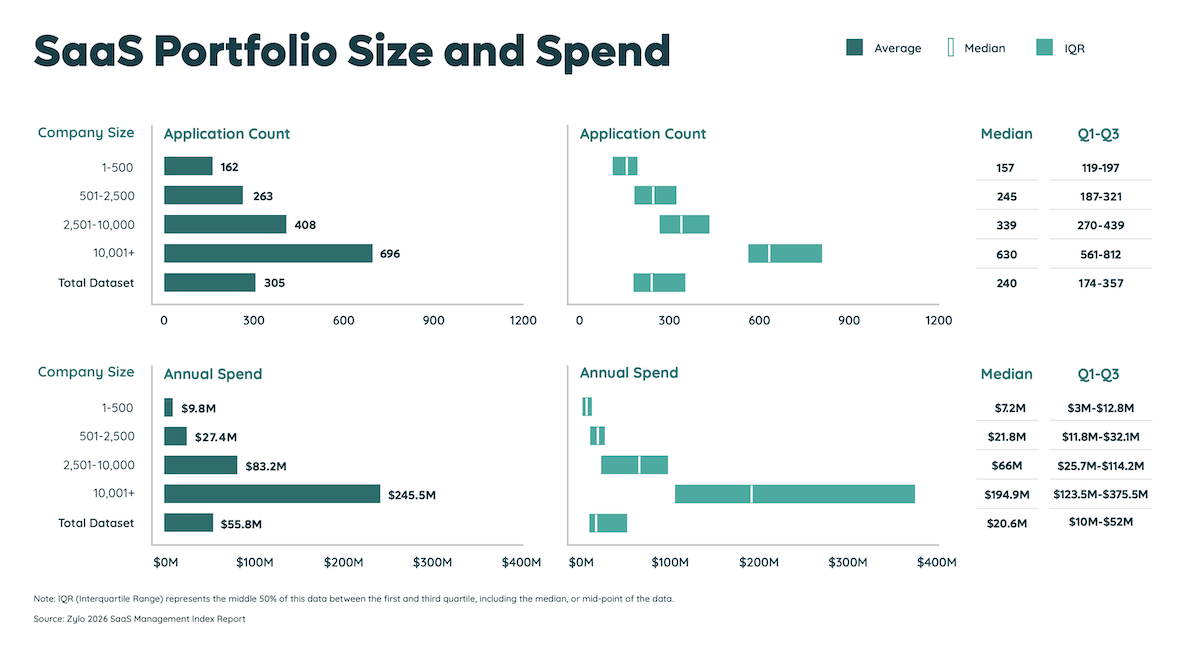
According to Zylo’s 2026 SaaS Management Index, the average enterprise now manages 696 applications and IT is responsible for just 15% of those apps. As AI adoption accelerates, organizations are adding even more AI-enabled applications, integrations, and external services to already complex environments.
A fragmented environment creates challenges around:
- SaaS visibility
- AI governance
- access management
- workflow standardization
- operational oversight
- spend optimization
Custom Integrations Do Not Scale Efficiently
Without a standardized protocol, organizations often build one-off integrations between AI tools and individual SaaS platforms—which isn’t scalable for enterprises.
Teams often rely on one-off APIs, separate connectors for each AI platform, manual workflow orchestration, and/or inconsistent permission frameworks. As a results, that creates:
- Integration sprawl
- Duplicated engineering work
- Inconsistent permission controls
- Limited interoperability
- Increased operational overhead
- More governance complexity
For IT, SAM, and Procurement leaders, the broader implication is operational. Many organizations already manage extensive integration overhead across their SaaS portfolio. They don’t want to add more complexity.
Without MCP, AI adoption will only make the environment more convoluted and increase the operational burden for teams responsible for governance and technology oversight.
How Does Model Context Protocol Work?
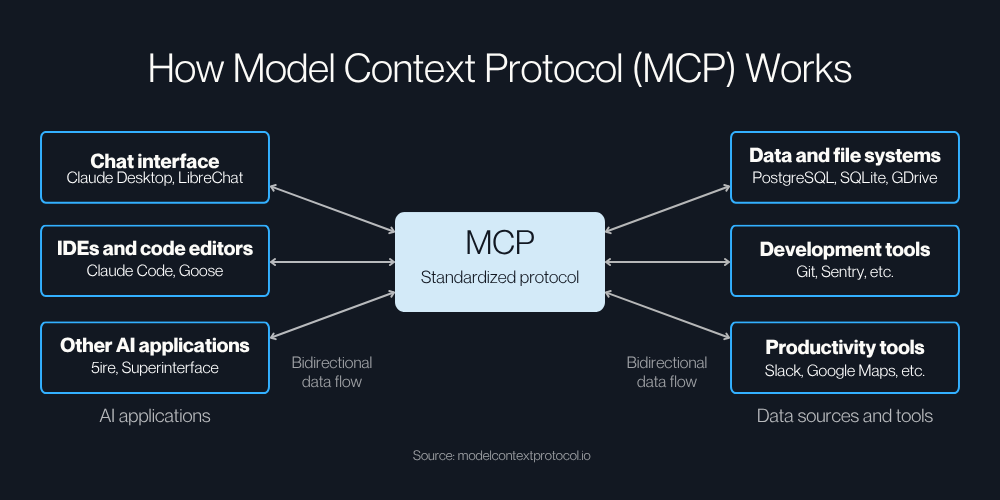
Model Context Protocol works by creating a standardized communication framework between AI applications, enterprise systems, and external tools. MCP uses a client-server architecture that allows AI models to retrieve information, access resources, and execute actions across SaaS environments without requiring separate custom integrations for every system.
At a high level, MCP enables:
- AI applications to discover available tools and data sources
- Enterprise systems to expose resources in a standardized format
- AI agents to retrieve operational context in real time
- Workflows to execute across multiple SaaS applications
- Permission-aware communication between AI systems and business platforms
This architecture allows organizations to scale AI connectivity more consistently across fragmented enterprise environments.
MCP Hosts
MCP hosts are the AI applications or environments where users interact with AI systems, such as:
- Claude Desktop
- Enterprise AI copilots
- AI-powered IDEs
- Internal chat assistants
- Workflow automation platforms
- Custom enterprise AI applications
The host coordinates interactions between the user, the large language model, and connected MCP resources.
In enterprise environments, hosts often act as the operational layer where employees request actions such as:
- Retrieving SaaS utilization data
- Surfacing contract information
- Accessing internal documentation
- Reviewing application inventory
- Executing workflow automation tasks
Hosts do not directly contain all enterprise data. Instead, they communicate with MCP clients and servers to retrieve the necessary operational context.
MCP Clients
MCP clients manage communication between the host application (e.g., Claude, ChatGPT) and MCP servers.
The client is responsible for:
- Sending requests
- Discovering available tools
- Managing sessions
- Handling permissions
- Coordinating data exchanges
- Maintaining structured communication between systems
This creates a standardized interaction layer between AI applications and enterprise services.
For example, when a user asks an enterprise AI assistant to identify underutilized SaaS licenses, the MCP client can coordinate requests across connected systems that contain:
- SaaS usage data
- Identity and access information
- Procurement records
- Renewal timelines
- Employee provisioning data
The AI application can then use that context to generate recommendations or trigger workflows.
MCP Servers
MCP servers expose enterprise tools, applications, APIs, and data sources in a format AI systems can consistently access.
Servers commonly exist for:
- SaaS platforms
- Internal applications
- Databases
- File systems
- APIs
- Cloud storage environments
- Business intelligence systems
Each MCP server defines the resources, tools, and permissions available to connected AI applications.
MCP servers typically provide only the tools required for a specific task or workflow instead of exposing all available context simultaneously. This helps AI systems retrieve more relevant information while reducing unnecessary context overload.
Examples of MCP-enabled workflows could include:
- Accessing software utilization data from a SaaS Management platform like Zylo
- Retrieving support tickets from ITSM provider like ServiceNow
- Pulling renewal information from procurement systems like Coupa
- Surfacing employee access data from identity providers like Okta
- Accessing operational dashboards from BI platforms like PowerBI
With this architecture in place, organizations can centralize and standardize how AI systems interact with enterprise environments.
Tools, Resources, and Prompts
MCP frameworks organize interactions through three primary components: tools, resources, and prompts.
Tools
Tools are executable actions AI systems can perform through connected applications or services, such as:
- Creating tickets
- Querying SaaS utilization data
- Triggering workflows
- Updating records
- Executing automation tasks
- Running operational reports
Tools allow AI agents to move beyond information retrieval into workflow execution.
Resources
Resources are the structured data sources and content repositories AI systems can access, such as:
- Internal documentation
- SaaS inventory data
- Procurement records
- Financial reports
- Knowledge bases
- Configuration files
- Application telemetry data
Resources provide the operational context AI systems use to generate accurate outputs.
Prompts
Prompts are reusable instructions, workflows, or predefined interaction patterns that guide how AI systems perform tasks across enterprise environments.
To create more consistent AI behavior across teams and systems, organizations may use prompts to standardize:
- Procurement workflows
- Access reviews
- SaaS governance tasks
- Compliance reporting
- IT support procedures
- Software optimization workflows
MCP Workflow Example
An MCP-enabled workflow includes a sequence of AI-assisted tasks that retrieve information, analyze data, trigger actions, and coordinate processes across business applications.
Here’s an example workflow for software license management:
- An IT analyst asks an enterprise AI assistant to identify underutilized SaaS licenses before an upcoming renewal.
- The AI host receives the request.
- The MCP client communicates with connected MCP servers.
- The servers expose tools to the AI assistant that allow it to retrieve SaaS utilization data, procurement records, and renewal timelines from connected platforms.
- The AI system analyzes the operational context.
- The assistant returns recommendations for license reduction, reclamation opportunities, or renewal optimization.
Without MCP, organizations often need multiple custom integrations and disconnected workflows to complete the same process.
As enterprises adopt more AI-powered SaaS applications and workflow automation tools, standardized AI connectivity becomes increasingly important for operational scalability, governance, and SaaS and AI spend optimization.
Why Model Context Protocol Matters for Enterprise AI
The more enterprise AI is embedded in business operations, the more MCP becomes a mainstay to enable IT priorities such as:
- SaaS and AI spend optimization
- Workflow automation
- Operational scalability
- AI-driven business processes
- Cross-platform orchestration
- Enterprise automation efficiency
- AI agent enablement
Using MCP turns ad hoc AI use into an integrated operational powerhouse for the enterprise.
MCP vs API vs RAG
Model Context Protocol, APIs, and retrieval-augmented generation (RAG) solve different problems within enterprise AI environments.
- APIs provide direct system-to-system communication.
- RAG helps AI models retrieve external information to improve responses.
- MCP creates a standardized framework that allows AI systems to discover tools, access business context, and coordinate actions across enterprise applications and workflows.
These technologies are complementary, but they serve different operational roles.
MCP vs Traditional APIs
APIs define how applications communicate with each other. MCP defines how AI systems interact with tools, resources, and workflows across enterprise environments.
Most enterprise software already relies on APIs for integrations and data exchange. SaaS platforms like Salesforce, ServiceNow, Workday, Slack, and Microsoft 365 expose APIs that allow external systems to retrieve information or execute actions.
Model Context Protocol does not replace those APIs; it teaches the LLM how to use them.
APIs power the underlying systems, while MCP helps standardize how AI applications interact with them.
MCP vs Retrieval-Augmented Generation (RAG)
RAG improves AI outputs by retrieving relevant external information before generating a response.
Organizations commonly use RAG for:
- Enterprise search
- Knowledge retrieval
- Internal documentation access
- AI-powered question answering
- Context-aware chatbot responses
RAG focuses primarily on information retrieval.
MCP supports retrieval as well, but it also enables AI systems to interact with tools, workflows, and operational processes across enterprise applications.
To understand the difference, check out this example:
- A RAG workflow may retrieve a software policy document.
- An MCP-enabled workflow may retrieve the policy, analyze SaaS utilization data, identify noncompliant applications, and trigger a remediation workflow.
When Enterprises Should Use MCP
Organizations should use MCP when they need AI systems to interact with multiple applications, workflows, and external data sources. Among Zylo clients, we often see MCP use at larger enterprises with more sophisticated SaaS Management programs.
Typically, organizations consider using MCP when:
- AI tools need access to live operational data
- AI agents execute multi-step workflows
- Teams manage growing AI integration complexity
- Multiple SaaS applications participate in the same AI workflow
- Enterprises need standardized AI connectivity across business units
- Governance teams require more consistent oversight of AI interactions
MCP may be less necessary for simpler AI use cases that only involve:
- Standalone chat experiences
- Static document retrieval
- Limited API interactions
- Narrow single-system automations
As enterprise AI adoption matures, the operational challenge often shifts from experimenting with AI tools to managing AI connectivity, workflow coordination, governance, and scalability across the broader SaaS environment.
Common Use Cases for Model Context Protocol
Common Model Context Protocol use cases include:
- AI copilots
- AI agents
- Enterprise search
- Knowledge management
- SaaS workflow automation
- SaaS and AI spend optimization
- Development environments
- Cross-platform operational workflows
AI Copilots
AI copilots are AI-powered assistants that help employees retrieve information, complete tasks, and support operational workflows inside business applications and workplace environments.
Enterprise AI copilots use MCP to retrieve information from connected systems to support operational tasks such as:
- Surfacing renewal information
- Retrieving software utilization data
- Supporting employee access requests
- Providing policy-aware recommendations
- Coordinating workflow approvals
AI Agents
AI agents are AI systems capable of executing tasks, coordinating workflows, and interacting with enterprise applications with varying levels of autonomy.
Unlike AI assistants focused primarily on generating responses, AI agents can trigger workflows, executive actions, coordinate tasks across systems and automate repetitive processes.
For example, an AI assistant may help with:
- Software license reclamation workflows
- Procurement approval coordination
- Access review automation
- SaaS utilization analysis
- IT ticket escalation workflows
Enterprise Search and Knowledge Management
Enterprise search and knowledge management systems help organizations retrieve, organize, and surface operational information across internal platforms and repositories.
MCP can improve these workflows by helping AI systems retrieve information from multiple business applications and knowledge sources simultaneously.
To improve the relevance of AI-generated responses, MCP should provide information such as:
- Internal documentation systems
- Knowledge repositories
- Governance documentation
- SaaS reporting environments
- Support systems
- Operational dashboards
SaaS Workflow Automation
SaaS workflow automation uses AI systems and connected applications to coordinate operational processes across the software environment.
Organizations can use MCP to support workflows such as:
- Employee onboarding and offboarding
- SaaS access provisioning
- Renewal preparation
- License reclamation
- Application inventory updates
- Compliance reporting
- Vendor management coordination
Often, workflows involve multiple approvals, operational systems, and business applications. MCP helps AI systems coordinate those interactions more consistently across the environment.
SaaS and AI Spend Optimization
SaaS and AI spend optimization focuses on improving visibility, governance, usage, and cost control across software and AI-related investments.
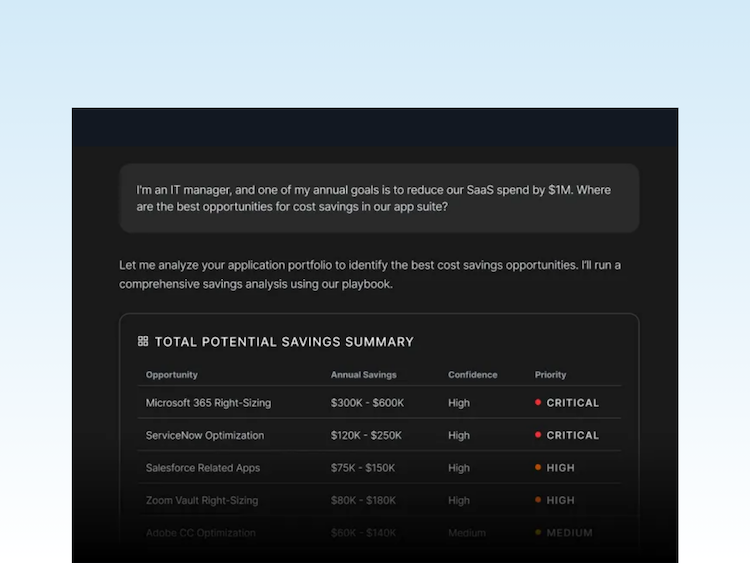
MCP supports software optimization by helping AI tools retrieve spend, contract, usage, and risk data across procurement systems, software asset management tools, SaaS management platforms, and vendor environments.
For example, use MCP to:
- Identify unused licenses and reclaim them
- Surface duplicate SaaS and AI tooling
- Monitor AI-related SaaS adoption
- Support vendor consolidation and app rationalization
- Analyze consumption-based AI spend
- Prepare renewal optimization workflows
Using an MCP for SaaS Management also accelerates the shift from static reporting toward self-service operational insights. While operational accessibility can improve decision-making speed, it also increases the importance of governance, visibility, and spend oversight as more employees interact directly with AI-powered operational workflows.
At the same time, organizations are rapidly increasing investment in AI-native applications and embedded AI functionality across the SaaS environment. As AI-related software adoption grows, enterprises face increasing pressure to manage application overlap, usage-based pricing, vendor sprawl, renewal governance, and decentralized AI purchasing decisions more effectively.
As AI adoption scales, organizations need stronger visibility into how AI tools, integrations, and workflows influence operational costs across the SaaS environment.
Development Tools and IDE Integrations
Development environments and integration development environment (IDE) integrations use AI systems to support coding workflows, repository management, documentation retrieval, and engineering operations.
MCP can connect AI coding assistants with:
- GitHub repositories
- CI/CD platforms
- Internal developer documentation
- Infrastructure management tools
- Issue tracking systems
- Testing environments
These integrations help AI systems retrieve development context and support engineering workflows across software delivery environments.
MCP and the Growing Importance of SaaS Governance
As automation capabilities expand, so do the operational, compliance, and security risks. Model Context Protocol increases the importance of governance, SaaS visibility, access oversight, and spend optimization as AI systems gain broader access to enterprise applications and operational workflows.
Traditional SaaS governance models were designed around human users interacting directly with applications. Because AI agents introduce a different operating model, it changes the governance requirements for:
- Access management
- Workflow authorization
- Data exposure controls
- Operational accountability
- Application visibility
- Audit readiness
Shadow AI Expands with AI Connectivity
Shadow AI refers to employees or teams adopting AI-powered applications, integrations, or workflows without centralized IT, Security, and Procurement oversight.
Like shadow IT, the root of shadow AI is decentralized purchasing. On average, only 15% of applications (SaaS and AI-native) are owned by IT—per Zylo’s 2026 SaaS Management Index.
.png)
That makes way for:
- Unauthorized AI tools
- AI browser extensions
- External AI integrations
- Unapproved SaaS purchases
- AI-enabled workflow automations
As AI adoption accelerates, unmanaged AI connectivity can create:
- Security gaps
- Duplicate tooling
- Compliance concerns
- Untracked spend
- Governance inconsistencies
AI Trustworthiness Improves But Governance Still Matters
MCP can help improve AI trustworthiness by supplying AI systems with more relevant operational context during workflows and decision-making processes.
When AI systems lack sufficient context, they can generate incomplete outputs, inaccurate recommendations, or hallucinations because they are missing operational information needed to complete a task reliably. MCP frameworks help reduce that risk by dynamically providing task-specific context instead of relying entirely on static prompts or disconnected document uploads.
Nonetheless, MCP does not eliminate governance risk or guarantee output accuracy. AI systems can still generate incorrect conclusions if:
- The underlying model has limitations
- The provided data is incomplete
- Permissions are misconfigured
- Operational systems contain outdated information
- AI workflows lack oversight
As organizations scale AI adoption, operational trust increasingly depends on both the quality of the AI model and the quality of the governance framework surrounding it.
AI Access Management and Permissions Become More Complex
Conceivably, your LLM can connect to hundreds of applications via MCP, requiring access to each to support automation and decision-making tasks. As a result of that scale, managing access and permissions becomes more complex.
In many MCP implementations, AI systems inherit the permissions associated with the credentials or API keys used to connect to enterprise applications. An AI system may be able to retrieve data, execute workflows, or interact with applications based on the level of access granted by the underlying credentials.
That increases the importance of:
- Identity governance
- Least-privilege access
- Credential management
- Permission scoping
- Workflow authorization
- Auditability
- Data access controls
- Monitoring AI-generated actions
As AI agents execute more operational tasks, organizations need stronger oversight into:
- Which systems AI tools can access
- What actions AI systems are authorized to perform
- How AI-generated actions are monitored
- Which workflows involve sensitive data exposure
These considerations become more important as AI workflows expand across procurement, IT operations, SaaS Management, and enterprise automation environments.
Compliance and Vendor Risk Increase
AI systems connected to enterprise applications can introduce additional compliance, regulatory, and vendor management concerns.
Zylo’s 2026 SaaS Management Index found that 43% of IT leaders identified exposure of sensitive company data as their top concern related to AI use, followed by regulatory and compliance risks at 33%.
These concerns increase as AI systems gain broader access to:
- Financial systems
- Employee data
- Procurement records
- Operational reporting
- Internal documentation
- SaaS environments
Organizations also face increased pressure to evaluate:
- Third-party AI vendors
- Data handling policies
- AI-related contract terms
- Compliance obligations
- Security controls
- Operational dependencies
As AI adoption scales, operational maturity increasingly depends on balancing AI enablement with governance, visibility, and spend oversight.
AI Connectivity Will Define the Next Phase of SaaS Management
AI is rapidly moving beyond chat interfaces and embedding itself across SaaS applications, operational workflows, procurement systems, and enterprise automation. MCP is accelerating that shift by giving AI systems a more consistent way to access data, interact with applications, and execute work across the enterprise.
That creates a new operational reality: organizations are no longer managing only SaaS applications. They are managing expanding networks of AI agents, AI-powered workflows, integrations, and consumption-based software spend.
Operational visibility is quickly becoming foundational to enterprise AI adoption. Organizations that operationalize governance, SaaS visibility, and AI spend oversight now will be in a stronger position to scale AI strategically—and avoid losing control of the SaaS environment as AI connectivity accelerates.
Learn how you can connect Zylo to the AI tools you already use to improve SaaS visibility, strengthen AI governance, and optimize SaaS and AI spend. Request a demo to see it in action.
Frequently Asked Questions About Model Context Protocol
Model Context Protocol (MCP) is an open standard that allows AI systems to connect with SaaS applications, APIs, databases, and enterprise workflows through a consistent framework. Organizations use MCP to support AI copilots, AI agents, workflow automation, enterprise search, SaaS operations, and AI-driven business processes across connected applications.
MCP uses a client-server architecture that allows AI applications to communicate with enterprise systems, tools, and data sources. MCP hosts, clients, and servers coordinate how AI systems retrieve information, access resources, and execute actions across SaaS applications, operational workflows, APIs, databases, and internal business platforms.
A large language model (LLM) is the AI model that generates responses, analyzes information, and supports reasoning tasks. MCP is the framework that allows those AI models to access external tools, operational data, SaaS applications, and enterprise workflows. MCP extends what an LLM can interact with beyond its training data.
Retrieval-augmented generation (RAG) helps AI systems retrieve external information before generating a response. MCP supports retrieval as well, but it also enables AI systems to execute actions and coordinate workflows across business applications. RAG primarily improves information retrieval, while MCP supports broader operational interactions with enterprise systems.
APIs allow systems to exchange data and execute functions, but they require custom integrations for each application or workflow. MCP creates a more consistent framework for how AI systems discover tools, retrieve operational context, and interact with multiple applications across enterprise environments without relying entirely on one-off integrations.
Enterprises typically evaluate MCP when AI systems need to interact with multiple SaaS applications, operational workflows, and external data sources through a standardized framework. Common scenarios include AI agents, workflow automation, enterprise copilots, SaaS operations, procurement workflows, and AI-driven processes that span multiple business systems.
MCP may be unnecessary for simpler AI use cases involving standalone chat experiences, isolated document retrieval, or limited single-system automations. Organizations with narrow AI requirements may rely on existing APIs or lightweight integrations instead of implementing a broader AI connectivity framework across enterprise environments.
MCP can introduce governance, security, and operational complexity if organizations lack centralized oversight of AI systems and integrations. Common challenges include permission management, shadow AI, data exposure risks, AI-related SaaS sprawl, workflow oversight, and increasing operational complexity as AI agents gain broader access to enterprise applications and business processes.
Model Context Protocol is an open standard supported by an expanding ecosystem of AI vendors, developers, and enterprise technology providers. Organizations can build MCP-compatible integrations, servers, and workflows using publicly available specifications, SDKs, repositories, and development frameworks designed to support interoperable AI connectivity.
Anthropic introduced Model Context Protocol to support standardized connectivity between AI systems and external tools, applications, and data sources. In 2024, Anthropic donated it to the Linux Foundation, who continues to build and maintain it.