What AI Spend Management Software Actually Does


In 2026, Finance teams are becoming dependent on spend management software with AI features to automate reporting, accelerate data processing, and proactively detect risk. But what about spend management software to manage AI spend? Both are essential for holistic spend management.
While spend management tools have long been part of the finance tech stack, AI spend management solutions are a new addition—and one you need now.
In the past year, 78% of IT leaders incurred unexpected charges tied to usage-based pricing, and 61% cut projects due to unplanned SaaS cost increases, according to the 2026 SaaS Management Index. Your software costs are increasingly driven by AI and consumption, growing volatile and difficult to manage, budget, and forecast.
This guide breaks down each type of AI spend management software: what they do, how they compare, and what to ask when evaluating vendors.
"AI Spend Management Software" Means Two Different Things: How to Tell Which One You Need
“AI spend management software” can mean finance or procurement software with AI features to manage corporate spend, or software management tools to manage AI spend on tech investments.
If your team owns corporate spend, then a spend management platform with AI is the best place to start. Use a software spend management tool instead if your team owns SaaS and AI spend.
Corporate Spend Management with AI
AI for corporate spend is for CFOs, Accounts Payable teams, and Procurement to code and match invoices, flag duplicate or out-of-policy charges, and shorten vendor onboarding cycles. Commonly used vendors include Coupa, SAP Ariba, GEP, Ramp, and Brex.
SaaS and AI Spend Management
SaaS and AI spend management is built for IT, Software Asset Management, Procurement, and FinOps teams responsible for software spend (subscriptions, licenses, renewals, and utilization) and AI cost consumption, including vendors like Zylo, Torii, and Flexera. Controlling AI consumption costs is sometimes a feature of a SaaS management platform but can also be found as a standalone product.
Is AI Spend Management Software the Same as Cloud Cost Management?
No. AI spend management software is not the same as cloud cost management. The two are complementary, and mature teams pair them so cloud budgeting accounts for both infrastructure bill software expenditures.
AI spend management software focuses on software and AI-related spend: SaaS subscriptions, AI add-ons, and consumption-based AI services like OpenAI API or Anthropic API.
Cloud cost management focuses on infrastructure: compute, storage, and networking on AWS, Azure, or Google Cloud.
What the "AI" in AI Spend Management Software Actually Does
AI within a spend management software does five jobs:
- Anomaly detection: what the AI is actually looking for
- Forecasting: what the models predict
- Recommendation engines: rightsizing, consolidation, and renewal optimization
- Discovery: vendor recognition from messy data
- Natural language interfaces: asking questions about spend
How well an AI tool does depends on the architecture underneath, which is where, as a buyer, you can get burned.
"AI" on a vendor website can mean production machine learning models or a chatbot layered over a dashboard. These features are different yet get marketed with the same term. You usually pay a premium for it, and capability claims are hard to verify once you've signed.
Knowing what each job should deliver and which technique runs it gives you something specific to test in a demo.
| Capability | What it does | Technique that usually runs it | What to test in a demo |
|---|---|---|---|
| Anomaly detection | Flags spending that breaks from an established pattern before it becomes a budget problem | Classical ML | Ask it to separate a real spike from normal seasonality |
| Forecasting | Projects future spend from historical data, growth trends, and vendor pricing changes | Classical ML | Ask for accuracy on consumption line items specifically, not just seat-based forecasts |
| Recommendation engines | Turns detection into a prioritized action list: rightsizing, consolidation, renewal optimization | Classical ML | Ask how often customers reject its recommendations, and why |
| Discovery | Recognizes vendors from messy, misspelled, or aggregated financial data | Classical ML + LLM | Ask which data sources it ingests natively (SSO, expense, contracts) |
| Natural language interfaces | Lets you query spend insights in plain English and auto-generate reports | LLM | Ask it to justify a recommendation, not just retrieve a number |
Anomaly Detection: What the AI Is Actually Looking For
Anomaly detection flags spending that breaks from an established pattern before it becomes a budget problem. Good models separate a sudden spike from slow creep, distinguishing real problems from normal seasonality.
The signals you should monitor include:
- Vendor-level anomalies: a mid-term price increase or an unexpected tier upgrade
- Usage anomalies: one user consuming 50 times the team average
- License anomalies: active users far below the licensed count
To detect anomalies accurately, it requires clean historical data and seasonality awareness. Otherwise, you get false alarms that your team learns to ignore.
Forecasting: What Consumption Models Predict
Forecasting projects future spend from historical data, growth trends, vendor pricing changes, and headcount plans.
While renewal cost forecasting and headcount-driven license forecasting are relatively mature, consumption-based spend forecasting is the hard new problem. Token and API costs scale with activity that shifts week to week, so a model that nails seat-based forecasts can still miss badly on an AI-native vendor.
Ask any vendor what forecast accuracy you should expect on consumption line items specifically, and how they measure it.
Recommendation Engines: Rightsizing, Consolidation, and Renewal Optimization
Recommendation engines turn detection into a prioritized action list. The three most valuable outputs are license rightsizing (cancel inactive seats, downgrade tiers, redistribute), vendor consolidation (surface functionally overlapping tools), and renewal optimization (timing, comparable benchmarks, and leverage points).
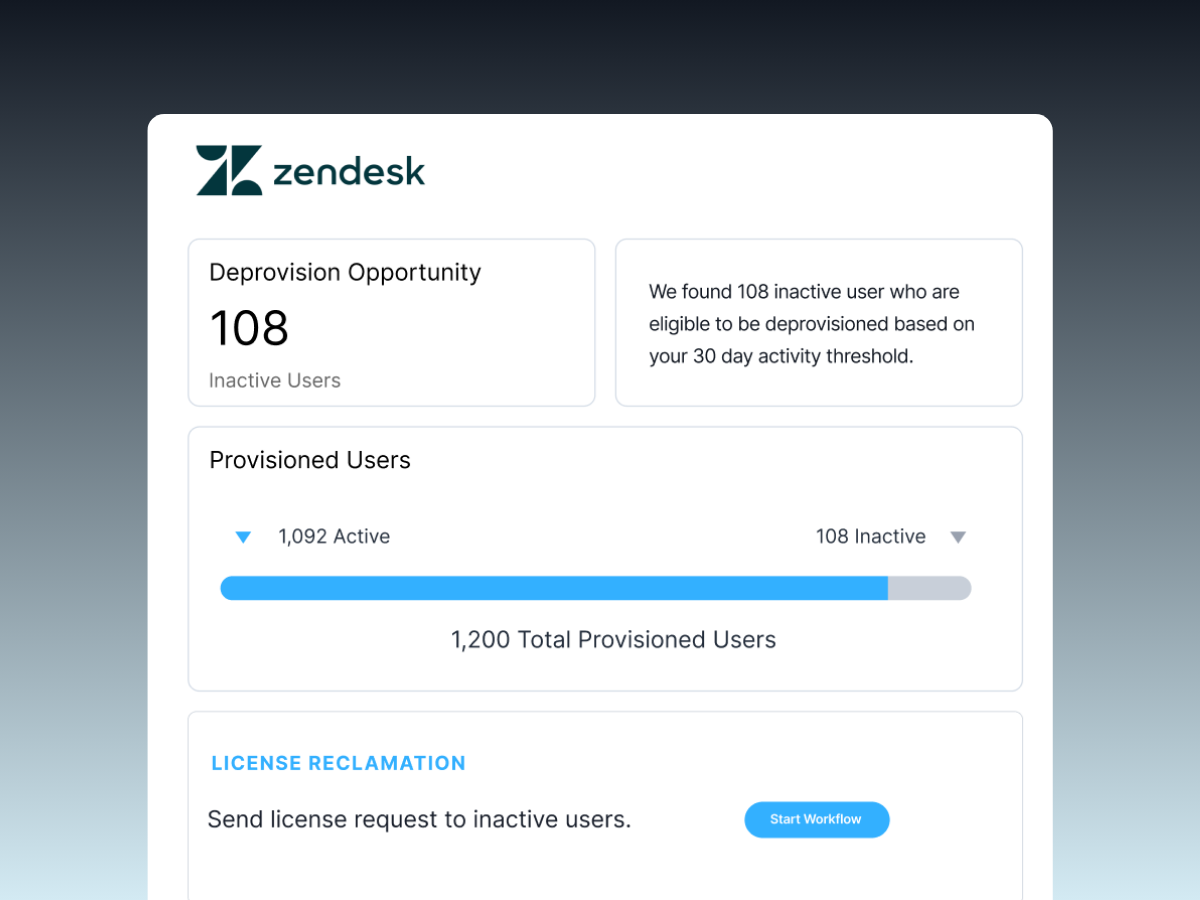
License rightsizing has the fastest payback: according to Zylo’s 2026 SaaS Management Index, organizations waste an average of $19.8M on unused SaaS licenses every year. A tool like Zylo Clarity AI ranks renewals by savings potential and quantifies reclaimable license spend.
When it comes to recommendation engines, the buyer question is the same for every vendor. How often do customers reject the recommendations, and does the tool explain why it made each one?

Discovery: Vendor Recognition From Messy Data
Discovery recognizes vendors from financial data that's often misspelled, abbreviated, or aggregated into a single line item. Strong discovery starts with financial data, supported by SSO logs and contract repositories to build one accurate application inventory.
With discovery, shadow IT and shadow AI get exposed. However, it is limited in that AI can only flag what it sees. Spend routed through a personal card or an untracked channel stays hidden until a data source surfaces it, which is why discovery breadth matters more than any single algorithm.
Decentralized buying makes financial discovery urgent, as IT directly controls just 15% of software spend while lines of business drive 81%, per Zylo's 2026 SaaS Management Index.

Natural Language Interfaces: Asking Questions About Spend
Natural language interfaces let you query spend insights in plain English: "Which vendors had the largest renewal uplifts last year?" They also auto-generate reports and executive summaries.
These interfaces work well for retrieval and far less well for prescriptive guidance. Getting a fast, accurate answer to a spend-analytics question is a real time-saver. Trusting that same interface to tell you what to do, without a model and a rationale behind it, is where your team can go wrong and lead to poor business decisions .
Classical ML Versus LLM-Based Versus Hybrid: What Most Vendors Actually Run
Most platforms run a hybrid of both classical machine learning (ML) and large language models (LLM). Classical machine learning handles forecasting, anomaly detection, and recommendation engines, while large language models handle natural language interfaces, contract parsing, and vendor categorization.
Why do vendors use both models instead of choosing one? Classical models are mature and explainable, trained on structured spend data, and they can show the math behind a forecast or a flagged anomaly. In contrast, LLMs handle messy, unstructured inputs like contract PDFs that can produce confident, wrong answers when they hit something unfamiliar, making it important to also have the machine learning layer.
Since hybrid is the default, the question isn't "Do you use AI?" but rather “Which type of AI runs each capability, and what keeps the LLM components from guessing?” Vendors who can answer that cleanly are building AI. Vendors who wave at "AI-powered" usually aren't.
How Long Before AI Spend Management Software Gives Reliable Recommendations?
Most deployments take 30 to 90 days before AI recommendations stabilize, because the models need clean historical spend, usage, and contract data to establish a baseline. Vendors with broad, fast data ingestion shorten that window; vendors with thin integrations lengthen it. Ask for a specific time-to-first-insight range and what drives it before you sign.
Managing Spend ON AI: The Other Half of AI Spend Management
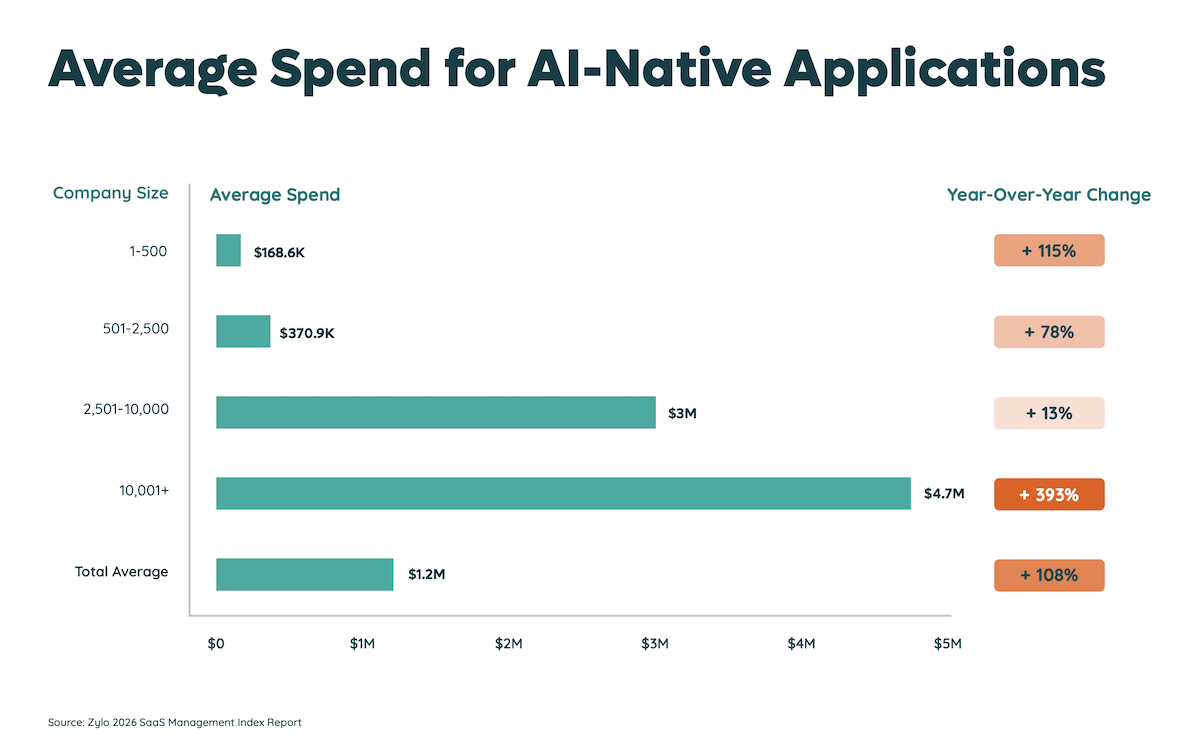
Managing spend on AI means controlling the tokens, inference, and API costs your organization incurs using AI, and it has its own evaluation criteria. The category is exploding: AI-native application spend rose an average of 108% year over year, and jumped 393% in large enterprises, per Zylo's 2026 SaaS Management Index. That makes AI consumption cost management a budget line worth governing on its own.
Four dynamics separate AI spend from traditional software spend:
- Token, inference, fine-tuning, and embedding costs
- Per-user, per-team, and per-project AI cost allocation
- Why AI consumption breaks traditional procurement workflows
- MCP, agentic spend, and AI gateways
Token, Inference, Fine-Tuning, and Embedding Costs
AI cost components hide in different parts of different contracts: per-token inference on model APIs, separate embedding and fine-tuning charges, and consumption units bundled into existing SaaS tiers. Per-token pricing is hard to forecast because it scales with activity you don't fully control, including how your own customers use your AI features.
In practice, vendors and buyers often use "consumption-based" and "usage-based" pricing as loose synonyms for the same thing: cost that scales with activity like API calls or compute, frequently layered on top of a base subscription in a hybrid pricing model. What matters more than the label is the mechanics behind how each vendor meters usage/consumption and how that affects your commitment structure.
Per-User, Per-Team, and Per-Project AI Cost Allocation
Allocating AI cost is a chargeback problem, because shared AI infrastructure resists tidy cost-center math. When five teams hit the same model endpoint through one API key, seat-based allocation attributes none of it correctly.
Per-team and per-project telemetry matters more than per-user counts here. Breaking cost down to allocate AI spend by team is what lets finance attribute consumption to the group that drove it, rather than dumping it into an unowned shared-services bucket.
Why AI Consumption Breaks Traditional Procurement Workflows
AI consumption breaks procurement because there's no purchase order at the point of use. Costs accrue continuously across the term instead of at a negotiated moment, so the controls built around POs and annual renewals simply don't fire.
That creates the mid-term surprise: the "we hit our annual commit in month seven" problem, followed by overages at unfavorable rates. Consumption commits, overages, and true-ups need consumption cost management that models and monitors them in real time, not reconciliation after the invoice lands.
MCP, Agentic Spend, and AI Gateways
Model Context Protocol, agentic systems, and AI gateways are the 2026 primitives reshaping AI cost visibility. The Model Context Protocol connects spend and contract data to AI tools like ChatGPT, Claude, and Gemini, so that questions and actions carry full context rather than guesswork.
Agentic systems raise the stakes, because AI can now initiate spend on its own through autonomous API calls and tool use. AI gateways and routing layers sit in front of that activity as a control point, giving you a place to meter, cap, and attribute consumption before it becomes a commitment.
How do you track AI consumption costs across multiple providers?
Track AI consumption by unifying usage and contract data from every provider into one system of record, then attributing it to teams and projects. A platform that normalizes OpenAI, Anthropic, Snowflake, Databricks, and Google Vertex billing into a single view can map tokens, credits, and API calls to spend, so you can forecast against commitments and catch overages before they hit.
AI Spend Management for Procurement Versus SaaS: Why the Tools Are Different
Procurement spend tools and SaaS spend tools solve different problems on different data, so one rarely substitutes for the other. Mature enterprises run both. Comparing them across four dimensions shows where each belongs and where the boundary between them blurs:
- What each one manages, and the data behind it
- Which vendors compete in each category
- Where the two categories overlap
- Where the categories don't overlap
| Dimension | Procurement & Corporate Spend | SaaS & AI Spend |
|---|---|---|
| Primary buyer | CFO, AP, and procurement teams | IT, ITAM, FinOps, and SAM teams |
| What it manages | Invoices, POs, corporate cards, travel and expense, vendor onboarding | Subscriptions, licenses, renewals, usage, and AI consumption |
| Data sources | Invoices, POs, virtual cards, expense reports, vendor master data | Contracts, usage telemetry, SSO logs, license utilization, financial feeds |
| Core workflows | AP automation, travel and expense, vendor payments | Discovery, license rightsizing, renewal optimization, consumption monitoring |
| Example vendors | Coupa, SAP Ariba, GEP, Spendesk, Payhawk, Ramp, Brex, Airbase | Zylo, Vendr, Flexera, Torii, Apptio |
| Doesn't cover | License rightsizing, SSO discovery, consumption telemetry | AP automation, travel and expense, virtual cards |
| Where they overlap | Vendor consolidation visibility, shared contract repository, some renewal workflows, and the unified "office of the CFO" data layer | |
Different Categories of Spend, Data Sources, and Workflows
Procurement tools process invoices and payments. SaaS spend tools track software lifecycles. The corporate spend universe runs on invoices, POs, virtual cards, travel and expense, and vendor master data. The SaaS and AI universe runs on subscriptions, contracts, usage telemetry, SSO logs, and license utilization.
Those are different inputs feeding different workflows. An AP automation engine and a license rightsizing engine share almost no underlying data, which is why one product rarely does both well.
Which Vendors Compete in Each Category
Corporate and procurement spend vendors include Coupa, SAP Ariba, GEP, Spendesk, Payhawk, Ramp, Brex, and Airbase. SaaS spend management vendors include Zylo, Vendr, Flexera, Torii, and Apptio.
The lists barely intersect, and that's the tell. Vendors build for the data they can get and the buyer they sell to, so a platform optimized for invoice throughput won't have the SSO and usage integrations that license reclamation depends on.
Where the Two Categories Overlap
Both categories give you vendor consolidation visibility, a shared contract repository, and some renewal management workflows. Both are also being pulled toward a single "office of the CFO" data layer, where finance wants one view of every dollar leaving the business.
Those shared capabilities are why buyers assume the categories are interchangeable, and why the overlap is worth understanding before you consolidate tools on that assumption.
Where The Categories Don't Overlap
AP automation, travel and expense, and virtual cards live entirely in corporate spend. License rightsizing, SSO-based discovery, and consumption telemetry live entirely in SaaS and AI spend. Expecting an AP platform to reclaim unused licenses, or a SaaS platform to run your card program, is where the substitution mistake shows up on the invoice.
Mature enterprises run both because each covers a blind spot the other can't see. Procurement tools govern how money leaves the building. Tools built for FinOps and IT teams govern whether the software you're paying for is used, redundant, or up for renewal.
Common Use Cases for AI Spend Management Software
Every use case is really one or two AI capabilities doing the work. Naming the capability tells you what to test in a demo.
- SaaS spend optimization runs on recommendation engines for rightsizing and consolidation.
- Procurement savings run on anomaly detection against price increases, plus benchmarking.
- Vendor consolidation runs on discovery that recognizes redundant applications.
- Shadow IT and shadow AI visibility run on discovery across SSO, expense, and finance feeds.
- Renewal management runs on forecasting, recommendations, and contract parsing together.
- AI consumption cost forecasting runs on usage-pattern modeling, the newest and least proven of the group.
- Mid-term cost surprise prevention runs on real-time anomaly detection against consumption components.
How to Tell Real AI From "AI Marketing" in Spend Management Tools
AI-washing is the practice of marketing ordinary software as AI-powered, such as calling a bolted-on chatbot “intelligence” or rule-based alerts as “anomaly detection.” Because AI features often carry premium pricing, understanding what is actually AI and what isn’t ensures you’re not paying inflated prices for basic non-AI features.
Six questions separate real capability from packaging. Ask them in the demo, before pricing conversations start, and you'll know which vendors can defend their claims and which ones are reading from a slide:
- Can the vendor name the architecture: proprietary models, an LLM wrapper, classical ML, or hybrid?
- Is the AI integrated end to end, or bolted on as a chatbot?
- What does the AI deliver that a well-built dashboard couldn't?
- How does the AI fail? Vendors who can't describe failure modes usually aren't building AI.
- Is there a human in the loop, and at which decision points?
- What's the customer override rate on AI recommendations?
The answers give you three things: a basis for comparing vendors on capability rather than claims, leverage in negotiation when a premium isn't justified by what the AI actually does, and a realistic view of what you'll get in the first quarter after implementation.
Four red flags come up often enough to plan for:
- "AI-powered" with no specifics about what's powered
- AI that lives entirely in a chatbot tab
- AI that can't explain its own recommendations
- "AI" that needs custom re-implementation for every customer (which usually means it isn't AI at all)
Buyer's Evaluation Framework: 12 Questions to Ask AI Spend Management Vendors
Ask every vendor the same twelve questions, in the same order, and write down the answers. Consistency is what makes this useful: vendors sound similar in isolation and differentiate fast once you compare responses side by side.
Bring these questions to the first technical demo, not the final negotiation, since the answers should shape your shortlist rather than confirm a decision you've already made.
- What's your AI architecture: proprietary models, LLM wrappers, classical ML, or hybrid? A specific answer means engineering ownership. Vague answers usually mean a thin layer over someone else's model.
- What data is the AI trained on: our data only, your aggregate customer base, or public data? Aggregate benchmark data across customers is what makes pricing and utilization comparisons meaningful. Models trained only on your data can't tell you whether your renewal uplift is normal.
- How long from contract signing to first AI-generated insight or recommendation? Ask for a range and what drives it. This sets the expectation you'll be held to internally when someone asks what the platform has produced.
- What's your customer override rate on AI recommendations? A vendor who tracks this is measuring whether customers trust the output. A vendor who's never considered it isn't watching whether the AI works in production.
- How does the AI handle novel vendors or pricing models it hasn't seen before? AI-native vendors and consumption pricing are new enough that this is where tools break. Ask specifically about vendors that bill by token or credit.
- Can the AI explain why it recommended any specific action? Have them show it live on a real recommendation. Your team has to defend these decisions to business owners, and "the system said so" doesn't survive that conversation.
- How does the AI handle PII, data residency, and compliance constraints? Confirm where data is processed, what's retained, and whether your data trains models used for other customers. Get it in writing, not in a demo answer.
- What's your retraining cadence? Pricing models and usage patterns shift constantly. Annual retraining means recommendations based on a market that's already moved.
- How do you handle consumption-based and AI-native vendors like OpenAI, Anthropic, Snowflake, and Databricks? Ask which of these they support natively today, not on a roadmap. This is the fastest-growing part of your spend and the thinnest part of most products.
- How deep is the integration with our ERP, expense, ITAM, and SSO stack? Name your actual systems and ask about each one. Integration depth determines discovery accuracy, and discovery accuracy determines everything downstream.
- What's the human-in-the-loop pattern, and where can users override? Find out which actions the system takes on its own and which require approval. That boundary is your risk exposure.
- What's a customer benchmark for spend recovery in the first 90 days? Ask for a reference customer of similar size and portfolio complexity. Vendors who can point to one are describing outcomes; vendors who can't are describing features.
The pattern in the answers matters more than any single response. Vendors build real AI answers, specifically volunteer limitations, and offer to demonstrate on your data. Vendors selling AI-washed software redirect to the roadmap, cite other customers without specifics, or reframe the question.
Real Limitations of AI-Powered Spend Management Tools
AI spend management software has limitations worth knowing before you buy. It can't see spend that never touches a connected system. It needs months of clean data before its recommendations are trustworthy. It struggles with vendors and pricing models it hasn't encountered before. And it can't act on any of it without people who understand what it's telling them.
Those are failure modes: the specific ways a system produces wrong, incomplete, or unusable output. Vendors rarely publish them, which is why so many deployments underperform for reasons buyers could have seen coming.
The failure modes vendors don't advertise:
- Cold start: 30 to 90 days before recommendations stabilize.
- Visible-spend bias: the AI can't flag spend it never sees.
- Hallucinations on unfamiliar vendors and novel AI pricing.
- Explainability: can the AI defend a "cancel 40 licenses" call?
- Data residency and PII handling for regulated and EU data.
- Retraining cadence: annual lags continuous.
- Adoption: recommendations in an unopened dashboard return nothing.
- Override rate: too high means wrong, too low means unwatched.
The Cold-Start Problem
A cold start is the period after implementation when the AI doesn't yet have enough of your data to produce reliable output. The models need historical spend, usage, and contract records to learn what normal looks like in your environment before they can flag what isn't. Expect 30 to 90 days before recommendations stabilize.
Vendors with broad, fast data ingestion shorten that window. Vendors with thin integrations stretch it, because the models spend longer waiting on data that trickles in from disconnected systems.
Ask how long until the platform produces recommendations you can defend to a business owner, and what drives that timeline. The answer usually comes down to integration depth, since AI is only as good as the data it's fed.
Bias Toward Visible Spend
AI spend management tools are biased toward visible spend because they can only analyze what flows through a connected system. Anything outside those feeds is invisible to the model no matter how good the model is.
Hidden spend lives in predictable places: shadow IT on personal cards, unmanaged corporate cards, and AI subscriptions charged to an individual and expensed as something else. None of it shows up in a discovery report, which means your inventory can look complete while a meaningful share of software and AI spend sits outside it.
The unlock is discovery breadth, not model sophistication. Connecting SSO, expense, finance, and browser signals gives the AI more surface to work with, and each additional source shrinks the blind spot. Ask vendors which sources they ingest natively, and treat that list as the real limit on what their AI can find.
Hallucinations on Novel Vendors and Unusual Pricing
LLM-based components can hallucinate when they meet an unfamiliar vendor or an unusual contract structure. AI consumption pricing is novel enough that many tools still mishandle it. Check for confidence scores or override controls before trusting a recommendation on a vendor the model hasn't seen much of.
The Explainability Gap
When the AI recommends cancelling 40 licenses, the procurement lead has to defend that to a business owner. Black-box models without a rationale leave humans unable to act, which turns a good recommendation into a stalled one. Explainability is a 2026 requirement, not a nice-to-have.
Data Residency and PII Handling
EU customers, regulated industries, and government clients carry constraints that classical ML didn't always have to handle, and LLM components add new data-residency questions. Ask where data is processed, what's stored, and what's used for training. Vague answers here are a compliance risk.
Retraining Cadence
Retraining cadence is how often a vendor updates its models on new data, and you should make them state it explicitly rather than assuming it's frequent. A tool retrained annually will lag behind one retrained continuously, especially on fast-moving AI-native vendors.
That gap matters because the inputs shift constantly. Vendor pricing changes mid-term, new AI-native tools enter the market every quarter, and your own usage patterns move with headcount and adoption. A model trained on last year's market will benchmark your renewal against pricing that no longer exists.
Ask when the models were last updated, and what triggers an update between scheduled cycles.
Adoption and Workflow Integration Challenges
When data and recommendations sit in a dashboard nobody opens or are disconnected from internal workflows, adoption suffers. Both halves of that are integration problems, and both cost you the value you paid for.
Workflow integration is what closes the gap. Push notifications route recommendations to the people who act on them, renewal calendar integration puts dates in front of the owners who negotiate, and direct connections to Slack or Teams surface alerts where your team already works instead of in a tool they have to remember to check.
Adoption metrics predict value better than a feature checklist. Track login frequency and recommendation acceptance rate after implementation, and ask vendors what those numbers look like across comparable customers.
Override Rate as a Buyer-Evaluation Metric
Override rate (the share of AI recommendations users reject) is a blunt read on trust and accuracy. A very high override rate suggests the AI is wrong or unconvincing; a near-zero rate suggests humans aren't reviewing at all. Ask vendors for their typical range and how they'd interpret yours.
ROI Metrics That Matter for AI Spend Management
Serious buyers track outcomes, not features. These are the metrics worth putting in a business case and revisiting after deployment.
- Time to first insight: months from contract to first defensible recommendation.
- Override rate on AI recommendations.
- Recovery percentage on identified shelfware in the first 90 days.
- Forecast accuracy on consumption-based vendors, measured as deviation from actual.
- Procurement cycle reduction: days saved per vendor evaluation.
- Renewal uplift containment: average renewal increase relative to the benchmark.
- Shadow IT discovery rate: apps surfaced after deployment versus the pre-deployment baseline.
Grounding these in real data is what separates a credible tool from a confident one. Zylo's recommendations draw on more than 40 million SaaS licenses and $100B+ in spend under management, which is the kind of dataset that makes a benchmark defensible.
The Agentic Frontier: When Spend Management Stops Recommending and Starts Doing
Agentic spend management, where an AI agent executes actions for you, is the new frontier for 2026 and beyond. It matters now because the economics changed: consumption pricing accrues cost continuously, so waiting for a human to review a recommendation means paying for the delay. An agent that acts between renewals captures savings that a quarterly review cycle misses entirely.
Whether an agentic feature is worth buying comes down to why the shift is happening now, what could go wrong when an agent acts on your spend, and what makes any of it work reliably.
The Shift From AI Recommendation to AI Execution
Most tools today surface a recommendation and wait. An agentic tool acts on it.
Before: the platform flags 40 inactive Salesforce licenses and adds them to a report. Someone on your team opens the report, confirms the users are gone, files a ticket, and waits for provisioning to process it. Three weeks later, the seats come back.
After: the agent verifies the accounts are inactive against SSO, reclaims the licenses, notifies the app owner, and logs the change. The same work happens in an afternoon.
The same pattern applies across routine work: drafting renewal counter-offers from benchmark data, reassigning seats based on usage telemetry, and requesting approvals when a threshold is crossed. None of it is novel analysis, but executing what used to sit in a queue.
Risk Profile of Autonomous Spend Agents
The risk of autonomous agents is that they can take the wrong actions or act correctly but on incomplete data.
- An agent working from stale SSO data reclaims licenses from an entire team that was mid-migration to a new identity provider, and they lose access to a system they use daily.
- An agent misreads a quiet stretch as excess capacity and downgrades a commitment tier, then a product launch drives consumption past the reduced commit, and you pay overage rates on the difference.
- An agent cancels a contract inside its auto-renewal window, and the vendor holds you to the full term anyway.
That's why guardrails come before autonomy. Scope the permissions limit on what an agent can touch, reversible actions, complete audit trails, and human-in-the-loop checkpoints on high-impact decisions. Ask vendors which actions their agent takes without approval, and what the rollback path looks like when one of them is wrong.
An agent that can't undo a change, or can't show what it did and why, doesn't belong near a live budget.
Where MCP and Agentic Patterns Fit
Agentic spend management depends on Model Context Protocol (MCP), the open standard that connects AI tools to enterprise systems and data. Without it, an agent works from whatever it can scrape together—a result of having incomplete data. With MCP, an agent reads from a governed system of record and acts through documented, auditable connections.
That's the difference between an agent guessing and an agent working from your actual contracts, usage, and spend. Zylo's MCP Server connects that data to tools like ChatGPT, Claude, and Gemini, so questions and actions carry full context.
Agentic capability is only as trustworthy as the data underneath it. Evaluate the system of record first, then the agent.
Final Thoughts: Choosing the Right AI Spend Management Tool
AI spend management software serves two very different buyer types, so identify which one you are before evaluating a vendor. Finance and procurement teams start with corporate spend platforms, while IT, FinOps, and SAM teams need tools built for both software and AI spend. Confusing the two is an expensive early mistake.
Judge the AI by what it predicts, detects, recommends, and discovers, not by the chatbot tab. Push every vendor to say which technique runs each capability and how it fails, because the ones building real AI can answer and the ones marketing it can't.
AI consumption is becoming a major spend category in its own right, and the tools managing it are still maturing, so early movers get the most leverage. Whichever tool you choose, governance and human-in-the-loop discipline determine the return. AI tools are an assist option, not the final answer.
AI transforms Zylo from a system of record into a system of action, using $100B+ in SaaS and Cloud spend data to surface savings, prioritize impact, and guide your next move. Ready to optimize your software and AI spend? Learn how Zylo helps you save money and control consumption costs, or book a personalized demo to see it in action.