Best Software License Management Software Ranked for IT & SAM Teams in 2026


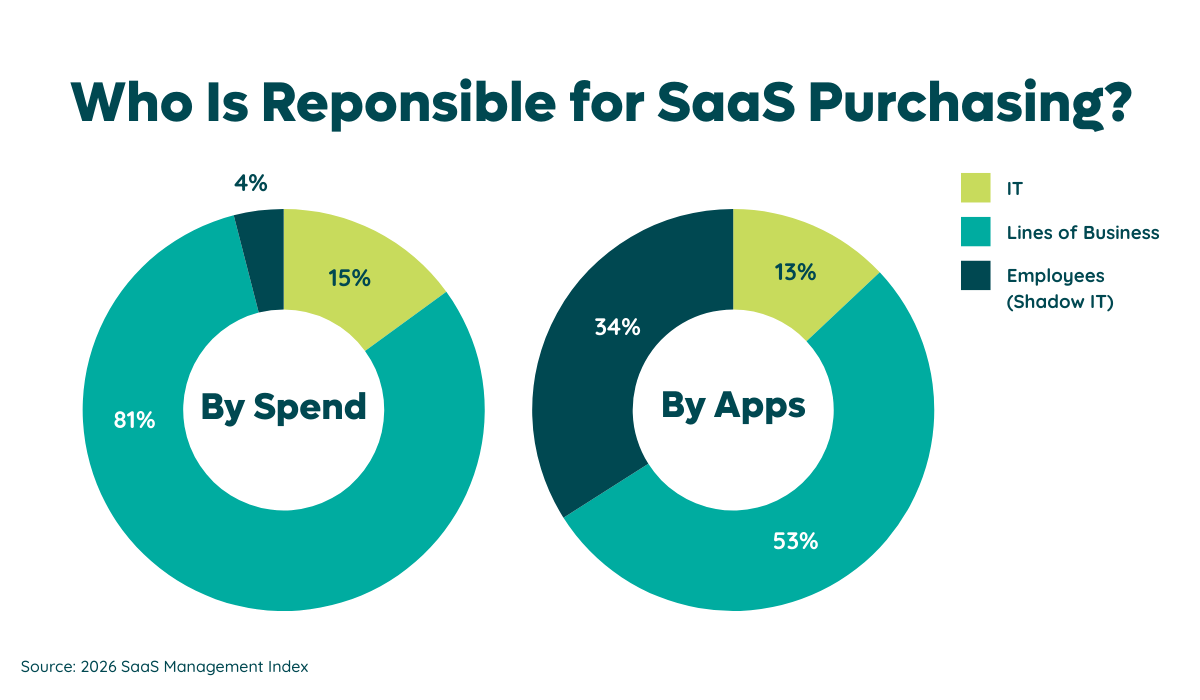
Forty-size percent of SaaS licenses go unused in a given month, yet most of that software never came through IT. Zylo's 2026 SaaS Management Index shows that business units now control more than 81% of SaaS spend, leaving IT and software asset management teams without visibility into what's been purchased, who holds active licenses, or whether those applications meet your compliance and security standards. What you can't see, you can't manage.
License management software closes that gap. The right platform gives IT and software asset management teams a centralized view of every license, contract, and renewal across SaaS, on-premises, and hybrid environments, so you can address unknown waste, compliance exposure, and security risk before they embed themselves in next year's budget.
What Is License Management Software?
License management software is a platform that tracks every software license across an organization, monitors usage and compliance, and identifies opportunities to cut costs.
IT and software asset management teams use it to:
- Centralize contract data, entitlements, and user access in a single system
- Manage renewals and prevent audit exposure from incomplete entitlement records
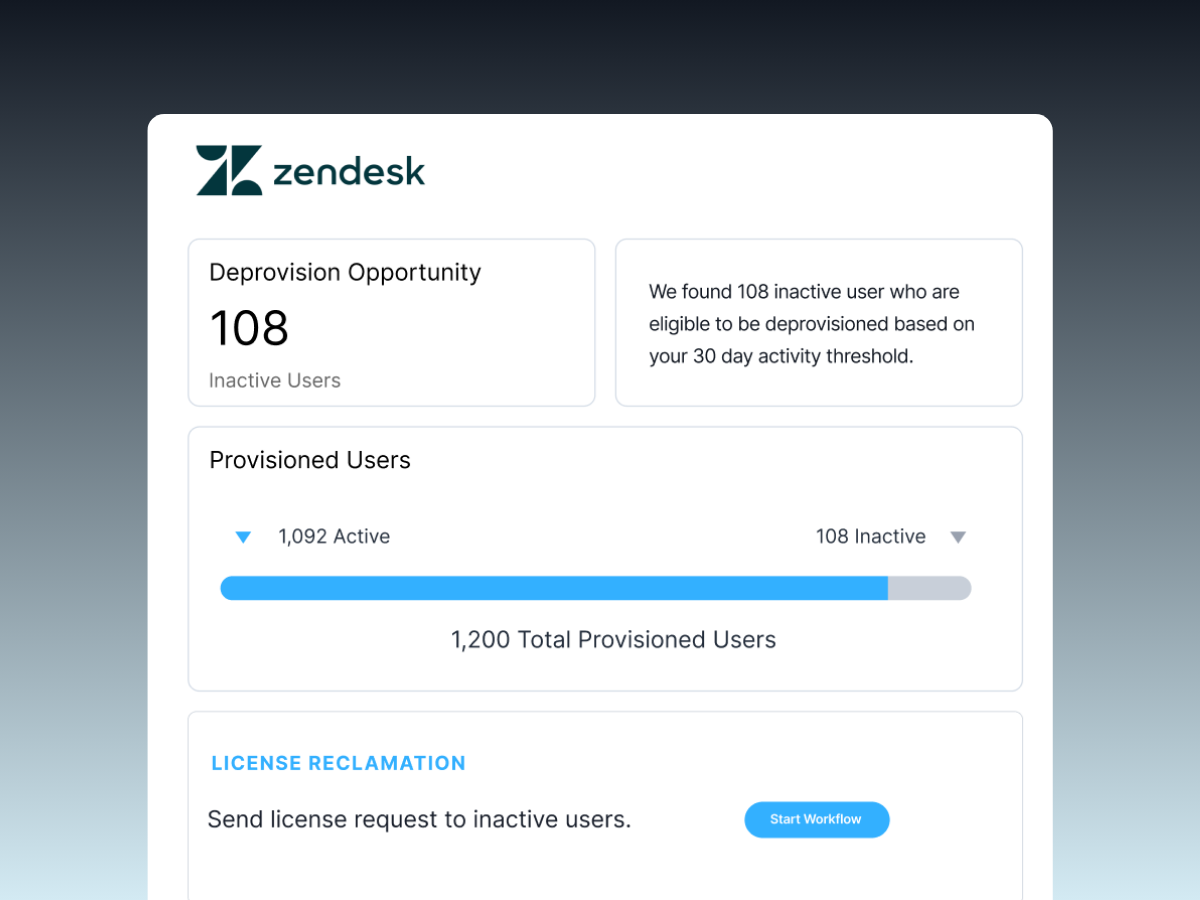
- Reclaim unused licenses before they drain the budget
- Monitor consumption-based pricing and detect shadow IT
- Integrate with identity providers like Okta and Microsoft Entra ID to automate deprovisioning.
What Business Problems Does License Management Solve?
License management addresses four recurring pain points for IT and software asset management teams:
- Unused licenses quietly draining budgets
- Missed renewal windows that lock in overpriced contracts
- Shadow IT and shadow AI creating security and compliance risk
- Audit exposure from incomplete entitlement data
The work rolls up to two outcomes that matter most: keeping your software portfolio compliant and generating savings through better license visibility and renewal management.
Why License Management Matters in 2026
License management matters more in 2026 because the conditions that create waste and risk are getting worse, not better. Four forces are driving the urgency:
- SaaS spend is rising alongside unused license waste
- Renewals represent the largest controllable cost, yet most teams aren't treating them that way
- Shadow IT and shadow AI are creating compliance and security exposure that's hard to see
- AI features are introducing consumption-based pricing that traditional tracking can't handle
The cost of inaction shows up in hard numbers from Zylo's 2026 SaaS Management Index:
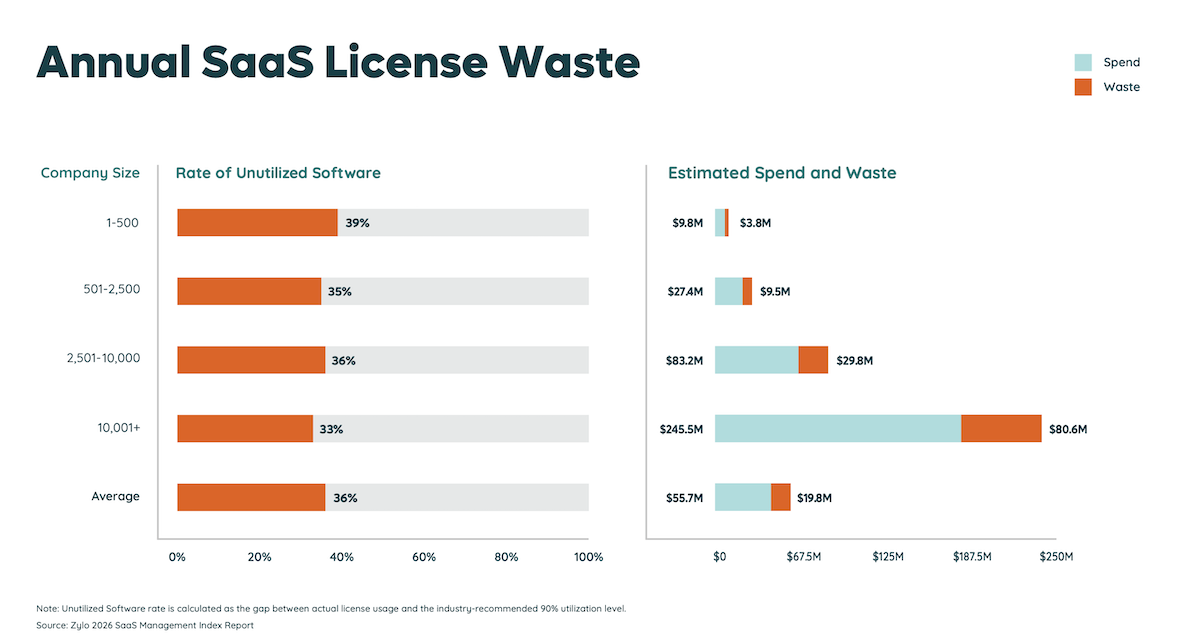
- The average organization carries $19.8M in annual license waste, with utilization stuck at 54%.
- Renewals account for 87% of SaaS spend, yet only 38% of IT leaders treat them as a cost-reduction opportunity.
- Expense-based SaaS spend grew 267% year over year as employees purchase AI tools outside of IT.
- Incomplete entitlement data leaves organizations exposed to vendor true-ups from publishers like Microsoft, Oracle, SAP, and Adobe.
Hybrid pricing models that combine subscription fees with consumption charges are now standard. Zylo's 2026 data found that 78% of IT leaders experienced unexpected charges tied to consumption or AI features in the past year.
Without a license management solution, you can't see where those charges originate, let alone control them.
Key Features to Look For in License Management Software
Six features determine whether a license management platform gives IT and software asset management teams the control they need over costs, compliance, and risk:
- Centralized inventory of all software licenses
- Automated software tracking and usage monitoring
- Compliance monitoring and audit readiness
- Contract and renewal management
- Cost savings through rightsizing and reclamation
- User access and security controls
Centralized Inventory of All Software Licenses
A centralized inventory gives IT and software asset management teams a system of record for their software. Depending on the platform, that might cover SaaS applications, on-premises licenses, or cloud subscriptions.
Look for a platform that starts with discovery—surfacing everything that's been purchased, including shadow IT and expense-based applications that never went through a formal procurement channel.
From there, you'll want integrations that pull license and usage data from financial systems, SSO providers, browser agents, and vendor APIs. No platform today covers all of those sources, so the discovery methods a tool supports should be one of your first evaluation criteria.
With decentralized purchasing accounting for 81% of SaaS spend, a centralized inventory is how you close the visibility gap that makes compliance and cost control difficult. SaaS visibility and inventory management turns a reactive license program into a proactive one.
Automated Software Tracking and Usage Monitoring
Automated software tracking measures how often licenses are actually used, then flags inactive users and underutilized seats so IT and software asset management teams can act before the next renewal.
Platforms pull usage data through a few different methods—application APIs, browser signals, or SSO activity—but these sources vary in reliability. API integrations tend to give the most accurate picture; browser and SSO signals can fill gaps, but shouldn't be the primary source of truth for utilization decisions.
This is the feature that surfaces unused licenses quietly draining your annual budget, and the depth of the usage data a tool provides should weigh heavily in your evaluation.
Compliance Monitoring and Audit Readiness
Compliance monitoring tracks entitlement versus utilization for every seat-based product, so you stay inside contract terms and avoid true-up penalties. Look for a platform that flags seat-based overages and logs access events for frameworks like SOX, SOC 2, HIPAA, and ISO 27001.
For software asset managers, effective license positioning is part of the compliance picture too—knowing not just whether you're compliant today, but whether your current entitlements are structured to stay that way through the next renewal or audit cycle.
When looking at highly audited publishers like Microsoft, Oracle, Adobe, and SAP, this feature alone often justifies the platform.
Contract and Renewal Management
Contract and renewal management features exist to handle the volume and cadence of renewals—on average, 211 annually per organization. To avoid last-minute renewal scrambles, look for a platform that:
- Centralizes every agreement
- Tracks contract expiration dates
- Sends automated alerts at key renewal milestones
- Supports a structured negotiation workflow

For IT and software asset management teams, the primary value is control and visibility: knowing what's renewing, when, and on what terms. When you have accurate usage data and renewal timelines in front of you, you're in a position to rightsize, negotiate, and avoid locking in waste for another contract cycle. That’s when you begin to realize cost savings.
License management software without contract and renewal management functionality may lead to ad hoc processes. Those processes then break down, resulting in:
- Missed notification or renewal deadlines
- Auto-renewals on licenses you meant to cut
- Contracts that renew at full price because there wasn't time to negotiate
Cost Savings Through Rightsizing and Reclamation
Cost-saving features identify rightsizing opportunities—downgrading tiers, reducing seat counts, or consolidating redundant applications—and automate license reclamation when users leave or go inactive.
The platforms that deliver the most savings pair usage data with benchmark pricing so you know what a fair deal looks like before a renewal conversation starts. Without that context, you're negotiating blind.
User Access and Security Controls
User access and security controls connect license management to identity—integrating with providers like Okta, Microsoft Entra ID, and Google Workspace to automate provisioning and deprovisioning when employees join, change roles, or leave.
Look for a platform that closes the gap between HR events and the license that should be reclaimed or reassigned. It also reduces shadow IT risk by flagging SSO-based access to applications that IT never sanctioned.
The Top 9 Best License Management Software Platforms for 2026
The nine solutions below were selected based on:
- Verified user reputation (G2 and Gartner Peer Insights reviews captured in February 2026)
- Product capability depth
- Ecosystem integration count
- Security posture
- Company maturity
The list is alphabetized and numbered for reference rather than ranked. Each tool covers core license management capabilities, but the right choice depends on whether your environment is SaaS-forward, mostly on-premises, or hybrid, and whether your priority is cost optimization, IT asset management, or identity governance.
| Tool | Best For | Target Users | Key Capabilities | Financial Discovery | Ideal Company Size |
|---|---|---|---|---|---|
| BetterCloud | SaaS lifecycle automation | IT operations and security teams | User lifecycle automation, license reclamation, 92 integrations | Yes | Mid-market to enterprise |
| Flexera One | Hybrid ITAM with complex publisher licensing | SAM and procurement | Oracle, Microsoft, IBM, SAP license management, FinOps | Yes | Large enterprise |
| Ivanti Neurons for ITAM | ITSM-integrated IT asset lifecycle | IT operations on the Ivanti stack | Hardware and software asset tracking, CMDB integration, mobile app | Limited | Mid-market to enterprise |
| Lumos | Identity-first SaaS access and license governance | IT and security teams | JML automation, AppStore self-service, access reviews | Partial | Mid-market |
| ServiceNow Software Asset Management | Enterprise SAM on the ServiceNow platform | IT and SAM | SAM Professional and Enterprise SKUs, Now Assist AI, CMDB integration | Yes | Large enterprise |
| Torii | SaaS discovery and workflow automation | IT operations and SaaS admins | Shadow IT discovery, workflow builder, renewal calendar | Yes | Mid-market to enterprise |
| USU | Specialty publisher SAM with SAP depth | SAM managers and IT asset managers at large enterprises managing complex Oracle, SAP, IBM, or Microsoft licensing | SAP S/4HANA simulation, FUE tracking, hybrid SAM | Partial | Large enterprise |
| Zluri | Identity governance plus SaaS management | IT and security | Automated discovery, IGA access reviews, license optimization | Yes | Mid-market |
| Zylo | Enterprise SaaS license optimization and renewals | IT, FinOps, Procurement, and SAM | AI-powered discovery, benchmarks from $100B+ in spend, SaaS Negotiator | Yes | Mid-market to large enterprise |
1. BetterCloud
BetterCloud is a SaaS management platform with deep automation capabilities for user lifecycle management, license reclamation, and SaaS security. Launched in 2011 and now part of CoreStack, it's one of the longest-tenured tools in the category and ships with broad integration coverage across Google Workspace, Microsoft 365, and hundreds of other business applications. IT teams use it to run onboarding, offboarding, and mid-lifecycle changes without touching multiple admin consoles, and Spend Optimization surfaces unused seats across connected apps for automated reclamation.
- Best for: Mid-market to enterprise IT and security teams that want SaaS governance, automation, and spend optimization in a single platform.
- Key strengths:
- Broadest integration ecosystem in this set, with 92 integrations listed on G2
- Mature workflow builder for user lifecycle and file security automation
- Granular security policy enforcement across Google Workspace and Microsoft 365
- Named a Leader in G2's Spring 2026 Grid Report for SaaS Management Platforms
- License reclamation coverage across apps, including Dropbox, DocuSign, Asana, PagerDuty, and Calendly
- Not built for:
- Finance-first teams that need deep procurement workflows and vendor negotiation support
- Hybrid or on-premises SAM with heavy Oracle, IBM, or SAP exposure
- Ratings: G2: 4.4/5 across 478 reviews | Gartner Peer Insights: 4.4/5 in SaaS Management Platforms
- Verdict: If you lead with automation and security, BetterCloud is the category incumbent worth shortlisting.
2. Flexera One
Flexera One is an IT asset management platform that covers hybrid environments, spanning SaaS, cloud, data center, and on-premises software. Flexera acquired Snow Software in February 2024, consolidating two of the largest names in ITAM and extending its publisher coverage. The platform is known for depth with complex vendors like Microsoft, Oracle, IBM, SAP, and Adobe, and it's one of only two third-party tools IBM certifies as a replacement for its License Metric Tool.
- Best for: Large enterprise SAM and procurement teams managing hybrid IT with high-stakes publisher audits.
- Key strengths:
- Deepest publisher-specific license intelligence in this set, covering Oracle, SAP, IBM, and Microsoft
- Hybrid discovery across on-premises, SaaS, and cloud infrastructure
- FinOps capabilities for AWS, Azure, and Google Cloud cost optimization
- Extensive integrations with ITSM, endpoint management, and procurement systems
- 27 integrations listed on G2
- Not built for:
- SaaS-first organizations wanting lightweight deployment
- Mid-market teams without dedicated SAM resources to operate the platform
- Ratings: G2: 4.3/5 across 123 reviews | Gartner Peer Insights: 4.4/5 in Software Asset Management Tools
- Verdict: Flexera One is the default choice when SAM complexity, especially Oracle and SAP, outweighs the appeal of SaaS-first simplicity.
3. Ivanti Neurons for ITAM
Ivanti Neurons for ITAM manages hardware, software, server, client, virtual, and cloud assets through a single configurable platform. It's tightly integrated with Ivanti Neurons for ITSM and Ivanti Neurons for Discovery, which makes it a natural fit for organizations already standardized on Ivanti's endpoint management and service desk stack.
- Best for: IT operations teams running a full hardware plus software asset lifecycle on the Ivanti platform.
- Key strengths:
- Full hardware and software asset lifecycle in a single repository
- Real-time discovery and automated reconciliation with the CMDB
- Mobile app with barcode scanning for on-the-go asset updates
- No-code workflow configuration for custom asset processes
- Vendor scorecards and contract lifecycle management are built in
- Not built for:
- SaaS-first teams that need deep shadow IT discovery and renewal workflows
- Cloud-native organizations without an existing Ivanti deployment
- Ratings: G2: 4.3/5 across 32 reviews
- Verdict: Ivanti Neurons for ITAM makes the most sense when you want a single vendor to cover hardware, software, and service management.
4. Lumos
Lumos is an identity platform that merges SaaS management with identity governance and administration. The company positions itself as an autonomous identity platform, and its strength lies in tying license management to identity events: when an employee joins, changes roles, or leaves, Lumos automatically adjusts access and reclaims licenses no longer associated with that user.
- Best for: Mid-market IT and security teams that want SaaS access, license reclamation, and user attestations managed together.
- Key strengths:
- AppStore-style self-service catalog for user access requests
- Automated joiner, mover, and leaver workflows with multi-step policy enforcement
- License reclamation triggered by inactivity thresholds
- Audit-ready access reviews aligned to SOX, HIPAA, SOC 2, and GDPR
- 23 integrations listed on G2, including Okta, Microsoft Entra ID, GitHub, and Workday
- Not built for:
- Traditional ITAM or hybrid SAM covering on-premises software and hardware
- Procurement-led spend management where renewal negotiation is the primary goal
- Ratings: G2: 4.7/5 across 68 reviews | Gartner Peer Insights: 4.8/5 in SaaS Management Platforms
- Verdict: If identity governance is the entry point and license optimization is a downstream benefit, Lumos is one of the strongest options available.
5. ServiceNow Software Asset Management
ServiceNow Software Asset Management extends the ServiceNow Platform with capabilities for license compliance, optimization, and SaaS management. It's available as two subscription SKUs, SAM Professional and SAM Enterprise, and benefits from native integration with the ServiceNow CMDB and over 1,500 prebuilt integrations via the ServiceNow Store. As of December 2025, ServiceNow employs 29,187 full-time staff, making it the largest enterprise software vendor on this list by workforce size.
- Best for: Large enterprises already standardized on ServiceNow that want SAM unified with the CMDB.
- Key strengths:
- Deep CMDB integration and native ITSM workflows
- SAM Enterprise adds cloud cost management across AWS, Azure, and GCP
- Now Assist AI agents for compliance summarization, remediation, and anomaly detection
- SSO integration via Okta and Microsoft Entra ID enables discovery across 12,000+ SaaS applications
- Reference-scale enterprise deployments and long vendor runway
- Not built for:
- Organizations not already on ServiceNow
- Teams prioritizing fast time to value over platform depth
- Ratings: G2: 4.4/5 across 59 reviews | Gartner Peer Insights: 4.2/5 in Software Asset Management Tools
- Verdict: ServiceNow SAM is the logical choice when ServiceNow is already the system of record, and you want SAM inside the same platform.
6. Torii
Torii is a SaaS management platform built around discovery, workflow automation, and license tracking across an organization's SaaS stack. It's marketed to IT teams and SaaS admins looking to surface shadow IT, automate onboarding and offboarding, and avoid renewal surprises through a centralized renewal calendar.
- Best for: Mid-sized businesses and enterprises seeking SaaS discovery and automation without the complexity of enterprise tools.
- Key strengths:
- AI-powered discovery that surfaces shadow IT from finance, browser, and SSO signals
- Workflow builder for onboarding, offboarding, and license optimization
- Contract repository with renewal alerts and vendor management
- Transparent pricing model that scales with employee count
- Customers including Delivery Hero, Instacart, Payoneer, Palo Alto Networks, and Sisense
- Not built for:
- Deep publisher-specific SAM for Oracle, SAP, or IBM environments
- Full ITAM programs that cover hardware and on-premises software
- Ratings: G2: 4.5/5 across 303 reviews | Gartner Peer Insights: 4.6/5 in SaaS Management Platforms
- Verdict: Torii is a good fit when you want SaaS operations automation with lower deployment overhead than enterprise-tier platforms.
7. USU
USU is a German IT management provider with a global customer base, strongest in EMEA. Its core SAM portfolio covers Microsoft, Oracle, IBM, and SAP licensing, backed by an integrated product database and a longstanding partnership with Raynet for discovery. Thoma Bravo acquired a majority stake in USU's product business in October 2024.
- Best for: Global enterprises with significant SAP or mainframe estates that need specialty publisher depth.
- Key strengths:
- SAP license management with S/4HANA migration simulation and Full Usage Equivalent tracking
- Oracle, IBM, and Microsoft license intelligence with normalized publisher data
- USU SAM for SaaS extends coverage via native portal APIs for Microsoft 365, Salesforce, and Adobe
- AI-supported normalization and contract processing
- Deployment flexibility: SaaS or on-premises via Kubernetes
- Not built for:
- SaaS-only organizations with no SAP or hybrid publisher exposure
- Mid-market teams without dedicated SAM resources
- Ratings: G2: 4.5/5 across 53 reviews | Gartner Peer Insights: 4.4/5 in Software Asset Management Tools
- Verdict: USU is a strong shortlist candidate for enterprises with complex SAP environments or significant exposure to specialty publishers.
8. Zluri
Zluri is a next-generation Identity Governance and Administration platform that combines SaaS management with identity-centric access control. The company's positioning has shifted toward IGA through 2025 and 2026, though the core license optimization, spend tracking, and shadow IT discovery features remain central to the product.
- Best for: Mid-market IT and security teams that want SaaS governance and access governance in a single platform.
- Key strengths:
- Automated SaaS discovery across finance systems, SSO, and endpoint agents
- Access review workflows mapped to SOX, HIPAA, and SOC 2 requirements
- License optimization tied to inactive-user tracking and service account classification
- App catalog of over 239,000 applications with auto-classification
- 20 integrations listed on G2, including Okta, Microsoft Entra ID, Google Workspace, Atlassian, and Slack
- Not built for:
- Hardware and on-premises SAM programs
- Procurement-led renewal negotiation without an identity governance use case
- Ratings: G2: 4.6/5 across 177 reviews | Gartner Peer Insights: 4.7/5 in SaaS Management Platforms
- Verdict: Zluri is a good fit for organizations seeking identity governance and SaaS license optimization delivered on a single platform.
9. Zylo
Zylo is an enterprise SaaS and AI optimization platform focused on SaaS license optimization, renewal management, and SaaS spend management. The platform is powered by an industry dataset covering more than 40 million SaaS licenses and over $100B+ in SaaS and cloud spend under management, which feeds renewal benchmarks, peer comparisons, and pricing guidance for customer negotiations.
- Best for: Enterprise IT, Procurement, FinOps, and SAM teams focused on SaaS license optimization, contract negotiations, and renewal savings.
- Key strengths:
- Continuous, automated AI-powered discovery across financial, SSO, expense, and HRIS integrations
- AI-powered capabilities, including in-app chat experience, agents, and model context protocol (MCP)
- Consumption-based cost visibility for AI tools and usage-driven contracts
- Optimization insights tied to renewals, true-ups, and strategic cost events
- SKU-level price benchmarks drawn from the industry’s largest dataset of $100B+ in managed SaaS and cloud spend
- Renewal management workflow automation to manage software renewals at scale
- Professional services with guaranteed cost savings
- Reference customers include AbbVie, Adobe, Atlassian, Hyatt, Intuit, MGM Resorts, Salesforce, and The Home Depot
- Not built for:
- Organizations needing end-to-end license deprovisioning workflows or user onboarding and offboarding
- Organizations seeking always-on granular usage telemetry for every SaaS application
- Buyers looking for a lightweight, lower-cost SaaS license tracker
- Ratings: G2: 4.8/5 across 51 reviews | Gartner Peer Insights: Customers' Choice, 93% willingness to recommend | Gartner Magic Quadrant: three-time Leader for SaaS Management Platforms
- Verdict: Zylo is the default shortlist candidate for enterprises that treat SaaS license optimization and renewals as a strategic savings discipline.
How to Choose the Right License Management Software for Your Business
To choose the right license management software, match the tool to your software environment (SaaS, hybrid, or on-premises), your stakeholders (IT, Finance, Procurement, SAM, or Security), and your primary goal (cost savings, compliance, or access governance).
Before you start evaluating platforms, understand what problems you're trying to solve and why solving them now matters. The answers shape every other decision on this list.
- What environment are you managing? If your portfolio is primarily SaaS, SaaS-first platforms like Zylo, Torii, or BetterCloud will deliver value faster than hybrid ITAM tools. For heavy on-premises or SAP environments, Flexera One, USU, or ServiceNow SAM carry deeper publisher coverage.
- Who owns license management? If IT owns the program, automation and discovery matter most. If Finance or Procurement owns it, spend management, benchmarks, and renewal workflows should lead your evaluation.
- What compliance frameworks apply? If SOX, HIPAA, SOC 2, or ISO 27001 are in scope, access governance features like access reviews, attestations, and evidence capture should be non-negotiable.
- How much manual effort can your team absorb? Integrations and discovery quality determine whether your team actually adopts the tool. Check G2 review counts and integration lists before shortlisting.
- What's your top savings target? For IT and software asset management teams, the primary goal is usually control and visibility—knowing what's renewing, when, and on what terms. Cost savings follow from that foundation, so evaluate tools that provide robust renewal features.
A broader deep dive into software license management tips walks through how teams typically sequence these questions during a buyer evaluation.
Future Trends in License Management
Three shifts are reshaping license management through 2026 and into 2027:
- AI in license management
- Different types of licenses, from seat-based to consumption
- Integration with IT asset management strategies
AI in License Management
AI is reshaping license management from two directions at once.
On the vendor side, most software now includes AI features that change how it's priced. According to the 2025 SaaS Benchmarks Report, 92% of SaaS companies have launched AI features or have them on their roadmap, and 36% say AI is core to the product itself. As those features roll out, vendors are introducing consumption charges layered on top of existing subscriptions—meaning your contracted seat cost is no longer the ceiling.

On the buyer side, license management platforms are embedding AI agents that automate discovery, normalization, anomaly detection, and renewal negotiation. The practical directions to take advantage of this:
- Audit which of your current tools have introduced AI tiers or consumption components.
- Make sure your license management platform can track token- or credit-based usage.
- Look for platforms using AI to surface renewal recommendations and pricing anomalies before they hit the budget.
Different Types of Licenses: From Seat-Based to Consumption
License types are diversifying faster than most contract libraries can keep up. The common models in 2026 include:
- Named user subscriptions
- Concurrent licenses
- Device licenses
- Indirect or digital access
- User-based subscriptions
- Capacity-based licensing (per CPU, socket, or core)
- Consumption licensing (token-based, pay-as-you-go, or credit-based)
Consumption pricing is the fastest-growing model, especially for AI products. Vendors are charging per token, per action, or per task, which means your license management platform has to track units of consumption rather than just seats.
Tools that still assume seat-based math will miss the largest share of unexpected charges going forward. Working knowledge of cloud-based software license management applications is becoming table stakes for buyers managing hybrid pricing.
Integration with IT Asset Management Strategies
License management is increasingly integrated with IT asset management, FinOps, and identity governance programs, especially as SaaS applications become the dominant form of enterprise software.
Gartner's January 2026 Market Guide for Software Asset Management Tools describes the market as entering a phase of platformization, in which SAM, SaaS management, cloud cost optimization, and container discovery converge into unified analytics.
License depth—meaning the ability to track not just what's been purchased but how licenses are structured, consumed, and contractually defined across different pricing models—is what separates platforms that can operate across these boundaries from those that can't.
IT teams running SAM programs now need that SaaS license depth, and IT teams running SaaS management need ITAM context for hybrid environments. The platforms that integrate well across these boundaries, or that specialize and integrate with others, will win the next generation of license management budgets.
How Zylo Can Help with Your License Management
License management is how IT and software asset management teams turn visibility into savings—controlling costs, reducing compliance exposure, and preventing waste from compounding year over year. As licensing evolves from seat-based to AI consumption and hybrid models, organizations need a solution that provides a unified view of all software.
Zylo's SaaS Management Platform helps enterprises drive cost avoidance and savings through SaaS license management by combining AI-powered discovery and insights, SKU-level benchmark data, and automated renewal management workflows.
Turn license management into a predictable, data-backed savings program. Request a demo to see what Zylo can do for your SaaS portfolio.