How to Stand Up Zylo: What Implementation Really Takes

You've heard the horror stories about enterprise software rollouts. Implementations take months—sometimes quarters—and require implementation services to even get started, delaying time to value. So when you're evaluating a SaaS Management Platform, "How long will this actually take?" is a fair question to ask before you sign anything.
Zylo implementation follows a set of milestones and technical steps to help you go from zero to savings quickly. In this article, I’ll answer the most common questions we receive about implementation: what it takes to stand up Zylo, how long it takes to get to value, common blockers, and what to expect throughout the process.
What Does Standing Up Zylo Actually Involve?
Standing up Zylo involves project scoping, application discovery, building your system of record, aligning with executives on your go-forward strategy, and taking action on early insights. It includes key milestones for Pre-kickoff, Kickoff, Path to Value, and Kickoff to Value.
How Long Does It Take to Implement Zylo?
Most Zylo implementations, from kickoff to go-live, typically run 8-14 weeks long, and it takes just 30-45 days to get your first spend insights. For more complex global enterprises, that timeline can extend a few more weeks.
How long your implementation will take comes down to:
- Financial data approvals
- Contract volume
- SSO and usage integration readiness
- Stakeholder availability
What Are the Steps to Implement Zylo?
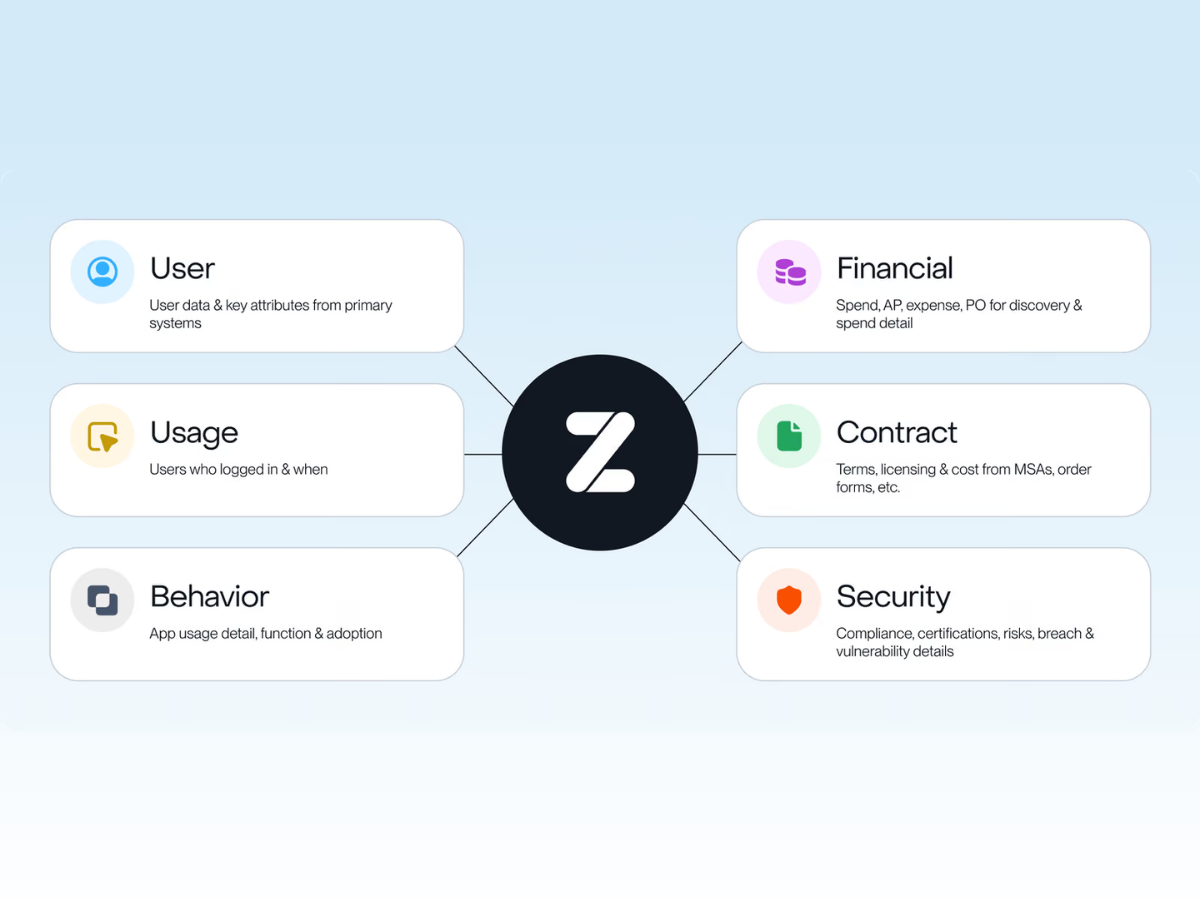
Standing up Zylo runs through four steps: connecting financial systems, ingesting contracts, connecting SSO and usage integrations, and setting up governance for rollout. Each step layers in a new data source—payment records, then contracts, then usage—so your inventory gets more complete and actionable as implementation progresses.
1. Implementation Kickoff and Financial System Connections
Kicking off your Zylo implementation involves connecting your finance systems for the discovery process and developing a plan to achieve value.
Pre-Kickoff
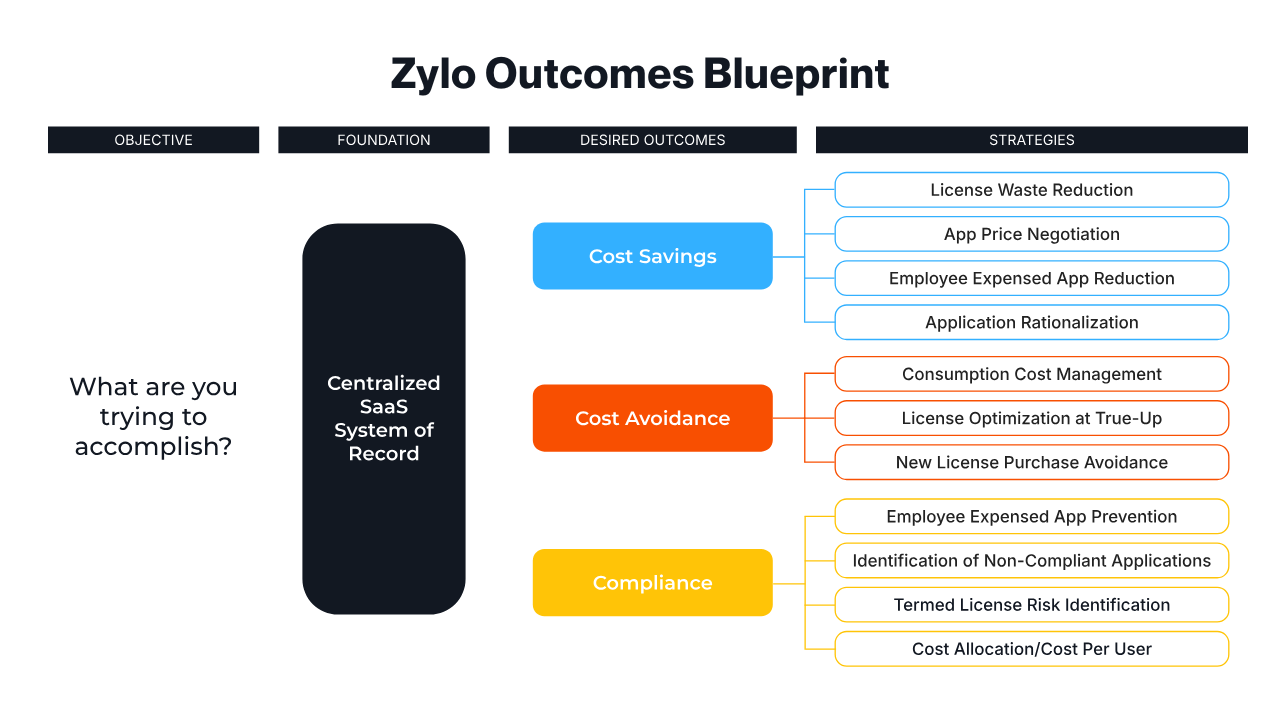
To begin, Zylo hosts a pre-kickoff meeting to scope out your implementation. Our team confirms what you shared with your account executive: your key systems, stakeholders, and primary objectives. Then, the team walks you through the Zylo Outcomes Blueprint for feedback before anything gets built.
The Outcomes Blueprint is Zylo’s framework that turns a decade of SaaS management expertise into a repeatable strategy. It starts with one objective: complete visibility and action across your software and AI portfolio, anchored by a centralized system of record. From there it maps to three business outcomes: cost savings, cost avoidance, and compliance. Each strategy breaks down into specific steps, and each step is backed by detailed playbooks in Zylo's knowledge base.
The tactical rollout starts once all the right people are pulled in. Zylo provides an overview of the implementation milestones and timeline, so nothing comes as a surprise. Financial system connections begin in earnest during this milestone.
SaaS and AI Discovery
Your Zylo account is connected to your financial sources: accounts payable reports and credit card or expense reports. Zylo’s Discovery Engine uses that data to build your first SaaS inventory, with an AI- and machine-learning model based on more than $100B in SaaS and AI spend under management.
The process follows these four steps:
- Ingest and normalize your data to ensure consistency and accuracy in the subsequent analysis. Then, it gets plugged into the Discovery Engine.
- Find all SaaS applications present in your organization by feeding your financial transactions through Zylo’s matching algorithms.
- Verify the data. Our team of SaaS data scientists review your data and certify the accuracy of the identification process.
- Initial discovery completed. Once verified, the data is populated in your Zylo account, which is discussed with your team at the Path to Value milestone.
An Executive-Approved Plan
Once you reach the Path to Value milestone, our teams—including your executive sponsor—meet for the first formal review of your portfolio. Together, we’ll identify your top-priority apps, which are typically those with the greatest savings potential in the next 12 months. Once your executive sponsor confirms the plan, the rest of implementation focuses on getting that prioritized list of applications fully onboarded.
"You have to be very clear on why you're doing this. It’s also really important to define what phase one is for you." — Ksenia Kouchnirenko, VP of Enterprise Operations & Technology, Verkada
There is enough data at this point that Zylo clients get early insights they can act on immediately—before implementation is completed.
For example, a large enterprise client in the banking industry started implementation in November with a goal of identifying $1M in savings before the end of the year. The opportunities making up those savings primarily consisted of license reduction and redundancy elimination targets. They met and exceeded that goal, identifying a total of $3M in identified savings by the end of implementation.
Roles & Responsibilities During Zylo Implementation
A Zylo Implementation Consultant runs the day-to-day project management for setting up Zylo. On your side, an executive sponsor and project lead need to be identified early, and your finance or AP team involved to gain access to payment reports.
Typical client-side effort, across the full implementation:
2. Contract Ingestion
Once you’ve completed the Path to Value milestone, the onboarding process begins—starting with building out your SaaS renewal calendar. Because you’ve narrowed the scope to a prioritized list of applications, getting those entitlement details into Zylo is more manageable.
This process includes:
- Pulling the subscription details (start/end dates, entitlements (licenses, usage, etc.)).
- Typically found in an Order Form
- Upload subscription details via Zylo Contract Assist
- Verify auto-mapped fields
- Customize as appropriate
- Trigger review by Zylo Data Analyst if warranted
Having contracts in Zylo ensures you’re tracking actual renewal dates for each application. Renewals are the only time to reduce contracted software spend. If you don’t know when an application renews, you can’t save money on it.
3. SSO And Usage Integrations
Step three of Zylo implementation is where user, license, and utilization gets brought into the platform using direct integrations and the API. We start with single sign-on (e.g. Okta, EntraID) and the applications on your priority list (e.g., Salesforce, Zoom, Claude). This is typically the fastest integration category to clear, since it's less sensitive than financial or contract data, though approval blockers still happen occasionally.
Connecting Single Sign-On
Zylo connects to your SSO provider to pull in login and assignment data across your whole portfolio, including active status, last login, and group membership. Each SSO application is matched to its Zylo counterpart, prioritizing the applications you want historical data for right away.
Setting Up Usage Integrations
Usage integrations complement SSO data, giving you license-level detail, like which license type a user holds or whether the license is being used at all.
Most integrations connect through simple OAuth and are done in minutes, whereas a few AI and usage-based apps like Snowflake or Databricks need more setup. When a direct integration isn't available for an application, Zylo’s Usage Connect import capability provides a flexible alternative.
Creating Custom User Reports
The last step, after you’ve connected your usage data in Zylo, is to set up reporting. Usage Connect enables you to import custom user reports right in the UI, while the Zylo Enterprise API allows you to build custom application usage tracking.
4. Governance Setup and Rollout
Setting up governance is the last step before you complete implementation. It enables your team to take the reins and keep them accountable.
This is the Kickoff to Value milestone. In this final implementation call:
- The list of priority applications gets refined one more time as apps renew, change ownership, or drop out of scope.
- Your team reviews specific upcoming renewals, commits to who owns what, and confirms completion of training or schedules it immediately after go-live.
- Your executive sponsor gives a final thumbs-up that implementation is complete.
See Gartner Peer Insights or G2 reviews for unfiltered client feedback on their implementation experience.
Do You Need Professional Services to Stand Up Zylo?
No, professional services are not required to stand up Zylo. Implementation support is included in every contract. The only optional add-ons are ongoing managed services after go-live.
What's Included
- Senior Director of Implementations: implementation oversight and escalation support.
- Implementation Consultant: manages the project day to day.
- Strategic Account Executive: owns the relationship and tracks outcomes.
- Client Success Managers: handle training and enablement during implementation, and stay engaged after go-live, helping build the business processes that turn Zylo's data into action.
What's Optional
Zylo does offer managed services as an ongoing partnership, outside of implementation, to help operationalize your program and manage renewals.
- SaaS Operations: a dedicated SaaS manager, embedded as a member of your team, runs the renewal lifecycle and governance program after go-live.
- SaaS Negotiator: a dedicated negotiator on your renewals, providing end-to-end procurement support and benchmark-driven negotiation.
See how Marigold uses Zylo services to save on sprawling SaaS costs.
How Does Standing Up Zylo Compare to Other SaaS Management Platforms?
Unlike other SaaS Management Platforms, standing up Zylo includes:
- Unmatched financial discovery. To optimize AI and SaaS costs, start with spend data. No other provider has the breadth and depth of Zylo’s data.
- Value throughout implementation. Start uncovering spend insights and identifying savings opportunities before implementation is complete.
- Dedicated implementation team. Lean on 10 years of expertise and experience in SaaS Management.
- Smooth handoff to your client services manager and strategic account executive (SAE). Your SAE is with you from day one of implementation.
Why do some platforms claim setup in days?
Some SaaS Management Platforms claim setup in days because they use discovery sources like SSO, browser extensions, and/or a cloud access security broker (CASB). While these methods are more straightforward to connect and easy to approve, they provide shallow and often fragmented data. Therefore, you only get partial visibility into your applications.
In contrast, Zylo setup is longer because approval for financial integrations can take time. Preparing your finance and security teams ahead of implementation can expedite this process.
Throughout implementation, our team also provides strategic guidance to help you build a framework for your SaaS management program, get to ROI more quickly, and build a sustainable practice you can mature over the long-term.
Does company size change the timeline?
The size of your company impacts how long you’re in implementation. Smaller, more centralized organizations can often turn Zylo on and drive value within approximately 30 days. Enterprise programs are inherently more complex due to more systems, stakeholders, and approvals—and can take longer to go-live.
What do you get for the extra time?
The technical setup of Zylo makes up about 60% of the timeline. For the other 40%, you build the strategy and framework for your SaaS management program alongside your implementation consultant and SAE. Many SaaS Management Platforms get the technical part of implementation right but skip guided expertise on how to get to value.
Using Zylo’s Outcomes Blueprint, you’ll map your program objectives to business outcomes. From there, you’ll get a strategic framework for executing the tactics and strategies to hit your goals.
How to Prepare for Your Zylo Implementation (And Avoid Getting Stuck)
To ensure a smooth and fast Zylo implementation, I recommend doing as much preparation as you can ahead of the pre-kickoff call. Our most successful clients do the following:
- Involve the right stakeholders. Many of our clients include a mix of representatives from IT, procurement, software asset management, and FinOps.
- Assign roles. Ensure everyone on your team is clear on what they’re responsible for during implementation and after. Assigning an owner or project lead is critical to keep implementation moving.
- Get approval for integrations. Secure buy-in from finance, security, legal, and procurement to prevent delays in getting payment, contract, and usage data connected to Zylo.
- Establish specific goals aligned to your overall business objectives. For example, a client may have a mandate to save $3 million this fiscal year.
- Ensure executive backing. SaaS and AI spend management is often a CIO and CEO directive, in partnership with the CFO. Executive support is key to long-term program success.
The Home Depot: Overcoming Gaps to Drive Progress
At The Home Depot, extended timelines traced back to unclear ownership and a missing organizational mandate to participate. Stakeholders assumed they could opt out of connecting their data. Defining roles and reinforcing executive backing for the mandate unlocked the progress needed to increase the velocity and value.
"We chose Zylo because the tool is great, but the team is wonderful." — Ridge Fussell, Senior Manager, FinOps at The Home Depot
Get to Value Quickly with Zylo Implementation
The fear that implementation could take six months and consume your team's bandwidth is a reasonable thing to worry about. Many software implementations happen that way.
With Zylo, you can complete implementation in a matter of weeks. By the time you go live, you’ll have full visibility across your portfolio, a strategic plan, stakeholders ready to take action—and maybe some wins to celebrate.
If you have more questions about Zylo’s implementation process or want to jump into a demo, reach out to our team.
Frequently Asked Questions About Zylo Implementation
Most implementations run five to fourteen weeks from kickoff to go-live, with a full SaaS inventory typically ready in 30-45 days—well before implementation is finished. Getting stakeholder buy-in, integration approvals, and clarity on your goals before implementation helps accelerate setup.
Setting up Zylo and the platform connections are straightforward. Your timeline mostly comes down to the state of your data and how quickly finance, security, and legal approve access to it.
Zylo connects to:
- Accounts payable and expense platforms like Coupa
- Identity providers like Okta for SSO
- Applications such as Salesforce, ServiceNow, and Snowflake
See the integration catalog for the complete list.
Not well. Stalled implementations almost always trace back to unclear ownership or missing approvals. A named project lead or future Zylo subject matter expert is the best predictor of a fast stand-up.