AI Cost Management Is a Software Management Problem First

Ask a CFO about AI cost management, and you'll likely get a different answer than if you ask a CIO, FinOps leader, or Procurement executive.
That’s because AI cost management now means different things depending on who you talk to. In 2026, the biggest challenge is now the exponentially-growing cost of AI embedded within existing software.
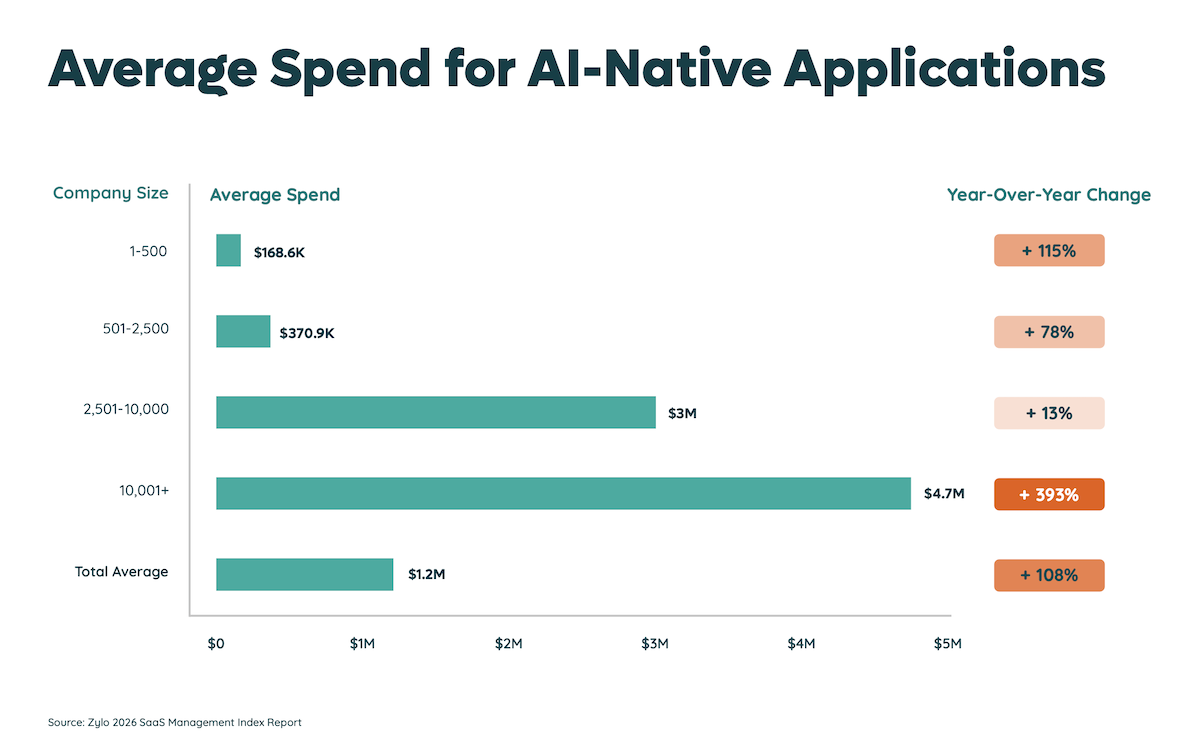
According to Zylo's 2026 SaaS Management Index, spending on AI-native applications for large enterprises increased nearly 400% year over year, with organizations spending an average of $4.7M annually. At the same time, 78% of IT leaders reported unexpected charges tied to AI or consumption-based pricing, while 61% were forced to delay or cut projects because of unplanned software cost increases.
AI is not creating an entirely new software problem. It is exposing the visibility, ownership, and governance gaps that many organizations have struggled with for years. As AI spending expands across the business, those gaps become more costly and more difficult to manage.
This guide explains how to identify AI costs, build governance, and establish the processes needed to manage AI spending as adoption accelerates.
AI Cost Management Means Three Different Things. Here's How to Tell Which Costs You're Managing
Depending on your role, “AI cost management” can mean managing AI infrastructure costs, AI API and consumption costs, and AI software costs embedded within enterprise SaaS applications.
Most articles discussing AI cost management focus on cloud infrastructure or large language model (LLM) consumption. Those costs matter, but they represent only part of the enterprise AI spend picture.
For IT, Procurement, FinOps, and SAM leaders, a growing share of AI spending comes from software vendors adding AI capabilities, usage-based pricing, and AI-powered premium tiers to products already in the portfolio.
Understanding which category you're managing is the first step toward selecting the right governance model, processes, and AI cost management tools.
1. AI Infrastructure Costs
AI infrastructure costs are the expenses associated with building, training, hosting, and operating artificial intelligence models and workloads.
These costs include cloud compute, GPUs, storage, networking, and model training workloads provided by platforms such as AWS, Microsoft Azure, and Google Cloud environments. Typically, management sits within engineering, data science, platform, and MLOps organizations.
2. AI Consumption Costs
AI consumption costs are the usage-based expenses generated when applications, products, or internal tools consume artificial intelligence services through APIs or foundation models.
Product, software engineering, and AI development teams typically manage AI consumption costs for providers like Anthropic Claude, Cohere, and Mistral. Costs are frequently driven by token usage, API requests, prompt volume, model selection, agent execution, and inference frequency.
3. AI Software Costs
AI software costs are the expenses associated with AI capabilities embedded within enterprise software applications like Microsoft (Copilot), Salesforce (Agentforce), and Adobe (Firefly).
Costs are commonly driven by factors such as copilot licenses, AI add-ons, and AI-related renewal increases and are managed cross-functionally by IT, Procurement, SAM, and FinOps teams.
Which Type of AI Cost Management Are You Solving?
What Is AI Cost Management?
AI cost management is the practice of monitoring, governing, forecasting, and optimizing the costs associated with artificial intelligence technologies, AI-powered software, and AI consumption models. It helps organizations improve cost predictability, eliminate waste, strengthen governance, and maximize the business value of AI investments.
As organizations adopt more AI capabilities, spending becomes distributed across cloud environments, software contracts, business units, expense reports, and consumption-based billing models.
Without centralized visibility, leaders struggle to understand what they are spending, who owns the spend, and whether those investments are delivering measurable value.
For many organizations, these challenges are familiar. The difference is that AI adoption, consumption-based pricing, and decentralized purchasing can magnify those challenges much faster.
Who Owns AI Cost Management?
Because no single team has the full picture of AI spending, AI cost management requires collaboration across IT, Procurement, FinOps, and Software Asset Management.
IT Leaders
IT leaders oversee enterprise AI governance, technology strategy, security, and software portfolios, making them responsible for establishing visibility into AI usage and spend across the organization.
With AI cost management, IT leaders focus on:
- AI cost visibility
- Governance and compliance
- Portfolio rationalization
- Risk reduction
- Cross-functional accountability
Their goal is to ensure AI adoption aligns with business objectives while maintaining control over cost, security, and operational complexity.
Procurement Leaders
Procurement leaders manage software vendors, contract negotiations, and renewal strategies, making them critical stakeholders in controlling AI-related software costs.
Procurement leaders focus on:
- AI contract negotiations
- Vendor management
- Commercial protections
- Renewal planning
- AI pricing evaluation
Their goal is to ensure organizations pay for the AI capabilities they need while maintaining leverage during vendor negotiations.
FinOps Professionals
FinOps professionals manage technology spending and financial accountability, making them responsible for connecting AI usage to budgets, forecasts, and business outcomes.
FinOps teams focus on:
- AI spend management
- Cost allocation
- Forecasting
- Budget accountability
- Consumption monitoring
Their goal is to improve financial predictability while ensuring AI investments generate measurable business value.
Software Asset Management Professionals
Software Asset Management professionals govern software licenses, entitlements, and compliance, making them increasingly responsible for managing AI-enabled software portfolios.
SAM teams focus on:
- License optimization
- Usage alignment
- Audit readiness
- Software governance
- Compliance management
Their goal is to ensure organizations are purchasing, deploying, and renewing AI-enabled software efficiently and responsibly.
Why AI Cost Management Matters Now
AI cost management matters because software pricing models are changing faster than traditional governance practices can keep up.
Historically, software costs were relatively predictable. Organizations purchased a set number of licenses, negotiated annual contracts, and forecasted spending based on employee growth and renewal schedules.
AI has introduced new variables into that equation.
Software vendors are increasingly monetizing AI through consumption-based pricing, AI add-ons, premium license tiers, and hybrid pricing models. According to High Alpha's 2025 SaaS Benchmarks Report, 42% of software companies now monetize AI capabilities through usage-based or hybrid pricing models, reducing reliance on traditional subscription-only pricing.

At the same time, vendors are incorporating AI functionality into existing products and using those enhancements to justify significant price increases. According to recent Gartner research, some vendors have already achieved renewal increases of 20% to 40%, while AI-enabled repackaging initiatives have produced uplifts ranging from 30% to 60%.
These changes create new challenges for enterprise leaders:
- Forecasting becomes less accurate.
- Budget ownership becomes less clear.
- Software costs become more volatile.
- AI spending becomes harder to attribute.
- Renewal negotiations become more complex.
- Governance gaps create opportunities for shadow AI.
With AI cost management, organizations can mitigate these challenges and gain greater control of AI costs as adoption accelerates.
Why AI Costs Are Different From Traditional Software Costs
AI costs are different from traditional software costs because pricing is increasingly tied to usage, consumption, and AI-driven outcomes rather than fixed subscriptions. As a result, organizations face greater cost volatility, less predictable budgeting, and new governance challenges that traditional software management practices were not designed to address.
Usage-Based Pricing Creates Cost Volatility
Usage-based pricing is a software pricing model used by AI providers—like OpenAI, Anthropic, and Snowflake Cortex—that charges based on the consumption of units/services used, such as tokens processed, API requests, and agent execution.
For IT, FinOps, Procurement, and Software Asset Management, usage-based pricing introduces greater cost volatility because spending fluctuates with adoption, activity, and AI usage patterns.
The unit of consumption differs across vendors. For example:
- OpenAI charging based on token consumption
- Anthropic Claude charging based on input and output tokens
- AWS Bedrock charging based on model usage
- Snowflake Cortex charging based on consumed credits
Under traditional subscription pricing, costs generally remained fixed during the contract term. With consumption-based pricing, spending can fluctuate significantly based on employee behavior, application adoption, or business demand.
Hybrid Pricing Models Increase Complexity
Hybrid pricing increases complexity, as software costs are influenced by both contractual commitments and actual AI usage.
AI-enabled software—like Microsoft Copilot, Salesforce Agentforce, and Adobe Firefly—combine fixed per-user licenses with AI consumption charges. Spend is influenced by number of seats plus premium AI add-ons, usage credits, token consumption, agent execution fees, and overage charges.
As a result, forecasting may feel like a moving target. Accurately managing AI costs requires that you understand both dimensions of hybrid pricing.
Token Consumption Is Difficult to Predict
Token consumption creates a variable cost model. Every prompt, response, workflow, agent interaction, and AI-generated output consumers tokens, contributing to overall spend. The challenge is that token usage rarely scales linearly.
A small pilot may generate minimal spend, while enterprise-wide adoption can dramatically increase costs within weeks. New use cases, AI-powered agents, workflow automation, and employee experimentation can accelerate consumption even further.
Without visibility into token usage patterns, organizations often discover outrageous cost increases after invoices arrive. Instead, managing AI costs requires looking beyond excessive token usage and understanding what is actually driving those costs.
Rapid Employee Adoption (Shadow AI) Creates Hidden Costs
Shadow AI, like shadow IT, occurs when AI is acquired outside the approved purchasing process. Combined with rapid employee adoption, it creates a visibility gap for IT leaders, making spend, software risk, vendor management, and compliance more difficult to control.
If this phenomenon sounds familiar, that’s because it has happened before. Decentralized software purchasing started with SaaS and is now experiencing a resurgence with artificial intelligence tools. Many AI applications are easy to trial, inexpensive to purchase initially, and immediately valuable to employees.
According to Zylo's 2026 SaaS Management Index, ChatGPT was the most expensed application, while AI-native applications represented 16% of the top 50 most expensed applications.
When multiple departments purchase similar AI tools independently, organizations lose the ability to standardize vendors, negotiate enterprise agreements, and accurately forecast spend. Together, these challenges lead to inefficient purchasing, overspending, and uncontrolled costs.
Vendor Pricing Power Is Increasing
Software vendors are introducing AI-enabled editions, premium AI tiers, and new consumption-based pricing models that increase software costs over time.
Many organizations assume AI-related costs primarily come from new purchases. In reality, some of the largest cost increases occur within existing contracts.
When procurement teams lack visibility into AI costs, they frequently enter renewal negotiations without understanding how much value they are receiving from AI functionality already included in the contract. That weakens negotiation leverage and increases the likelihood of overpaying.
The challenge isn't understanding AI technology but how AI changes the economics of software.
The Three Categories of AI Costs Hidden in Your Enterprise
Most organizations underestimate AI spending because AI costs are distributed across software subscriptions, AI add-ons, and consumption-based pricing models. Understanding these sources of hidden costs helps you improve forecasting, govern adoption, and recognize the true financial impact of AI across the software portfolio.
AI Subscriptions: The Visible Costs You Already Track
AI subscriptions are standalone AI products—like Perplexity Enterprise or GitHub Copilot—purchased specifically for artificial intelligence use cases. Costs are generally easier to identify because they appear as dedicated subscriptions, contracts, or invoices with clear ownership and budget allocation. But when different departments adopt different AI tools that serve similar purposes, it introduces redundant functionality and inflates your budget.
When subscriptions aren’t well governed, it results in AI tool sprawl, which decreases your purchasing leverage, creates inconsistent user experiences, and increases support requirements. You either leave money on the table or face increased operational costs.
AI Add-ons Bundled Into Existing SaaS: The Hidden Costs in Contracts You Already Signed
One of the fastest-growing and least visible categories of AI spend are bundled add-ons. Leading software providers like Microsoft and Salesforce attach AI capabilities—like Copilot and Agentforce, respectively—to existing contracts you already own. Rarely do they appear as net-new purchases but are rather embedded as add-ons, premium tiers, and consumption allowances.
Because these costs are intertwined with broader software agreements, IT and Procurement leaders often struggle to separate AI spending from overall application costs. Over time, the business will experience a gradual increase in software costs without a corresponding increase in value.
Without visibility into AI usage, your organization risks paying for AI capabilities that employees rarely use.
AI Consumption Costs: The Variable Costs You Didn't Budget For
AI consumption costs are often the most unpredictable because spending changes as usage grows. As organizations expand AI initiatives, even modest increases in usage can create significant changes in monthly—and even weekly—spend. A project that appears inexpensive during testing can generate materially different costs once deployed across the organization.
With variable costs comes reduced financial predictability, which leads to:
- Inaccurate spend forecasting
- Delaying initiatives when budgets are exceeded
- Inability to confidently model future costs during negotiations
Organizations that lack consumption visibility will find themselves reacting to costs instead of proactively managing them. As more software vendors adopt usage-based and hybrid pricing models, consumption cost management is becoming a critical capability for controlling AI-related software spend.
Where AI Costs Hide in Your Organization
How to Build an AI Cost Management Program (An 8-Step Framework)
Effective AI cost management centers on repeatable processes for discovering AI spend, governing adoption, and measuring outcomes before costs become difficult to manage.
Use the following framework to establish AI cost visibility, reduce waste, strengthen governance, and improve forecasting across your software portfolio.
1. Build a Complete Inventory of AI Tools
The first step to AI cost management is to build a complete inventory of your software portfolio, not just your AI tools. You cannot manage AI costs if you don't have visibility into the applications, contracts, vendors, users, and purchasing channels where AI capabilities exist.
Begin by identifying software purchased through procurement, accounts payable, expense reports, corporate cards, and departmental budgets. Then identify which applications contain AI functionality, AI add-ons, AI assistants, or consumption-based AI services.
Include the following categories in your inventory:
- AI subscriptions
- AI-enabled SaaS applications
- AI add-ons
- AI consumption services
- Department-owned applications
- Employee-purchased AI tools
By having a complete software inventory, you create the foundation for AI cost visibility, AI cost governance, and AI spend management. Over time, that inventory should evolve into a system of record for software and AI investments, giving stakeholders a consistent view of applications, ownership, spending, usage, renewals, and AI-related costs.
2. Separate AI Spend from General Software Spend
Separate AI costs from broader software costs, as AI is often embedded within larger software agreements. When you have a dedicated view of AI spending across your software portfolio, it’s easier to forecast spending, identify trends, and evaluate business value.
Track AI spending separately across the following categories:
- AI subscriptions (e.g. ChatGPT)
- AI add-ons (e.g. Atlassian Intelligence)
- AI consumption costs
- AI-related renewal increases
- AI usage credits
3. Assign Ownership for Every AI Expense
Assign a business owner to every AI investment—like you would a software application—to create accountability for spend, adoption, governance, and business outcomes. Ownership may reside with IT, Procurement, FinOps, SAM, or line of business leaders.
The goal is to avoid a situation where AI costs appear on invoices but nobody is responsible for measuring usage, monitoring spending, or evaluating value. By clearly defining ownership, AI investments receive the same level of oversight as other strategic technology investments.
4. Monitor Adoption Before Expanding AI Investments
Measure adoption of your AI investments before purchasing additional licenses, add-ons, or consumption capacity. Adoption data should guide your expansion decisions, validating whether employees are actively using the capabilities already available to them.
As you review adoption data, answer the following questions:
- Who is actively using the AI capability?
- Which teams receive the most value?
- Which features are being used most frequently?
- Which licenses remain underutilized?
- Which investments should be expanded or reduced?
By using adoption data to guide investment decisions, you can prevent overspending and improve long-term AI cost optimization.
5. Eliminate Duplicate AI Solutions
Identify AI tools that are redundant or solve the same business problem and eliminate the solutions you don’t need. Review AI applications across departments and evaluate where overlap exists by comparing:
- Functional capabilities
- Adoption levels
- Business value
- Security requirements
- Total cost
- Vendor relationships
Marketing may use ChatGPT, Product may standardize on Claude, and research teams may adopt Perplexity. Consolidating overlapping tools can reduce spend, simplify governance, and improve vendor leverage, while creating a more consistent employee experience.
6. Establish AI Procurement Standards
To reduce risk and improve consistency across the organization, create a standardized process for evaluating, approving, and purchasing AI technologies. Evaluate every AI vendor against the same set of criteria before approval, such as:
- Security requirements
- Data privacy requirements
- Compliance considerations
- Vendor risk
- Pricing models
- Consumption controls
- Contract flexibility
Standardized procurement practices help prevent shadow AI costs while ensuring new investments align with business and governance requirements.
7. Create an AI Usage Policy
Create an AI usage policy to help employees use AI responsibly while reducing governance, compliance, and security risks. Before usage scales, document expectations for how AI applications, AI-generated content, and AI-powered workflows should be used across the organization.
Establish guidance for:
- Approved AI applications
- Sensitive data handling
- Acceptable use requirements
- AI-generated content standards
- Security expectations
- Vendor approval processes
8. Measure Business Value, Not Just Usage
While usage data helps identify adoption trends, business value should drive investment decisions. Measure the business outcomes generated by AI investments. Just because usage is high does not automatically mean you’re receiving equivalent value.
Evaluate outcomes such as:
- Cost per user
- Cost per workflow
- Time savings
- Productivity improvements
- Cost avoidance
- Revenue impact
Connecting AI spending to measurable business outcomes helps justify investments, improve prioritization decisions, and strengthen AI strategic cost management.
Build your AI cost management program around visibility, ownership, governance, and business value. Establishing these capabilities early well-positions you to control costs while supporting responsible AI adoption.
AI Cost Management Tools: How to Evaluate Your Options
The best AI cost management tool depends on the type of AI costs you're trying to manage. Organizations typically need visibility into AI infrastructure costs, AI consumption costs, and AI software costs, but each category requires different capabilities, stakeholders, and data sources.
Many organizations begin their search for AI cost management tools assuming a single platform can manage every aspect of AI spending. In reality, most tools are designed to address a specific category of AI costs.
Understanding those categories can help you identify the right solution for your needs and avoid investing in tools that only solve part of the problem.
Cloud and AI Infrastructure FinOps Tools
Cloud and AI infrastructure FinOps tools—like CloudZero, Ternary, and Mavvrik—help engineering, platform, and FinOps teams manage the costs associated with GPUs, cloud compute, storage, model training, and AI workloads running on infrastructure platforms.
These tools focus on infrastructure optimization and cloud cost governance with common capabilities including:
- GPU utilization monitoring
- Cloud cost allocation
- Resource optimization
- AI workload forecasting
- Infrastructure rightsizing
- Cost anomaly detection
If your organization builds AI products, trains models, or operates large-scale AI workloads, infrastructure-focused FinOps tools can help improve cost visibility and utilization.
AI API Observability and Cost Control Tools
AI API observability tools—like Helicone, LangSmith, and Portkey—help engineering teams monitor token consumption, API usage, model performance, and costs associated with OpenAI, Anthropic Claude, Google Vertex AI, and other foundation model providers.
These tools are designed to help organizations manage variable AI consumption costs, with common capabilities including:
- Token cost management
- API monitoring
- Usage analytics
- Cost allocation
- Model performance tracking
- Consumption forecasting
These tools are particularly valuable for organizations building AI-powered applications where token consumption and API usage directly influence operating costs.
SaaS Management Platforms with AI Cost Visibility
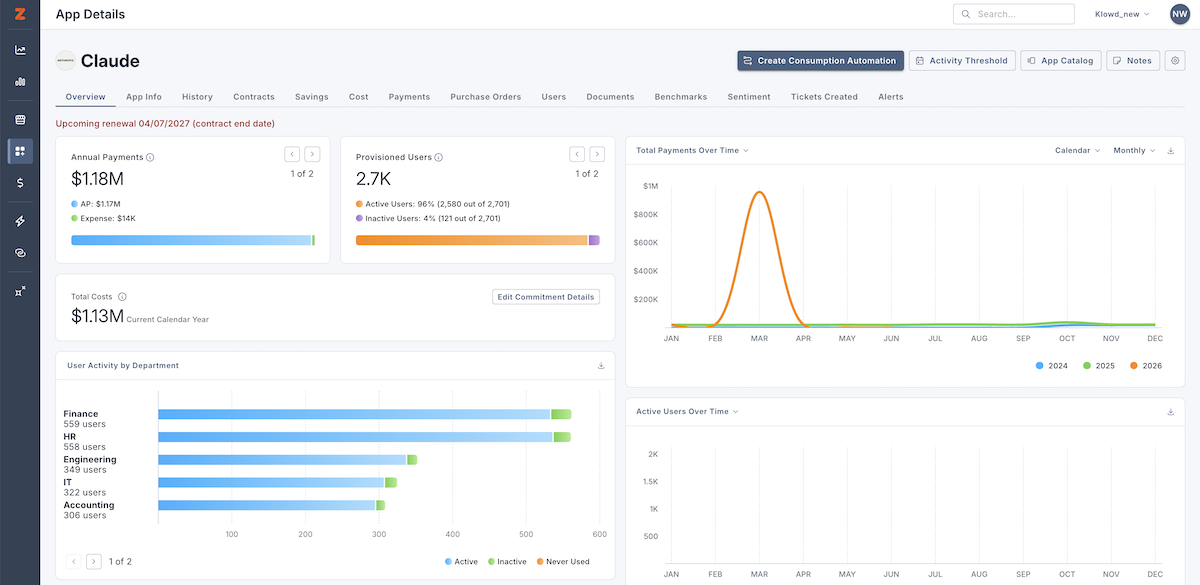
SaaS Management Platforms (SMPs) help IT, Procurement, SAM, and FinOps teams manage AI costs embedded within the software portfolio by providing visibility into AI subscriptions, AI add-ons, AI consumption costs, renewals, and shadow AI spending across the enterprise.
Unlike infrastructure and AI observability tools, SaaS Management Platforms like Zylo create a system of record for software and AI investments, helping organizations connect spending, usage, ownership, contracts, renewals, and AI-related costs in one place.
Common capabilities include:
- AI application discovery
- AI spend visibility
- AI license management
- Renewal management
- Consumption cost monitoring
- Shadow AI identification
- Vendor management
SMPs are most valuable for organizations trying to understand how AI is impacting existing software investments and consumption-based SaaS.
What to Evaluate When Choosing an AI Cost Management Tool
Evaluate AI cost management tools based on the type of AI costs you need to manage, the data sources you need to connect, and the business decisions you need to support.
Before selecting a solution, ask yourself these four questions:
- Does the tool provide visibility into the AI costs you actually need to manage?
- Can the tool connect spend, usage, and ownership?
- Does the tool support governance and optimization?
- Can the platform scale as AI adoption grows?
1) Does the tool provide visibility into the AI costs you actually need to manage?
A platform designed for cloud infrastructure costs may not help you manage Microsoft Copilot spending. Likewise, a SaaS Management Platform may not provide the detailed GPU telemetry required by engineering teams.
Start by identifying whether your primary challenge involves:
- AI infrastructure costs
- AI consumption costs
- AI software costs
- All three categories
2) Can the tool connect spend, usage, and ownership?
Cost visibility alone is not enough. Connecting spend, usage, and ownership is critical for AI cost governance and AI strategic cost management.
Look for solutions that help you understand:
- Who owns the investment
- Who is using the technology
- What the organization is spending
- Whether the investment is delivering value
3) Does the tool support governance and optimization?
The most effective solutions should serve as a system of action—not just a depository of reports and insights. Evaluate whether the platform helps you:
- Identify underutilized investments
- Monitor adoption
- Reduce duplicate tools
- Govern shadow AI
- Prepare for renewals
- Optimize spending
4) Can the platform scale as AI adoption grows?
AI pricing models continue to evolve. Choose a solution that can adapt to:
- AI subscriptions
- AI add-ons
- Consumption-based pricing
- Hybrid pricing models
- New AI vendors
- Emerging AI use cases
The right AI cost management tool depends on whether you need to manage AI infrastructure costs, AI consumption costs, AI software costs, or a combination of all three.
Common AI Cost Management Mistakes
Most AI cost management failures are not caused by AI itself but rather applying incomplete software management practices to a new category of spend. Organizations that lack visibility into applications, ownership, usage, renewals, and purchasing behavior often discover that AI amplifies existing software management challenges rather than creating entirely new ones.
Avoid the following AI cost management mistakes:
- Treating AI like traditional SaaS
- Managing AI without understanding your software portfolio
- Ignoring shadow AI
- Measuring adoption instead of business value
- Allowing AI tool sprawl
- Failing to assign ownership
- Waiting too long to establish governance
- Treating consumption pricing like seat pricing
- Negotiating AI add-ons as separate purchases
Mistake #1: Treating AI Like Traditional SaaS
- Mistake: Applying license-based software management practices to AI spending.
- What to Do Instead: Forecast AI spending separately from traditional software spend. Monitor consumption trends, adoption patterns, and cost drivers continuously rather than relying solely on annual budgeting assumptions.
Mistake #2: Managing AI Without Understanding Your Software Portfolio
- Mistake: Focusing only on standalone AI tools while ignoring AI functionality embedded within existing software investments.
- What to Do Instead: Start with a complete software inventory. Identify AI capabilities, AI add-ons, and AI-related costs across the entire software portfolio before evaluating new AI investments.
Mistake #3: Ignoring Shadow AI
- Mistake: Allowing AI purchases to occur outside established procurement, governance, and software management processes.
- What to Do Instead: Monitor expense systems, corporate card transactions, and software discovery sources to identify unapproved AI tools before they become widespread.
Mistake #4: Measuring Adoption Instead of Business Value
- Mistake: Evaluating AI success based primarily on usage metrics.
- What to Do Instead: Measure productivity improvements, time savings, process efficiency, cost avoidance, and business impact alongside adoption metrics.
Mistake #5: Allowing AI Tool Sprawl
- Mistake: Allowing multiple teams to purchase overlapping AI solutions independently.
- What to Do Instead: Review AI applications regularly, identify overlapping functionality, and consolidate vendors wherever practical.
Mistake #6: Failing to Assign Ownership
- Mistake: Purchasing AI capabilities without assigning clear business, technical, and financial ownership.
- What to Do Instead: Assign an owner responsible for budget accountability, adoption, governance, and business outcomes for every AI investment.
Mistake #7: Waiting Too Long to Establish Governance
- Mistake: Delaying governance until AI adoption becomes widespread.
- What to Do Instead: Establish ownership, procurement standards, usage policies, and visibility requirements early in the adoption cycle.
Mistake #8: Treating Consumption Pricing Like Seat Pricing
- Mistake: Applying your forecasting approach for seat-based software to AI consumption costs.
- What to Do Instead: Monitor consumption continuously and incorporate usage trends into forecasting, budgeting, and renewal planning.
Mistake #9: Negotiating AI Add-Ons as Separate Purchases
- Mistake: Evaluating AI capabilities independently from the broader vendor relationship.
- What to Do Instead: Evaluate AI investments within the context of total vendor spend, contract timing, adoption levels, and renewal strategy.
The Future of AI Cost Management
AI cost management is evolving from a tactical cost-control exercise into a core business discipline. The more AI becomes embedded in enterprise software, the more organizations will need to shift their approach to governance, forecasting, vendor management, and financial accountability.
AI Will Be Embedded Across Nearly Every Enterprise Application
Within the next 24 months, AI capabilities are expected to become standard features across most enterprise software. As a result, AI costs will become increasingly difficult to separate from broader software spending.
Today, organizations can often identify AI as a distinct budget category—but that distinction is already fading.
As vendors embed AI into productivity, collaboration, CRM, development, and business applications, organizations will need visibility into how AI affects the total cost and value of their software portfolio.
Mandatory AI Bundling Will Change Vendor Negotiations
Software vendors are increasingly incorporating AI into core product packaging, reducing customers' ability to opt out of AI functionality.
Historically, organizations could decide whether to purchase AI capabilities. Increasingly, that decision will be made for them.
As AI becomes part of standard licensing models, Procurement and Software Asset Management teams will need to focus less on purchasing decisions and more on measuring adoption, business value, and commercial impact during renewals.
Agentic AI Will Create a New Category of Costs
Agentic AI introduces pricing based on actions, workflows, outcomes, and conversations rather than users alone. For many organizations, this may become the next major category of AI spending.
Traditional SaaS pricing was built around seats. AI introduced consumption-based pricing. Agentic AI introduces a third model where costs may be tied to outcomes such ass:
- Tasks completed
- Agents deployed
- Workflows executed
- Conversations processed
As autonomous systems perform more work on behalf of employees, organizations will need to evolve software management practices accordingly.
SaaS Management Will Evolve Into SaaS and AI Portfolio Management
Organizations will increasingly manage SaaS and AI as a single portfolio rather than separate categories of technology spend.
Traditional software management practices—managing apps, licenses, contracts, and renewals—remain foundational. Meanwhile a modern approach means managing AI capabilities, AI-related costs, consumption models, and business value will become non-negotiable.
Over the next few years, the distinction between software management and AI cost management will continue to narrow.
AI Cost Management Will Become a FinOps Discipline
In 2026, AI cost management is emerging as a dedicated area of focus within FinOps as organizations seek better ways to forecast, allocate, and govern AI spending.
The FinOps Foundation has already begun exploring AI-related working groups and frameworks, reflecting growing demand for financial accountability across AI investments.
As AI adoption matures, organizations will develop more formal practices for:
- AI cost allocation
- Consumption governance
- Forecasting
- Business value measurement
- Financial accountability
Shared AI Governance Models Will Become Standard
No individual function within the business has complete visibility into AI spending, usage, contracts, adoption, and strategic outcomes. As a result, IT, Procurement, FinOps, and Software Asset Management teams will increasingly operate through shared governance models that connect visibility, accountability, forecasting, and optimization.
Looking Ahead
Organizations that gain the most value from AI will not necessarily be the ones that spend the most. Rather, they will be the ones that develop the discipline to understand, govern, and optimize AI costs as pricing models continue to evolve.
The next chapter of AI cost management will be shaped by embedded AI, mandatory AI packaging, agentic pricing models, and greater financial accountability. By establishing strong governance foundations today, you will be better prepared for the changes ahead.
Where to Start: Your First 90 Days of AI Cost Management
You do not need a perfect AI cost management program on day one. Use the first 90 days to build a foundation that supports long-term visibility, governance, and cost control. Establish visibility into AI spending, create accountability for AI investments, and build the monitoring processes needed to manage consumption-based costs over time.
Days 1-30: Establish Visibility and Monitoring
In the first 30 days, identify where AI costs exist across your software portfolio and establish ongoing monitoring from the beginning. Because consumption-based AI spending can spike at any time, visibility without monitoring is not enough to control costs.
Establish visibility and monitoring by:
- Building a complete software inventory
- Identifying AI subscriptions and AI-enabled applications
- Surfacing AI add-ons embedded within existing contracts
- Discovering shadow AI purchases
- Establishing a baseline for AI spending
- Identifying key consumption-based cost drivers
At the same time, establish a process for reviewing AI spending and usage regularly. The earlier you establish monitoring, the easier it becomes to identify spending changes before they impact your budget.
Days 31-60: Create Ownership and Governance
Days 31-60 of AI cost management requires assigning accountability for AI investments and establishing governance processes before AI adoption scales further. Governance should support AI adoption, not slow it down.
To create ownership and governance, follow this checklist:
- Assign business, technical, and budget owners
- Separate AI spend from broader software spend
- Establish AI procurement standards
- Create AI usage policies
- Define reporting requirements
- Build review processes for consumption trends
This phase creates the structure needed to support informed decision-making as AI spending grows. By establishing ownership early, you’ll evaluate investments, manage renewals, and respond to changing consumption patterns more effectively.
Days 61-90: Optimize, Forecast, and Operationalize
By day 90, AI cost management should become an ongoing operational process, focused on optimization, forecasting, and continuous improvement.
At this time, review:
- Adoption trends
- Consumption patterns
- AI spending by vendor
- Duplicate AI solutions
- Business value metrics
- Upcoming renewals
Use those insights to refine forecasts, identify optimization opportunities, and improve governance processes. The goal is not to reduce AI spending at all costs, but rather ensure AI investments generate measurable business value while maintaining financial accountability.
Build AI Cost Management on a Strong Software Management Foundation
AI cost management is an extension of software management. As AI becomes embedded across enterprise applications, organizations need a system of record that connects software and AI investments in a single view. Without visibility into applications, ownership, spending, usage, contracts, and renewals, controlling AI costs becomes increasingly difficult as they scale.
Leading organizations recognize that AI cost management starts with software management. They have the right data to connect usage and consumption to software investments, which allows them to control AI costs and increase the value of technology for the business.
Move beyond software visibility and build the capabilities you need to monitor and manage consumption-driven costs as AI adoption scales. Learn how Zylo’s AI & Consumption Cost Management solution helps you track AI spending, monitor usage, and stay in control. Request a demo to see how Zylo can help you manage AI costs with confidence.
Frequently Asked Questions About AI Cost Management
AI cost management is the practice of tracking, governing, forecasting, and optimizing spending associated with AI technologies. It helps organizations manage AI subscriptions, AI capabilities embedded within software, and consumption-based AI costs while improving visibility, accountability, and business value across the software portfolio.
AI cost management focuses on AI-related spending across software subscriptions, AI add-ons, and consumption-based AI services. Cloud cost management focuses on infrastructure expenses such as compute, storage, networking, and cloud resources. Organizations building AI applications often need both disciplines to manage total AI-related spending effectively.
FinOps is a financial operating model focused on cloud spending, cost allocation, forecasting, and accountability. AI cost management applies similar principles to AI investments, including AI subscriptions, AI consumption costs, software licensing, and AI governance. As AI adoption grows, AI cost management is becoming an increasingly important extension of FinOps practices.
AI cost management software—like Zylo—helps organizations discover AI applications, monitor AI spending, track adoption, identify shadow AI, govern usage, and optimize costs. The best solutions connect spending, usage, ownership, and business value to help IT, Procurement, SAM, and FinOps teams make more informed investment decisions.
AI spending varies by organization size and adoption maturity, but costs are increasing rapidly. According to Zylo's 2026 SaaS Management Index, spending on AI-native applications for large enterprises increased nearly 400% in 2025, reaching an average of $4.7M per organization. Costs often include subscriptions, AI add-ons, and consumption-based pricing models.
AI cost management is typically shared across IT, Procurement, FinOps, and Software Asset Management teams. IT provides visibility and governance, Procurement manages vendor relationships, FinOps supports forecasting and accountability, and Software Asset Management teams help optimize usage and spending.
Track shadow AI by monitoring expense reports, corporate card transactions, software discovery data, SaaS usage records, and procurement activity. Combining these data sources helps identify AI applications purchased or adopted outside approved processes, improving visibility into hidden costs and governance risks.
The best AI cost management tool depends on the type of AI costs you need to manage. Infrastructure-focused tools help manage cloud and model costs, while API observability platforms monitor AI consumption. For organizations managing AI spending across their software portfolio, SaaS Management Platforms like Zylo provide visibility into AI subscriptions, AI add-ons, consumption costs, and shadow AI.