FinOps Cost Optimization: How to Save on Cloud and SaaS Costs


TL;DR: FinOps Cloud Cost Optimization Expands in Scope
- FinOps cost optimization now includes both cloud infrastructure and SaaS spend.
- Visibility, ownership, and governance are the foundation of effective FinOps, because you can't optimize what you can't see or assign to an owner.
- The biggest savings come from usage and contract optimization, including rightsizing cloud resources and aligning SaaS contracts with actual license usage.
- Modern FinOps is about maximizing business value from technology, not just cutting costs.
In 2025, enterprises spent an average of $246M annually on SaaS, according to Zylo’s 2026 SaaS Management Index. In contrast, IDC forecasts public cloud services to exceed $1T by the end of 2026. The scale of technology spend continues to grow—with no end in sight—increasing the need for FinOps cost optimization.
To save on cloud and SaaS costs in 2026, FinOps teams must work cross-functionally with engineering, finance, and operations teams. Cloud and SaaS spending must align with business value. And visibility, ownership, and governance must be established so that technology spending decisions are strategic.
What Is FinOps?
FinOps, short for cloud financial operations, is an operational framework and cultural practice that helps organizations get maximum business value from their technology investments. The FinOps Foundation defines it as a discipline that creates financial accountability through collaboration between engineering, finance, and business teams.
The practice operates through three phases:
- Inform: Build visibility into what you're spending and where. For cloud, this means parsing billing data from providers like AWS, Azure, and GCP. For SaaS, it means discovering every application in your environment, including tools purchased through expense reports or departmental budgets that IT never approved.
- Optimize: Eliminate waste, rightsize resources, and align contracts with usage. In cloud environments, that looks like downsizing oversized instances or scheduling non-production resources to shut down overnight. In SaaS environments, it means reclaiming unused licenses before renewal and consolidating redundant applications.
- Operate: Embed cost awareness as a continuous discipline rather than a one-time project. This includes setting governance policies, automating cost alerts, and building a culture where teams consider cost in every technology decision.
In 2026, the FinOps Foundation updated its mission from "advancing the people who manage the value of cloud" to "advancing the people who manage the value of technology." That single word change reflects a major shift in how organizations apply FinOps thinking, and it signals that SaaS, AI, licensing, and even data center costs now fall under the same financial discipline.
How FinOps Differs from Traditional Cost Management
FinOps differs from traditional cost management in three ways:
- It operates in real time rather than relying on historical reports.
- It distributes financial accountability across engineering and business teams rather than centralizing it in finance.
- It manages cloud, SaaS, and infrastructure spend under one unified framework rather than treating them as separate budgets.
| Factor | Traditional Cost Management | FinOps |
|---|---|---|
| Timing | Reactive, based on monthly or quarterly invoice reviews | Real-time monitoring with continuous optimization |
| Accountability | Finance owns cost management | Shared across engineering, finance, and business units |
| Scope | Cloud, SaaS, and on-premises managed as separate budgets | Unified framework across cloud, SaaS, licensing, and infrastructure |
| Approach | Historical reporting and manual reviews | Data-driven with automated alerts, anomaly detection, and forecasting |
| Optimization Cadence | Periodic audits or annual budget cycles | Continuous, embedded into daily workflows |
| Goal | Reduce costs | Maximize business value from technology spend |
Real-Time Monitoring
FinOps operates in real time. Instead of reviewing costs after the fact, teams monitor SaaS spend in real time, catch anomalies early, and make adjustments before waste compounds.
Distributed Accountability
In a traditional model, finance owns cost management. In a FinOps model, engineers, product managers, and business units all share responsibility for the resources they consume.
Scope
Traditional cost management treats cloud, SaaS, and on-premises as separate budget categories. In contrast, FinOps practitioners increasingly manage all three within a single framework, giving leadership a unified view of technology spend.
The FinOps Framework and Its Core Principles
The FinOps Foundation's framework revolves around six principles that guide how organizations should approach cloud cost optimization:
- Teams need to collaborate. Engineering, finance, and business teams make decisions together rather than in silos
- Everyone takes ownership of their cloud usage. Decentralized teams are accountable for the resources they provision and consume
- A centralized team drives FinOps. A dedicated FinOps function sets policies, provides tooling, and creates shared reporting
- Reports should be accessible and timely. Real-time cost data replaces monthly reports so teams can act quickly
- Decisions are driven by business value. Cost optimization isn't about spending less. It's about spending on the right things
- Take advantage of the variable cost model of the cloud. Use the flexibility of cloud pricing (reserved instances, spot pricing, autoscaling) as a strategic lever
These principles apply whether you're managing cloud infrastructure, SaaS subscriptions, or both.
Benefits of FinOps Cost Management
By adopting a FinOps practice, organizations often see the following benefits.
- Direct cost optimization
- Better alignment with business objectives
- Improved governance
- Increased collaboration and efficiency
Direct Cost Optimization
FinOps programs consistently reduce cloud waste by eliminating idle resources, rightsizing oversized instances, and leveraging commitment-based discounts. On the SaaS side, similar gains come from reclaiming unused licenses and consolidating redundant applications.
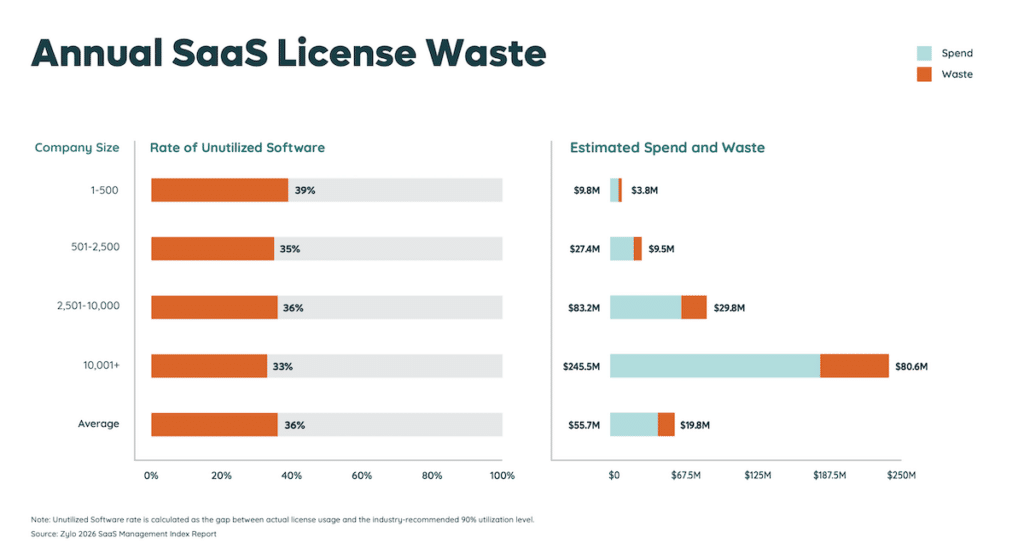
To illustrate the potential for direct cost optimization, Zylo's 2026 SaaS Management Index found that enterprise organizations waste an average of $80.6M annually on unused SaaS licenses alone.
Better Alignment With Business Objectives
When you tie technology costs to specific teams, products, or business units, leadership can evaluate whether those investments are delivering proportional value. FinOps turns a line item on a budget into a strategic lever.
Without this alignment, technology investments happen in a vacuum. Zylo's survey of 218 IT leaders found that 61% of respondents were forced to cut projects or initiatives due to unexpected SaaS cost increases. Those overruns happen because nobody has a clear view connecting spend to the value it delivers.
Improved Governance
FinOps establishes guardrails around provisioning, procurement, and vendor management. This reduces shadow IT, prevents unauthorized purchases, and ensures your organization meets compliance requirements.
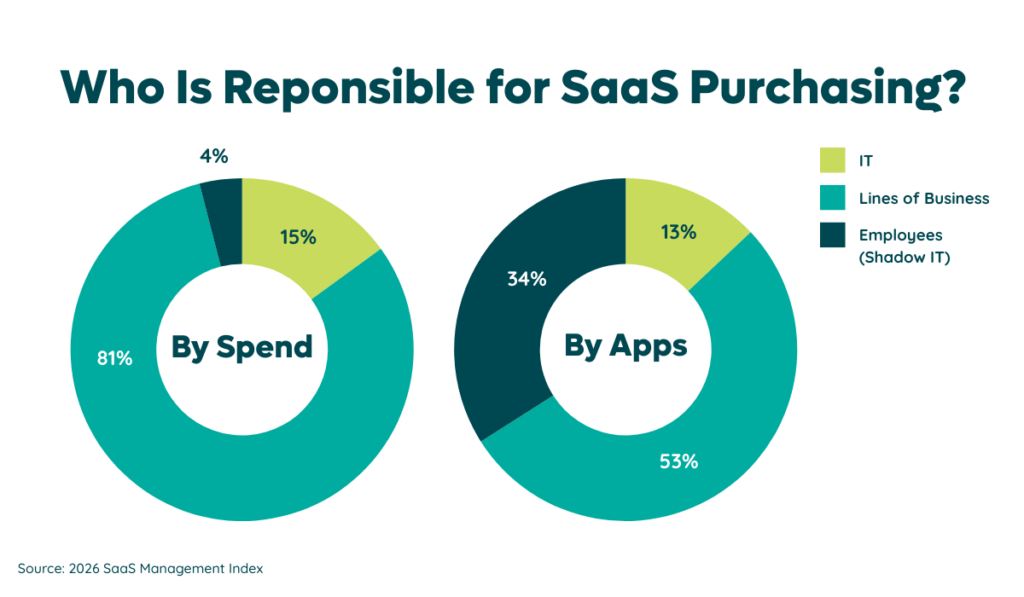
SaaS management platforms play an important role here, surfacing applications that bypass formal procurement channels. In the average organization, lines of business are responsible for 81% of software spend, while IT manages just 15%. Without governance, the majority of your software budget operates outside centralized oversight.
Increased Collaboration and Efficiency
FinOps breaks down silos between finance, IT, and business units. When everyone works from the same data, negotiations go more smoothly, renewals are managed proactively, and optimization becomes a shared responsibility rather than a top-down mandate.
The convergence of FinOps and ITAM is a strong example of this in action. FinOps brings analytical rigor to interpreting consumption patterns and forecasting variable spend. ITAM contributes governance, entitlement control, and financial oversight. Together, they represent the capabilities required to manage credit-based, unit-based, and AI-driven pricing at enterprise scale.
Why FinOps Cost Optimization Looks Different in 2026
FinOps in 2026 isn't the same discipline it was two years ago. Three shifts have redefined its scope and urgency:
- AI spend
- SaaS entering the FinOps remit
- The convergence of FinOps and ITAM
1. AI Spend
AI spend has skyrocketed, and its volatility and unpredictable nature make it increasingly difficult to control. Zylo's 2026 SaaS Management Index found that spending on AI-native applications rose 108% in 2025, and 78% of IT leaders experienced unexpected charges tied to consumption-based or AI pricing models.

Unlike traditional seat-based SaaS, AI costs scale with usage in ways that are difficult to predict. A single team experimenting with an LLM API can generate thousands of dollars in charges before anyone notices, and those costs don't show up in a standard procurement review.
As a result, the number of FinOps practitioners managing AI spend rose 32%, according to the State of FinOps 2026. Now, 98% of FinOps practitioners manage AI spend. AI workloads introduce unpredictable, consumption-based costs that don't follow traditional forecasting models, changing the way costs must be managed.
2. SaaS Entering the FinOps Remit
SaaS is no longer peripheral to FinOps. The State of FinOps found that 90% of FinOps respondents now manage SaaS spend or plan to within the year, up from 65% in 2025.
Business-critical platforms like Salesforce, Microsoft, and Workday are now clearly in scope alongside cloud infrastructure. As the FinOps Foundation's report noted, practitioners describe this evolution in phases: "First, they asked us to fix cloud. Then fix the software mess. Now, it's fix the contract and license mess."
3. The Convergence of FinOps and ITAM
SaaS publishers are shifting from fixed seat-based pricing to hybrid and consumption-based models. This means SaaS costs increasingly behave more like cloud workloads than traditional licenses. That pricing shift is driving FinOps and ITAM together, because neither function has the full picture on its own.
FinOps can interpret consumption patterns and forecast variable spend, but often lacks visibility into entitlements and renewal terms. ITAM has governance and contract oversight, but may not see real-time usage trends. Managing credit-based, usage-based, and AI-driven pricing at enterprise scale requires both.
Leading enterprises are already adapting. At The Home Depot, ITAM and FinOps were consolidated under a single leader to unify forecasting, governance, and spend management across cloud and SaaS.
"As more and more SaaS publishers move away from traditional user-based annual subscriptions into a usage-based model, the crossover of the skills between FinOps and ITAM is going to be paramount to making sure that this is a success."
— Ross Milne, ITAM Practice Lead at Capgemini Invent UK
Who Should Be Involved in the FinOps Process?
FinOps is most effective when it's cross functional. Five groups play distinct roles:
- FinOps practitioners: They bridge finance and engineering, owning cost analysis, reporting, and optimization recommendations
- Engineering and DevOps: They make the day-to-day decisions that drive cloud consumption, from instance sizing to architecture choices
- Finance: They set budgets, build forecasts, and ensure cost allocation aligns with financial planning
- Procurement and IT: They manage vendor relationships, negotiate contracts, and oversee software renewals
- Executive leadership: They set cost targets, allocate resources, and make strategic decisions about technology investments
The most effective FinOps organizations give their FinOps team a direct line to executive leadership. The State of FinOps 2026 report found that 78% of FinOps practices now report into the CTO or CIO organization. Teams with VP-level or higher executive engagement showed 2-4x more influence over technology selection decisions.
FinOps Best Practices for Cloud Cost Optimization
Optimization starts with the right foundation and scales through automation. The following strategies represent the core playbook for FinOps cost optimization across both cloud and SaaS environments:
- Establish full cost visibility
- Rightsize cloud resources
- Automate cloud cost management
- Optimize storage costs
- Allocate costs and establish ownership
- Implement a consistent tagging strategy
- Reduce waste in cloud infrastructure and SaaS applications
- Monitor spend and define showback and chargeback structures
- Use spot instances and preemptible VMs
- Leverage commitment-based discounts
- Delete unused resources and software
- Establish governance policies
- Build a cost-aware culture
- Establish multi-cloud cost governance
Establish Full Cost Visibility
You can't optimize what you can't see. The first step in any FinOps practice is building a comprehensive view of where your money goes. For cloud, that means parsing detailed billing data from AWS, Azure, and GCP. For SaaS, it means discovering every application in your environment, including those purchased through expense reports and departmental credit cards.
"It doesn't have to be optimization Day One. It's knowing what you have Day One that sets that tone forward."
— TJ Johnson, Lead Architect for Platform Economics at MGM Resorts International
Together, the following metrics form the baseline you'll use to identify waste, forecast spend, and measure the impact of optimization efforts.
| Visibility Metrics | Cloud | SaaS |
|---|---|---|
| Allocation | Cost per service, team, or business unit | Cost per user, team, or business unit |
| Forecasting | Cloud cost trends over time | AI and consumption SaaS costs over time |
| Utilization | Utilization rates for cloud resources | Ratio of licensed seats to active users; Percentage of licenses provisions vs purchased |
| Renewals | Not applicable | Upcoming renewal dates; Contract terms |
| Portfolio | Not applicable | Applications with duplicate spend or contract; Applications with functional overlap (redundancy) |
Rightsize Cloud Resources
To rightsize cloud resources:
- Start by identifying instances consistently running below 40% CPU utilization, memory-optimized instances handling compute-heavy workloads, and storage volumes provisioned with higher IOPS than the workload requires.
- Review CPU, memory, and storage utilization and downsize to an appropriate instance type.
- Begin with non-production environments where the risk is lowest, then apply learnings to production workloads.
Rightsizing can yield 15-25% savings with minimal performance impact, but many organizations miss the opportunity because they over-provision instances during initial deployment and never revisit the decision. Building rightsizing reviews into a regular cadence prevents that drift.
Automate Cloud Cost Management
Manual cost reviews don't scale. Implement automated policies to:
- Schedule non-production environments to shut down outside business hours
- Autoscale resources based on demand
- Flag anomalies when spending spikes beyond expected thresholds
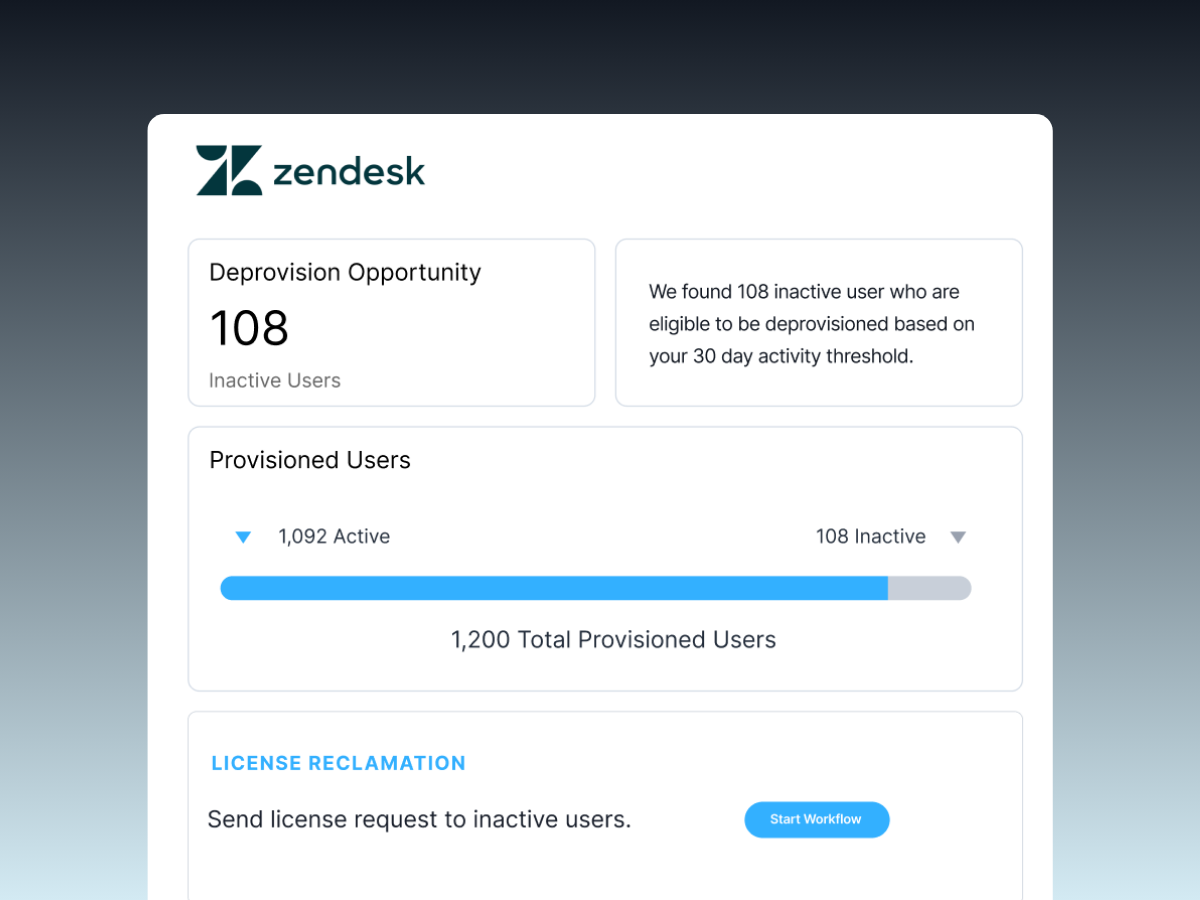
Automation also applies to SaaS. Implement automated license reclamation workflows to identify users who haven't logged into an application within a specific timeframe (e.g. last 90 days) and route reclamation requests to the application owner. This ensures you're not paying for seats that you aren't using.
Optimize Storage Costs
To optimize storage costs:
- Move cold data to lower-cost storage classes
- Set lifecycle policies to automatically archive or delete aging data
- Regularly audit storage volumes for old snapshots and unattached disks
Storage costs grow quietly, and infrequently accessed data stored in high-performance tiers is one of the most common sources of unnoticed waste.
Allocate Costs and Establish Ownership
Every dollar of technology spend should have an owner. Allocated costs by mapping cloud resources and SaaS subscriptions to specific teams, projects, or business units. When teams see the cost of what they consume, spending behavior changes.
This is equally relevant for SaaS. Lines of business and individual employees now purchase the vast majority of software, often through expense reports or departmental budgets that bypass IT entirely. When those purchases don't have a clear owner, there's no accountability, and waste compounds year after year.
Implement a Consistent Tagging Strategy
A consistent tagging strategy makes cost allocation work. Follow these steps:
- Define a tagging taxonomy that covers environment, team, project, and application.
- Enforce tagging at the point of provisioning
- Audit compliance regularly.
For SaaS, the equivalent is a normalized application inventory categorized by business function, owner, and contract terms.
Without consistent, enforced standards, your cost data will be incomplete and unreliable, undermining every downstream activity from showback reporting to renewal planning and consolidation decisions.
Reduce Waste in Cloud Infrastructure and SaaS Applications
Waste reduction takes different forms depending on the resource type.
Reducing Waste in Cloud Infrastructure
To reduce cloud infrastructure waste, target idle instances, orphaned volumes, and over-provisioned databases.
Use automated tools to identify resources with consistently low utilization and recommend termination or downsizing. Also, look for development and staging environments that run 24/7 when they're only needed during business hours.
Scheduling these environments to power down outside working hours can often save 10-20% on non-production costs.
Reducing Waste in SaaS Applications
For SaaS applications, waste reduction is achieved through license reclamation and rightsizing, and application rationalization at renewal.
License Reclamation and Rightsizing
SaaS license reclamation is the process of identifying and recovering unused or underutilized software licenses before a contract renews. Organizations waste $19.8M on unused licenses annually, according to Zylo's data, a huge opportunity for cost reduction. Follow these steps:
- Pull license utilization data 90 days before a renewal
- Flagging users who haven't logged in within the last 90 days
- Route reclamation requests to the application owner.
- Rightsize your license count before you enter negotiations.
"We saved a lot of money because we were able to see what we actually had, what we were using, and reduce license counts.”
— Ridge Fussell, Senior Manager of FinOps at The Home Depot
Application RationalizationApplication rationalization is one of the most effective ways to combat SaaS sprawl and eliminate unnecessary spend. Common areas of redundancy include online training, team collaboration,a nd project management tools—and increasingly GenAI tools.
Without a structured rationalization process, that sprawl accelerates and costs compound.
- Map every application to a business function.
- identify where multiple tools serve the same purpose.
- Cancel applications flagged for deprecation before your renewal notice period.
- Selected a preferred software title (or narrow list) for ongoing use.
Rationalization works best when it's tied to the renewal calendar so you can act on consolidation decisions before contracts auto-renew.
Monitor Spend and Define Showback and Chargeback Structures
Ongoing spend monitoring closes the feedback loop. Set up dashboards that track spend against budgets at the team and project level.
Then, decide whether to implement showback (reporting costs back to business units for awareness) or chargeback (billing costs back to business units from a shared budget). Many organizations start with showback and progress to chargeback as their FinOps practices mature.
Use Spot Instances and Preemptible VMs
Use spot instances on AWS and preemptible VMs on Google Cloud, as they offer 60-90% discounts compared to on-demand pricing.
They're ideal for fault-tolerant, stateless workloads like batch processing, CI/CD pipelines, and dev/test environments. The trade-off is that the cloud provider can reclaim capacity on short notice, so you'll need architectures designed to handle interruptions gracefully.
Leverage Commitment-Based Discounts
Take advantage of commitment-based discounts, as reserved instances and savings plans offer 40-72% savings over on-demand pricing.
Review your historical usage patterns and commit only to the baseline capacity you consistently need. The key is accurate forecasting. Overcommitting locks you into spending that you can't use. Meanwhile, undercommitting leaves savings on the table.
Delete Unused Resources and Software
Deleting unused resources and software is a FinOps best practice to eliminate waste.
Build a regular cadence for auditing and removing orphaned cloud resources, decommissioned applications still running in production, and SaaS subscriptions nobody uses.
For SaaS, tie audits to the renewal calendar. Because SaaS is contracted spend, renewal is the only moment in the renewal lifecycle to cut or renegotiate. Organizations manage an average of 211 renewals per year, each one is an opportunity to cut or renegotiate. Each one that’s missed locks in waste for another term.
Establish Governance Policies
Governance prevents waste from recurring. Set policies around provisioning approvals, instance type standards, and SaaS procurement workflows. Automate enforcement where possible.
For example, require tagging before provisioning resources, or route SaaS purchase requests through a centralized intake process.
Build a Cost-Aware Culture
The most impactful optimization approach is a culture where engineers, product managers, and business leaders consider cost implications in every technology decision. To build a more cost-aware culture at your organizations,
- Make cost data visible to every team
- Celebrate teams that reduce waste
- Include cost efficiency as a standing item in architecture reviews
Establish Multi-Cloud Cost Governance
If your organization runs workloads across AWS, Azure, and GCP, you need governance that spans all three.
- Standardize tagging conventions
- Normalize cost data to a common format (the FinOps Foundation's FOCUS specification is designed for this)
- Consolidate reporting to compare spending across providers
Without a unified view, optimization efforts in one cloud can be offset by waste in another.
The same principle applies to SaaS. When the same application is purchased through both accounts payable and expense channels, you end up with duplicate contracts, fragmented ownership, and weakened negotiation leverage. According to Zylo's 2026 SaaS Management Index, multi-channel SaaS spend rose 22% year-over-year, underscoring why a unified view matters for SaaS the same way it does for cloud.
Measuring FinOps Success: KPIs and Outcomes
Tracking the right metrics ensures your FinOps practice delivers measurable results. Three categories of KPIs matter most:
- Cost Efficiency Metrics
- Operational Metrics
- Business Value Metrics
Cost Efficiency Metrics
Cost efficiency metrics track the direct financial impact of your optimization efforts and should include:
- Cloud cost reduction percentage
- On-demand to committed spend ratio
- SaaS license utilization rate
- Cost avoidance at renewal
- Dollars saved through license reclamation
- Cost per unit of compute
On the cloud side, track the ratio of on-demand spend to committed spend. Organizations that effectively use reserved instances and savings plans should see committed spend account for the majority of stable workloads.
On the SaaS side, focus on license utilization rate, cost avoidance at renewal, and dollars saved through license reclamation.
Operational Metrics
Operational metrics measure the health of your FinOps practice itself and should include:
- Tagging compliance rate
- Percentage of total spend allocated to an owner
- Anomaly detection response time
- Renewals managed through a structured process versus ad hoc
- Percentage of applications with an assigned owner
For example, low tagging compliance is a leading indicator of unreliable cost allocation data. Tracking the number of renewals managed through a structured process versus ad hoc reveals how much of your SaaS spend is governed versus left to chance.
Business Value Metrics
Business value metrics connect technology spend to outcomes and should include:
- Cost per customer
- Cost per transaction
- Cost per revenue dollar
- Savings reinvestment rate
- Technology spend as a percentage of revenue
Unit economics help leadership understand whether technology investments scale efficiently as the business grows. Mature FinOps teams also track whether cost savings get reinvested into innovation, growth, or new technology rather than simply disappearing into budget gaps.
Tools and Technology for FinOps Cost Optimization
Effective FinOps requires purpose-built tooling across cloud cost management and SaaS spend management.
Cloud cost management
Native cloud cost management tools like AWS Cost Explorer, Azure Cost Management, and Google Cloud's Billing Reports provide baseline visibility into cloud consumption. Meanwhile, third-party platforms add deeper analytics, automated optimization, multi-cloud normalization, and features like automated savings plan management.
As FinOps matures, look for tools that support shift-left cost estimation, enabling architects to forecast costs before deploying resources rather than reacting afterward.
SaaS spend management
SaaS spend management platforms like Zylo have more expansive capabilities than cloud cost management tools. The best SaaS spend management software:
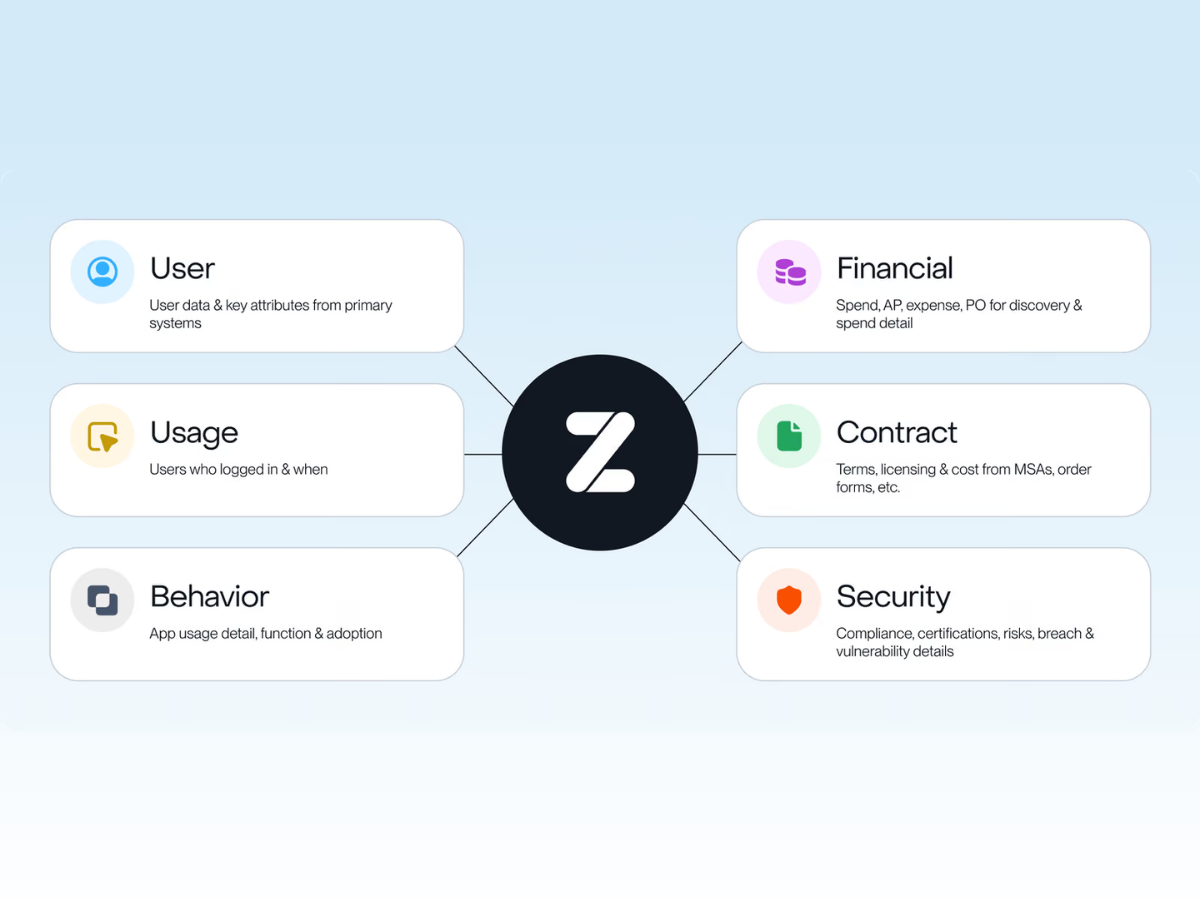
- Discovers all SaaS spend across multiple channels (accounts payable and expense)
- Enables cost optimization for SaaS license and consumption-based software and platform as a service (PaaS)
- Surfaces cost-saving opportunities and enables easy reporting on business outcomes
- Supports renewal management process, from unified contract, spend, and usage data to automated renewal alerts and price benchmarking
How Zylo Supports FinOps Cost Optimization
Zylo's SaaS management platform is designed to complement cloud FinOps cost management tools by covering the SaaS side of technology spend. While cloud cost tools handle infrastructure optimization across AWS, Azure, and GCP, Zylo extends FinOps visibility and governance to SaaS applications.
Core capabilities include:
- Unified visibility across cloud and SaaS spend through AI-powered discovery that identifies applications across financial systems, SSO, and expense data, including shadow IT and shadow AI
- Cost allocation and ownership across teams and business units, connecting every SaaS subscription to a responsible owner
- Ongoing optimization tracking and forecasting support, powered by benchmarking data drawn from more than $100B+ in SaaS spend under management
For FinOps teams expanding their scope into SaaS, Zylo provides the visibility and governance foundation that cloud cost tools alone can't deliver.
What's Next for FinOps Cost Optimization
Looking ahead to 2027 and beyond, FinOps cost optimization is evolving upstream into pre-deployment cost forecasting and deeper into AI-specific governance.
Shift-Left FinOps
Shift-Left FinOps means proactively forecasting and managing cloud costs before resources are deployed, rather than optimizing after the bill arrives. Cost estimation is part of the architecture review process, and every deployment proposal includes a projected cost alongside its technical design.
AI Cost Governance
AI governance is becoming a standalone discipline within FinOps. Organizations are building dedicated playbooks for managing token-based, consumption-driven AI costs. This includes:
- Per-model cost attribution
- Inference spend monitoring
- Policies for routing requests to the most cost-effective model that meets quality requirements
Bring SaaS into Your FinOps Practice with Zylo
With 90% of FinOps teams already managing or planning to manage SaaS, the line between cloud cost management and SaaS management is disappearing. The convergence of FinOps, ITAM, and SaaS management will continue to accelerate. Organizations that take action now to build cross-functional visibility, governance, and accountability across both cloud and SaaS will be positioned to manage the full technology portfolio.
With Zylo, your FinOps team gets a more holistic view of tech spend with centralized data to help you improve forecasting, cost optimization, and financial accountability across the business. Learn how Zylo can support your FinOps team, or request a demo to see how leading enterprises manage SaaS spend alongside cloud.