ITAM and FinOps Are Converging. How Does It Impact My Team?


Updated on April 2, 2026 with new data and market trends.
TL;DR: ITAM and FinOps Are Converging to Manage AI-Driven SaaS Spend
- AI and consumption-based pricing are changing how SaaS costs behave. Costs now scale with usage, making spend more variable and harder to predict.
- ITAM and FinOps are converging to solve the same problem from different angles. ITAM brings contract and entitlement context, while FinOps provides usage and cost visibility. Both are required to manage modern SaaS.
- The convergence zone includes consumption SaaS and PaaS. Tools like Snowflake, Datadog, and Twilio require continuous monitoring, forecasting, and cost control across both SaaS and cloud environments.
- Managing SaaS is a shared responsibility across teams. Effective organizations align ITAM, FinOps, Finance, and Procurement around shared data, processes, and accountability.
- Success depends on operationalizing consumption management. Monitoring usage trends, forecasting spend, setting alerts, and breaking down cost drivers enable teams to stay ahead of AI-driven cost variability.
ITAM and SAM have historically focused on managing software, while FinOps has owned cloud infrastructure. That division is starting to shift.
AI and consumption-based pricing are changing how software is priced and consumed. Costs now scale with usage, not just users—bringing SaaS and cloud dynamics closer together.
As a result, ITAM and FinOps are beginning to overlap in new ways. In 2026, this convergence is taking shape across many organizations.
In this article, I’ll examine what’s driving the shift, where responsibilities intersect, and how your team can adapt to control consumption-based spend. Watch the video below to see me walk through the ITAM and FinOps convergence.
Defining ITAM, SAM, and FinOps
ITAM, SAM, and FinOps all manage technology spend—but from different angles. Understanding each role clarifies where responsibilities start and where they begin to overlap.
What Is ITAM?
IT Asset Management (ITAM) oversees the full lifecycle of IT assets, including hardware and software. It focuses on:
- Financial management of assets
- Contract and vendor governance
- Risk and compliance
ITAM provides the umbrella for managing technology investments across the business.
What Is SAM?
Software Asset Management (SAM) is a subset of ITAM focused on software. It is responsible for:
- License tracking and optimization
- Usage monitoring
- Compliance and audit readiness
- Renewal management
SAM teams ensure organizations are using what they pay for and staying aligned with license terms.
What Is FinOps?
FinOps is a financial operations discipline focused on cloud spend (IaaS and PaaS). It brings together engineering, finance, and operations to:
- Track and allocate cloud costs
- Forecast and optimize spend
- Drive accountability for usage
FinOps enables organizations to scale cloud usage while maintaining financial control.
ITAM vs. SAM vs. FinOps: Responsibilities Comparison
AI Consumption Drives Unpredictable Spending
AI-driven, consumption-based pricing is increasing SaaS cost volatility and reducing budget predictability.
AI is no longer a standalone category but rather is being embedded into nearly every SaaS application. Tools like Slack, Microsoft Copilot, and Atlassian Intelligence have already introduced AI directly into existing workflows, fundamentally changing how software is used and priced.
This shift is already reflected in how vendors price their products. According to McKinsey, as of September 2025, 65% of AI-native applications use non-seat-based pricing models such as consumption, outcomes, or capacity—compared to just 32% of traditional vendors.
Even when pricing appears seat-based, it often includes credits, caps, or usage limits tied to AI features. At the same time, vendors are introducing hybrid models that combine per-user pricing with consumption-based components.
This shift is driven by economics. AI introduces real infrastructure costs for vendors, where every output consumes compute. As a result, flat-rate pricing becomes harder to sustain at scale.
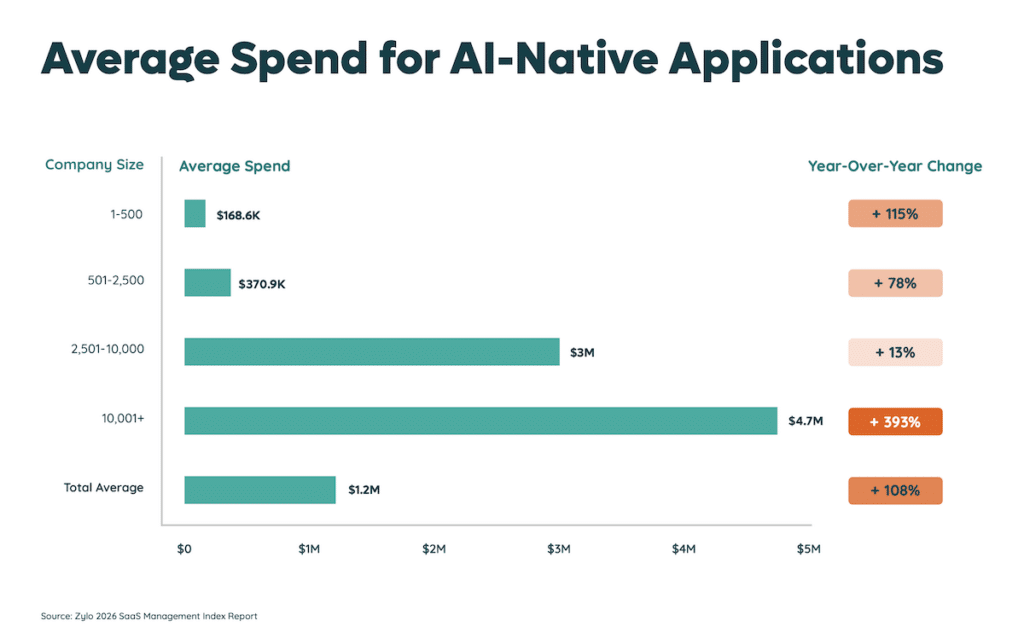
At the same time, organizations are seeing rapid growth in AI spend. On average, spending on AI-native applications increased 108%—per Zylo’s 2026 SaaS Management Index. In contrast, enterprise organizations saw a nearly 400% spike in AI-native spend.
Many organizations are already seeing costs increase faster than governance processes can respond.
Usage-Based Pricing Introduces New Cost Risks and Operational Challenges
Consumption-based pricing creates variability that impacts forecasting, cost control, and governance.
Costs now scale with activity, not just headcount. AI usage is driven by both human interaction and automated processes, including background agents that generate activity without direct user input.
This shift introduces several challenges:
- Unpredictable spend: Costs fluctuate based on real-time usage
- Reduced forecasting accuracy: License-based budgeting models lose reliability
- Mid-cycle cost changes: Spend can increase before renewal events
- Limited visibility: API usage and automated processes are harder to track
The impact is already measurable:
- 78% of IT leaders report unexpected SaaS charges tied to consumption or AI
- 61% have had to cut projects due to unplanned cost increases
At a fundamental level, organizations are moving from paying for access to software to paying for the work software performs.
Governance models must adapt accordingly. Periodic reviews are no longer sufficient when usage and costs can change daily. Teams need continuous monitoring, real-time forecasting, and proactive alerts to maintain control.
Key takeaway
AI-driven consumption introduces cost variability that requires continuous, usage-based management.
How SaaS Has Changed
The shift to AI and consumption-based pricing follows a familiar pattern—one we’ve seen before—that reshaped how organizations manage infrastructure and software.
From Owning Infrastructure to Renting It
In the early 2000s, running software required purchasing physical servers and perpetual licenses. Organizations had to estimate future capacity and invest upfront.
The result:
- Overprovisioned infrastructure
- Idle resources and unused capacity
- High upfront financial risk
From CapEx to SaaS—and New Forms of Waste
Cloud computing changed that model. Organizations moved to renting compute and subscribing to software.
That solved the upfront risk but created a new kind of waste:
- Paying for unused licenses
- Over-purchasing seats based on projected headcount
- Limited visibility into actual usage
AI Introduces a New Cost Model
In 2026, AI is now driving the next shift.
Software and infrastructure are converging. Every AI-driven action consumes compute, making cost directly tied to usage rather than access.
As a result:
- Pricing moves from fixed subscriptions to usage-based models
- Costs fluctuate based on activity, not users
- Governance must adapt to real-time changes
From Seat-Based Licensing to AI Consumption
AI changes how SaaS is priced, used, and governed, shifting from predictable, seat-based models to dynamic, usage-driven consumption.
With seat-based licensing, cost control happens at procurement events: renewals, true-ups, or license purchases.
With consumption-based pricing, those control points disappear. Usage and cost can change at any time, requiring continuous oversight.
As usage becomes the primary driver of cost, managing SaaS begins to mirror how organizations manage cloud infrastructure.
ITAM and FinOps Convergence: Why It's Happening and the Impact to Your Team
ITAM and FinOps convergence is the shared management of SaaS, PaaS, and IaaS using both contract data and usage-based cost insights—driven by the rise of consumption-based pricing.
As AI introduces variable, usage-driven costs, the traditional boundaries between software and cloud management start to break down. SaaS now behaves more like infrastructure, and managing it requires both contract context and real-time usage visibility.
In 2026, this shift is already changing how ITAM and FinOps teams operate. The FinOps Foundation even saw this coming, introducing SaaS and AI to its framework last year.
The sections below outline what this convergence looks like in practice and how it impacts ownership, governance, and accountability.
Why ITAM and FinOps Are Converging
Because SaaS now behaves more like cloud, it needs continuous oversight. The result: ITAM and FinOps are converging to manage it, contributing their unique areas of expertise.
At a basic level, both teams are starting to work with the same inputs. ITAM manages contracts and entitlements, while FinOps manages usage and cost. As SaaS pricing becomes more consumption-based, those lines start to blur.
But from what I’ve seen, that’s not really why this is happening. The real shift is how governance works.
With traditional SaaS, cost control happens at defined points in time:
- Renewals
- True-ups
- License purchases
These moments create natural checkpoints for optimization.
With consumption-based pricing, those checkpoints disappear. Usage and cost can change continuously, often in real time. AI-driven activity—whether from users or automated processes—can increase spend between billing cycles, without a clear trigger event.
As a result, governance shifts from periodic review to continuous oversight.
When cost behaves this way, managing SaaS starts to look a lot like managing cloud infrastructure. This is how FinOps teams have been operating for years—tracking usage, forecasting spend, and responding as things change.
That shift is what brings ITAM and FinOps together.
Both teams are now working from the same signals:
- Real-time usage
- Consumption-driven cost
- Forecasting based on activity
This creates a shared operating model, where contract context and usage insight must work together to effectively manage SaaS, PaaS, and AI spend.
The Convergence Zone: Where SaaS and Cloud Meet
The convergence zone is where SaaS and cloud overlap. It requires both ITAM and FinOps capabilities to manage consumption-driven costs.
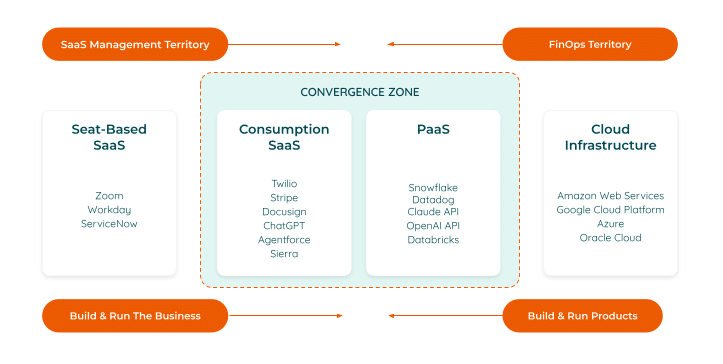
To understand the convergence, it helps to break down each side of the model.
On the left: ITAM and SAM
This is where teams manage traditional SaaS applications used to run the business—tools like Zoom, Workday, ServiceNow, or Asana.
These environments are governed through:
- Licenses and entitlements
- Contracts and renewals
- Periodic optimization and compliance
This is the foundation most ITAM and SAM teams operate within today.
On the right: FinOps
This is the world of cloud infrastructure—AWS, Microsoft Azure, Google Cloud, and other hyperscalers.
FinOps teams focus on:
- Tracking how infrastructure is consumed
- Attributing costs to products, services, or teams
- Continuously optimizing usage to control spend
The goal is to understand and manage the cost of running applications in real time.
In the center: The convergence zone
This is where traditional models start to break down.
Consumption-based SaaS and PaaS do not fit cleanly into either ITAM or FinOps. They combine elements of both—contracted software with usage-driven cost.
These include:
- Consumption SaaS (e.g., Twilio, DocuSign, ChatGPT, Agentforce)
- Platform as a Service (PaaS) (e.g., Snowflake, Datadog, Claude API)
- Tools with hybrid pricing models
Managing these environments requires:
- Contract visibility (ITAM)
- Real-time usage tracking (FinOps)
- Continuous forecasting and cost control
No single team has full ownership using traditional models.
As a result, ITAM and FinOps must work together to manage these tools effectively—bringing their capabilities into a shared operating model.
Key takeaway
The convergence zone requires both ITAM and FinOps because consumption-based SaaS blends contract management with real-time usage and cost control.
The Impact to ITAM and FinOps Teams
Convergence changes how each team operates by expanding visibility requirements and decision inputs.
As SaaS and cloud begin to follow similar usage and pricing patterns, the separation between ITAM and FinOps becomes harder to maintain. Each team still owns a distinct domain, but decisions increasingly depend on inputs from both sides.
For ITAM and SAM teams, this means going beyond contracts and licenses. Managing spend now requires visibility into how software is used between renewals—not just what was purchased.
For FinOps teams, the scope extends beyond infrastructure. SaaS applications with consumption elements must be included in cost analysis to understand total spend across services and business units.
Both teams are now working with overlapping signals:
- Usage trends
- Cost drivers
- Forecasting inputs
This expands the data each team needs to operate effectively, even before formal collaboration is established.
SaaS Spend Is a Shared Responsibility
Managing SaaS and AI spend now requires alignment across ITAM, FinOps, Finance, and Security—not ownership by a single team.
As consumption-based pricing expands, SaaS cost management spans contracts, usage, cost, and risk. These elements are interconnected, but they are rarely managed together.
No one team has full visibility or control—and treating SaaS spend as a siloed responsibility creates gaps that directly impact cost and governance.
The Risk of Siloed SaaS Management
What I see most often is that when teams stay siloed, this gets hard to manage fast. Usage and cost can change in real time, but decisions are still made in separate workflows. Cost signals may be identified but not acted on. Contract context may exist without usage insight.
Over time, these disconnects lead to:
- Missed optimization opportunities
- Budget overruns
- Increased financial risk
Building a Shared Operating Model Across ITAM and FinOps
A shared operating model is required to close these gaps and should align teams around:
- A consistent view of usage, spend, and contracts
- Standardized processes for monitoring, forecasting, and optimization
- Clear ownership of decisions and actions across teams
When alignment is in place, organizations gain the ability to respond to changes as they happen—rather than after costs have already increased.
The goal is not to restructure teams, but to ensure they operate with shared context and coordinated execution across ITAM and FinOps.
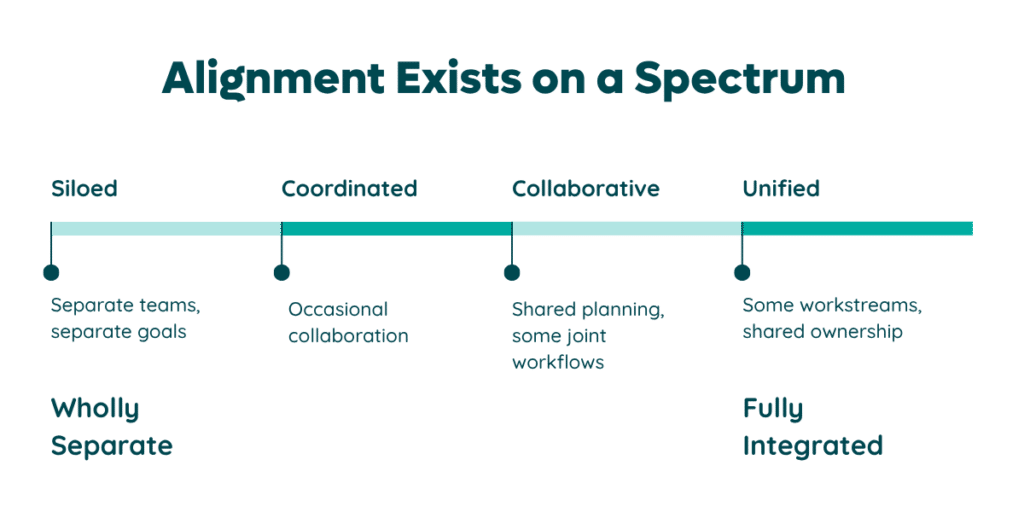
Alignment Exists on a Spectrum
There is no single model for ITAM and FinOps alignment. Organizations adopt different approaches based on structure, priorities, and operating style.
As ITAM and FinOps converge, alignment does not happen in the same way for every organization. Some teams operate independently, while others collaborate closely or share responsibilities across functions.
Rather than a fixed maturity curve, alignment exists on a spectrum.
Alignment Models Across ITAM and FinOps
Organizations typically fall into one of four models:
- Siloed: ITAM and FinOps operate independently with limited coordination
- Coordinated: Teams share information at key points, such as renewals or budgeting cycles
- Collaborative: Teams work together regularly, aligning on processes and shared goals
- Unified: A shared operating model with integrated workflows and responsibilities
Choosing the Right Level of Alignment
In my experience, the right approach depends on how your organization operates.
Factors such as team structure, ownership of SaaS and cloud spend, and internal processes all influence where alignment occurs. Some organizations may benefit from tighter integration, while others maintain separate teams with strong coordination.
What matters most is not the structure itself, but the ability to:
- Share context across teams
- Act on usage and cost signals quickly
- Align decisions across ITAM and FinOps
As consumption-based pricing introduces more variability, organizations need to move toward models that support faster coordination and shared visibility.
Four Core Elements of ITAM and FinOps Consumption Management
Effective consumption management requires four core elements: monitoring usage trends, forecasting future spend, setting alerts, and breaking down usage. Without these, costs quickly move beyond control.
Usage-based pricing introduces real-time cost variability that periodic reviews and manual oversight cannot keep up with. Cost now changes continuously based on usage, often driven by both users and automation.
You can’t track this manually anymore.
As a result, traditional approaches break down. Rather than relying on static checkpoints, teams need systems that surface changes in real time and enable immediate action across four areas:
1. Monitoring Usage Trends
Understanding how usage changes over time is the foundation of cost control.
Consumption-based pricing ties cost directly to activity. Without visibility into how usage evolves, cost increases often go unnoticed until after they occur.
Teams should focus on:
- Tracking usage patterns across SaaS, PaaS, and AI platforms
- Identifying changes in activity across users, teams, and workflows
- Detecting early signals of increased consumption
Consistent monitoring provides the baseline needed to understand and manage cost drivers.
2. Forecasting Future Spend
Forecasting shifts from contract-based planning to usage-driven modeling.
Historical usage data becomes a key input for predicting future costs. Static budgeting approaches are less effective when consumption fluctuates based on behavior and automation.
To improve accuracy, teams should:
- Use historical trends to project future spend
- Account for growth in adoption and usage
- Adjust forecasts as usage patterns change
Over time, stronger forecasting reduces uncertainty and supports better planning.
3. Setting Alerts
Alerts provide early visibility into changes that require action.
In a near real-time environment, it is not feasible to monitor every change manually. Alerts help teams identify anomalies, spikes, or deviations from expected usage patterns.
Common approaches include:
- Threshold-based alerts for usage or spend
- Notifications for unexpected increases in activity
- Signals when forecasts exceed planned budgets
With alerts in place, teams can respond before costs escalate.
4. Breaking Down Usage
Understanding what drives consumption enables targeted optimization.
Aggregate spend provides direction, but it does not explain what is driving cost. Breaking down usage by team, user, or workload reveals where costs originate and how they can be managed.
This includes:
- Attributing usage to specific teams or projects
- Identifying high-cost workflows or services
- Distinguishing between expected growth and anomalies
Detailed visibility makes it easier to prioritize high-impact actions.
Key takeaway
Managing consumption-based SaaS requires continuous visibility, forecasting, and action—supported by systems that operate in real time.
5 Tips for ITAM and FinOps-Powered SaaS Management
To manage consumption-based SaaS effectively, align teams around shared goals, data, and execution. The following practices help translate that alignment into measurable outcomes.
- Promote collaboration across ITAM and FinOps
- Focus on driving business value
- Ensure data transparency across systems
- Align on processes and best practices
- Budget for the future, not just the current contract
As ITAM and FinOps converge, success depends on how well teams coordinate—especially as AI costs and usage-based pricing introduce more variability into SaaS spend.
1. Promote Collaboration across ITAM and FinOps
One of the first things I recommend is bringing the right teams together early and often.
Because consumption-based SaaS touches multiple stakeholders, regular coordination across ITAM, FinOps, Finance, and Procurement improves decision-making. Alignment at key moments ensures decisions reflect both usage patterns and financial impact.
Focus on:
- Establishing shared ownership of SaaS and AI spend
- Aligning on priorities before renewals and budgeting cycles
- Creating consistent communication across teams
As collaboration improves, teams move faster and operate with clearer context.
2. Focus on Driving Business Value
Anchor decisions in outcomes, not just spend.
With consumption-based models, cost maps more directly to usage. As a result, teams can better evaluate whether spend is delivering meaningful value.
Prioritize:
- Identifying which tools support critical workflows
- Measuring usage alongside adoption and outcomes
- Balancing cost optimization with productivity and growth
Over time, this approach shifts conversations from cost reduction to value realization.
3. Ensure Data transparency Across Systems
Create a shared, reliable view of usage and spend.
When teams operate from different data sources, alignment becomes difficult. A centralized and consistent view of SaaS, PaaS, and IaaS usage enables more confident decision-making.
Key actions include:
- Centralizing visibility into applications, usage, and spend
- Connecting contract data with real-time consumption
- Standardizing how metrics are defined and reported
With greater transparency, teams can identify cost drivers earlier and act with more precision.
4. Align on Processes and Best Practices
Standardize how teams monitor, forecast, and optimize spend.
Even with shared data, inconsistent workflows slow progress. Clear, repeatable processes help teams act quickly and stay aligned over time.
Focus on aligning:
- How usage is monitored and reviewed
- How forecasts are created and updated
- How optimization actions are triggered and executed
As processes mature, consumption management becomes more consistent and scalable.
5. Budget for the Future, Not Just the Current Contract
Plan for variability, not just fixed commitments.
Given the variability introduced by AI and consumption-based pricing, budgeting approaches need to account for change. Planning based only on contracts limits flexibility.
Strengthen planning by:
- Using usage trends to inform forecasts
- Building flexibility into budgets for changing demand
- Revisiting assumptions as usage evolves
A forward-looking approach improves predictability and supports more informed long-term decisions.
Key takeaway
ITAM and FinOps-powered SaaS Management succeeds when teams align on collaboration, value, data, process, and planning—and execute consistently across all five.
ITAM and FinOps: A Unified Approach to Managing SaaS and AI Spend
AI and consumption-based pricing are already changing how SaaS spend behaves. Organizations that don’t adapt will lose visibility, control, and budget predictability.
Seat-based models made SaaS manageable through periodic reviews and renewals. That model no longer holds. Usage now drives cost, often in real time, across SaaS, PaaS, and AI platforms. Without a unified approach, spend increases faster than teams can track, forecast, or control.
Aligning ITAM and FinOps is a requirement for managing modern SaaS environments. Organizations that bring these disciplines together gain the visibility, coordination, and control needed to stay ahead of consumption-driven costs.
Zylo is built for this shift.
By centralizing SaaS and consumption data, Zylo gives teams a single system to monitor usage, forecast spend, and take action before costs escalate.
Request a demo to see how Zylo helps you take control of SaaS and AI spend with a unified ITAM and FinOps approach—before costs get ahead of you.
Frequently Asked Questions about ITAM and FinOps
ITAM manages software contracts, licenses, and compliance, while FinOps focuses on cloud usage, cost allocation, and optimization. As consumption-based pricing expands, both teams rely on shared data—combining contract context with usage insights to manage SaaS, PaaS, and AI costs more effectively.
AI and consumption-based pricing introduce usage-driven costs that span SaaS and cloud. ITAM provides contract and entitlement visibility, while FinOps provides usage and cost tracking. Convergence occurs because managing modern SaaS requires both perspectives to improve cost control, forecasting, and governance.
AI shifts SaaS pricing from fixed, seat-based models to variable, usage-based pricing. Costs now depend on activity such as API calls, tokens, and compute. This increases cost variability and requires continuous monitoring, forecasting, and governance instead of periodic, renewal-based management.
Organizations typically use a combination of SaaS Management Platforms (like Zylo) and FinOps tools. SMPs centralize visibility into SaaS and consumption-based applications, while FinOps tools manage IaaS spend. Connecting these systems creates shared visibility across environments, enabling better coordination, forecasting, and cost control.
Effective practices include monitoring usage trends, forecasting based on historical consumption, setting alerts for anomalies, and breaking down costs by team or workload. Aligning ITAM and FinOps improves accuracy by combining contract knowledge with usage data, enabling more precise forecasting and ongoing optimization.
Consumption-based SaaS costs can be allocated by mapping usage to teams, users, or workloads. Combining usage data with organizational structure enables accurate cost attribution. This improves accountability, supports chargeback models, and helps teams understand how their activity impacts overall SaaS and AI spend.