The Best Software Asset Management Tools for SAM Teams in 2026


On-premises software and SaaS create a complex environment for modern enterprise SAM teams to manage. In 2026, AI-native applications and consumption-based billing will make software asset management more important than ever to stay ahead of volatile costs and ensure compliance. To solve this challenge, we put together a list of the best software asset management tools available on the market today.
In this blog, you’ll understand the importance of SAM tools, what features to look for, and compare the top 10 providers for both SaaS and traditional software management.
Take Control of Your Software Investments
Every unmanaged renewal, redundant license, and hidden application adds unnecessary cost. See exactly where you can eliminate waste, optimize renewals, and strengthen compliance.
What Is Software Asset Management?
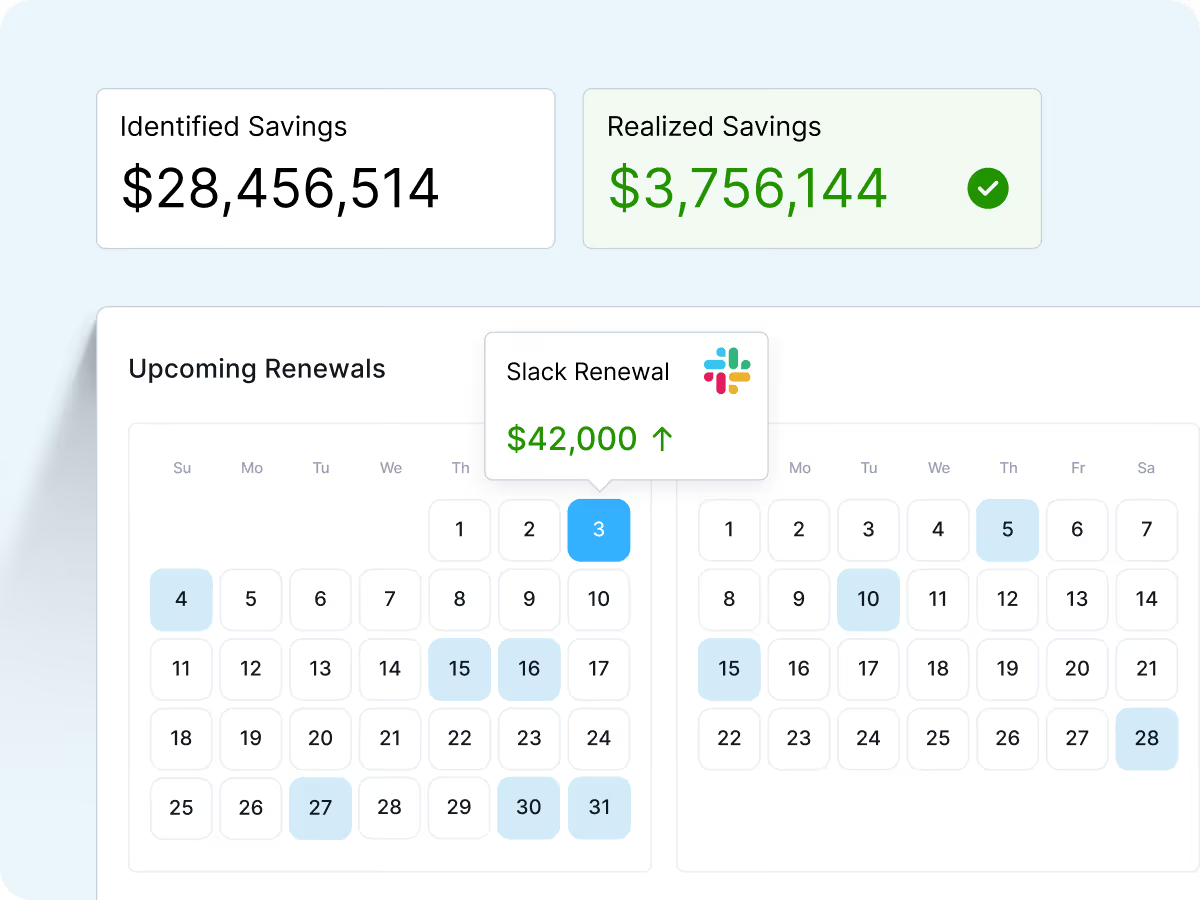
Software asset management (SAM) is the practice of discovering, tracking, and optimizing all software an organization uses. It applies across every software category: on-premises applications, cloud platforms, SaaS subscriptions, and increasingly, AI-native tools.
What Is a Software Asset Management Tool?
A traditional SAM tool helps software asset management teams manage licenses, create effective license positions, and ensure audit readiness for on–premises software. In contrast, a SaaS-forward tool helps SAM teams do the same for SaaS but with the added benefit of robust discovery.
The primary use case of software asset management tools is license management such as identifying over- or underconsumed licenses and ensuring compliance obligations are met. However, they're also expected to support:
- A centralized system of record for software
- Software spend optimization
- Renewal management
- Shadow IT detection
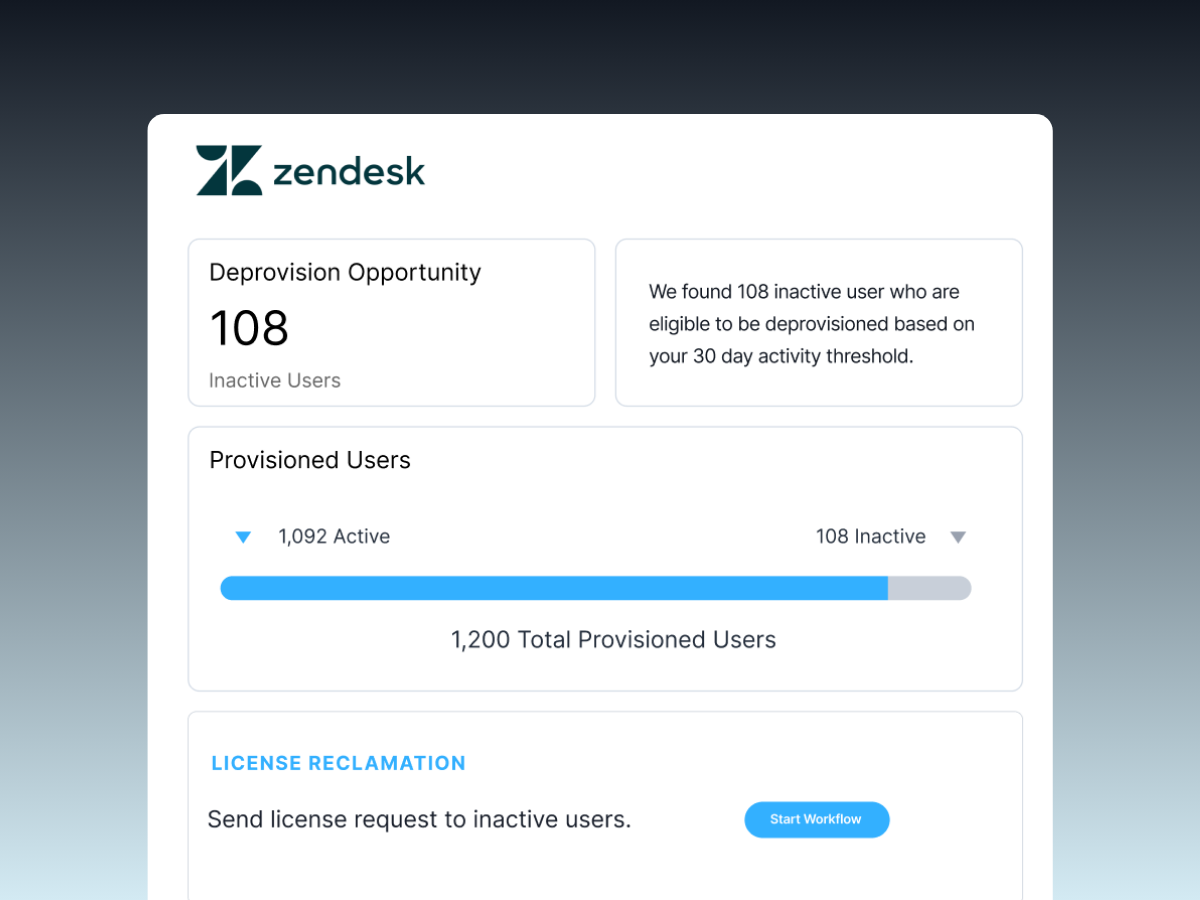
- Automation of the user lifecycle
- Integration with procurement, security, and ITSM systems
Why Organizations Need Software Asset Management Tools
Most organizations are losing money on software before they've even opened a SAM tool. Understanding these three issues is the key to success:
- Why SaaS spend is harder to track than you think
- How unused licenses and unmonitored consumption create hidden waste
- Where compliance risk shows up without warning
Why SaaS Spend Is Harder to Track Than You Think
SaaS spend is difficult to track because IT no longer controls the majority of software purchasing. The average IT department is responsible for just 15% of software spend, according to the 2026 SaaS Management Index, while lines of business and individuals account for the remaining 85%.
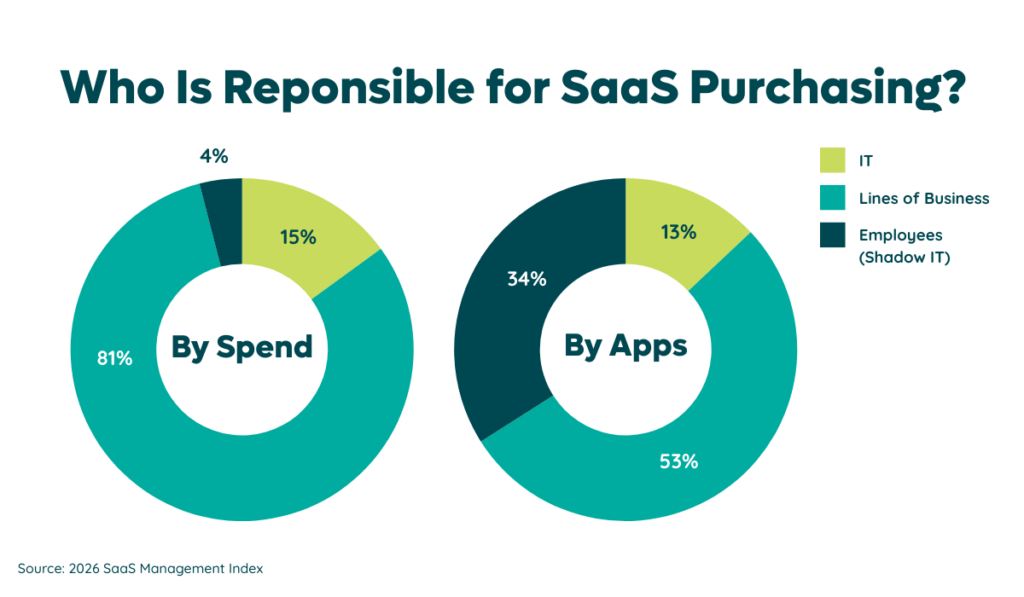
That decentralization creates blind spots. Software is bought through corporate cards, expensed through personal accounts, and approved outside of IT. Without a SAM tool aggregating that data from expense systems, SSO providers, and AP records, there's no single view of what's in the environment or what it costs.
How Unused Licenses and Unmonitored Consumption Create Hidden Waste
Unused software licenses are a source of unnecessary spend, while unmonitored consumption leads to potential overage costs.
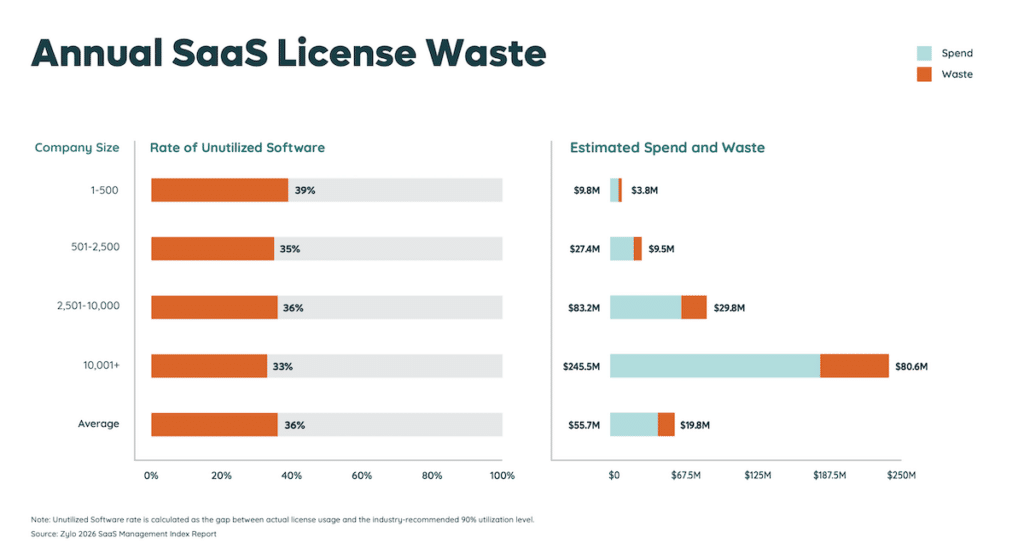
According to Zylo’s 2026 SaaS Management Index, organizations only use 57% of their SaaS licenses on average. That underutilization translates to an average of $80.6M in wasted SaaS spend annually per organization. License waste is largely invisible without tooling, since users leave, roles change, and licenses sit unreclaimed through renewal cycles.
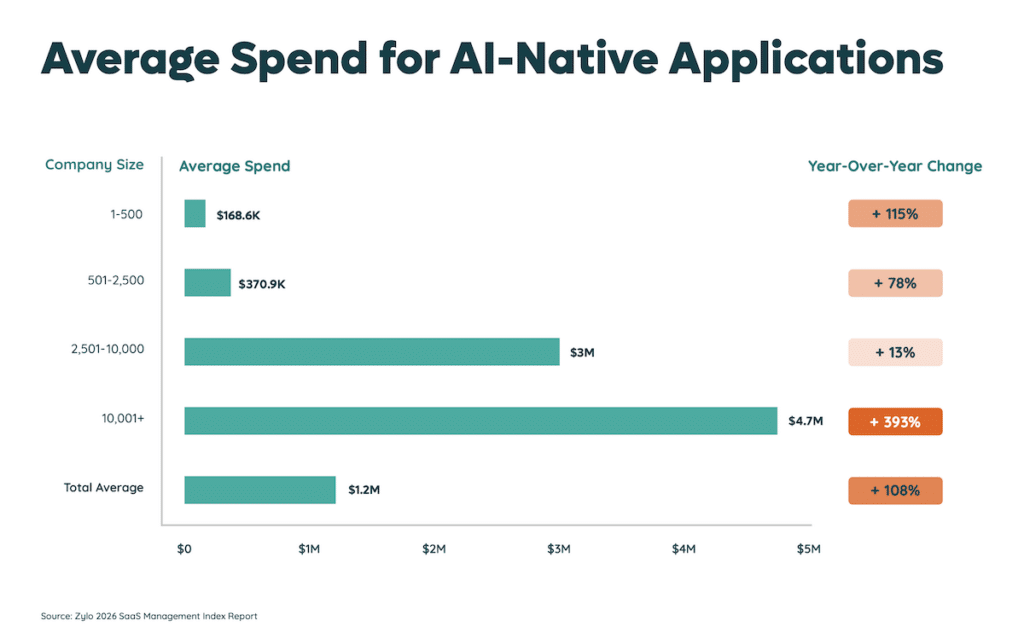
In contrast, 78% of the IT leaders Zylo surveyed experienced unexpected charges on a SaaS bill due to consumption-based or AI pricing models. The Index also shows an astronomical 393% jump in AI-native application spend, illustrating the scale of how AI is impacting the bottom line. When consumption is not monitored consistently, usage commitments are exceeded, driving unplanned costs to escalate quickly.
Where Compliance Risk Shows Up Without Warning
Software compliance risk surfaces in more places than most teams realize:
- End-of-life software still running in production
- Shadow IT apps without security review
- AI applications purchased without governance controls
- Regulatory obligations requiring documented software inventories
Software audits are a fact of life for enterprises with large portfolios. Vendors like Oracle, Microsoft, IBM, and SAP regularly audit customers to verify license compliance, and the cost of being under-licensed can be significant.
Key Features of the Best Software Asset Management Tools
The most important capabilities to evaluate when looking at SAM tools are:
- Software discovery and inventory
- License management and reconciliation
- Usage analytics and optimization
- Workflow automation and integrations
Software Discovery and Inventory
Discovery of all the software in your environment—SaaS, on-premises installations, and cloud workloads—is a non-negotiable feature of SAM tools. Regardless of how software was acquired or where it runs, full visibility is critical for:
- Establishing an up-to-date software inventory
- Preparing for software audits
- Mitigating security and compliance risks
Traditional SAM tools use agent-based and agentless scanning of endpoints, servers, and virtualized environments. The approach originates from the on-premises software world, and it's built around identifying what you already know you have.
This discovery limitation puts traditional SAM at a significant deficit when it comes to SaaS. Apps purchased outside IT, accessed through a browser, or expensed on a corporate card are often invisible to network-level scanning.
SaaS-focused platforms close that gap. They use SSO integrations, browser extensions, expense system ingestion, and direct API connections to surface apps regardless of how they were procured. Organizations with hybrid estates typically need both approaches.
"Once you follow the money, you see where the biggest opportunities to save are."
— Shravya Ravi, Manager of Asset Management at LinkedIn
License Management and Reconciliation
Reconciling what you own against what you use is where a SAM tool delivers its most direct financial value. Effective license positioning means tracking entitlements, monitoring consumption, identifying unused licenses, and flagging compliance gaps before they become audit risk.
For complex enterprise software like Oracle databases, IBM middleware, and SAP, reconciliation requires deep knowledge of vendor-specific metrics. Tools that specialize in this area offer dedicated compliance modules built around how those publishers actually calculate license exposure.
Usage Analytics and Optimization
Knowing a license exists is different from knowing whether it's being used. The best SAM tools surface actual usage data like:
- Last login dates
- Feature-level engagement
- User activity levels
- Departmental adoption trends
Visibility into usage analytics enables license rightsizing, contract renegotiation, and rationalization decisions where utilization doesn't justify the cost.
Workflow Automation and Integrations
SAM tools increasingly function as workflow hubs. They connect across the systems that touch software throughout its lifecycle such as:
- HR systems to trigger onboarding and offboarding
- ITSM platforms for request fulfillment
- Procurement and ERP systems to automatically pull contract and spend data
Whether a tool offers prebuilt connectors or requires custom development is one of the most important factors to evaluate for enterprise deployments. Gartner notes that SAM tools must now support interoperability with ITSM, procurement, security, and GRC platforms to deliver full value.
How to Evaluate and Compare SAM Tools
There's no universal best software asset management solution. The right choice depends on your environment, your team, and what you most need the platform to do. Four actionable steps should anchor your evaluation:
- Define your software environment and scope
- Match the tool to the team using it
- Assess integration depth and data quality
- Weigh implementation complexity and vendor support
Define Your Software Environment and Scope
The most important first question is: what are you managing? Organizations with large on-premises footprints and complex enterprise software contracts need tools built for that complexity—like Flexera One or ServiceNow SAM. Organizations running primarily SaaS and cloud applications need platforms optimized for that environment, like Zylo, Zluri, or BetterCloud.
Many organizations have both a software asset management platform and a SaaS management platform. As Gartner's 2026 Market Guide for SAM Tools notes, no single tool addresses 100% of an organization's complex software needs. Many companies will need a combination of tools to cover all their requirements.
“You need to have both [an SMP and SAM tool] because you have two fundamentally different types of software in the enterprise.”
— Jason Owens, ITAM leader
Match the Tool to the Team Using It
Who'll use the platform day-to-day matters as much as what the platform does. IT asset managers evaluating complex licensing need different tools than IT operations teams focused on provisioning workflows, or finance leaders optimizing SaaS spend at renewal. Ease of use and time-to-value are legitimate evaluation criteria—some platforms require significant configuration investment before delivering insights, while others surface actionable data within days of initial connection.
Assess Integration Depth and Data Quality
A SAM tool is only as useful as the data it can access. When evaluating integrations, depth and data quality matter more than a high integration count. A long list of partner logos means little if the connections only surface basic license information rather than actual usage data.
Look for direct API connections to your SSO provider, HRIS, ERP, and the SaaS applications that account for the largest share of spend. Ask vendors specifically what data each integration returns. Gartner flags data quality as one of the most persistent challenges in SAM programs, with over 47% of procurement leaders reporting their functions are low-maturity in data and analytics.
Weigh Implementation Complexity and Vendor Support
Implementation is often underestimated in SAM tool evaluations. Enterprise SAM platforms can require months of configuration and ongoing tuning, while modern SaaS-focused tools typically deploy faster but still require thoughtful setup. Ask vendors for realistic time-to-value estimates and understand what support is included versus what is purchased separately. User reviews on G2 and Gartner Peer Insights offer unfiltered insight into what the implementation actually looks like.
The Best Software Asset Management Tools in 2026
To come up with the list of best software asset management tools for 2026, we evaluated the following criteria:
- Depth of discovery and inventory capabilities
- Product impact and use case fit
- Integration breadth
- Evidence of continued platform investment
- Company size and maturity
- Security and compliance
- Customer ratings on Gartner Peer Insights and G2
Here’s a quick overview of the best software asset management tools to consider, covering both SaaS-native and hybrid enterprise environments.
BetterCloud
BetterCloud is the most established pure-play SaaS operations management platform in this guide. Founded in 2011 and recognized as a Leader in the 2025 Gartner Magic Quadrant for SaaS Management Platforms, it's built around no-code automation, data protection, and centralized governance of SaaS environments. It's the only vendor consistently recognized as a Leader across G2's SaaS Management, Provisioning, and Data Loss Prevention categories.
- Best for: Organizations that need robust SaaS workflow automation, data protection policies, and governance at enterprise scale.
- Key strengths:
- No-code workflow builder for automated onboarding, offboarding, and license lifecycle management across 70+ direct integrations
- DLP capabilities for detecting and remediating sensitive data in cloud storage—a unique capability among SAM tools
- SOC 2 Type II and ISO 27001 certified; trust center publicly available at trust.bettercloud.com
- Limitations:
- BetterCloud requires more configuration effort than newer plug-and-play SaaS tools, and reviewers note a steeper initial learning curve than with options like Torii or Zylo.
- Less focused on spend analytics and pricing benchmarks than dedicated SaaS spend optimization platforms.
- G2 rating: 4.4 stars (477+ reviews). Leader in the Gartner Magic Quadrant for SaaS Management Platforms (June 2026).
- Verdict: BetterCloud is the best choice for organizations that need enterprise-grade SaaS governance and automation, particularly those with complex policy, security, or data protection requirements.
CloudEagle
CloudEagle is an AI-powered SaaS management and procurement platform founded in 2021 and headquartered in Palo Alto, California. It's recognized in Gartner's 2026 Market Guide for Software Asset Management Tools. It stands out for its Savings-as-a-Service model, where the CloudEagle team assists customers with vendor negotiations as part of the platform subscription. Its 500+ integrations and AI-driven EagleEye assistant surface optimization recommendations automatically, and the platform has processed more than $15 billion in SaaS spend with over $2 billion in claimed customer savings.
- Best for: Mid-sized organizations focused on SaaS cost reduction and renewal optimization, especially those that want procurement support without a large internal SAM team.
- Key strengths:
- 500+ direct integrations across SaaS apps, ITSM, procurement, identity providers, and cloud security platforms
- Savings-as-a-Service model where CloudEagle assists with vendor negotiation—users report discovering they were overpaying by 15% or more on individual renewals
- EagleEye agentic AI assistant for natural language insights and automated license reclamation
- Proprietary SaaSMap database covers 150,000+ vendors for comprehensive discovery
- Compliance support for SOX, GDPR, and ISO 27001
- Limitations:
- CloudEagle is a newer, smaller vendor with limited public funding—a factor to weigh when evaluating long-term support and product investment roadmap.
- On-premises SAM is supported through a partnership with HCL BigFix rather than natively within the CloudEagle platform.
- Rating: 4.7 stars (93+ reviews) on G2. Gartner: Representative vendor, 2026 Market Guide for Software Asset Management Tools.
- Verdict: CloudEagle is a strong fit for organizations seeking AI-powered SaaS optimization, with the option of hands-on procurement support, particularly at the mid-market level.
Flexera One
Flexera One is the enterprise standard for software asset management in complex hybrid environments. It serves approximately 50,000 organizations globally, including large governments and regulated industries.
With roots in software license management going back more than two decades, Flexera today combines FlexNet Manager Suite, the cloud-native Flexera One ITAM platform, and Snow Software—acquired in February 2024—with a Technopedia database covering more than 200,000 software products and a FinOps module for cloud cost optimization.
- Best for: Large enterprises managing complex on-premises, cloud, and SaaS estates with Oracle, IBM, SAP, or engineering software licensing requirements.
- Key strengths:
- Most comprehensive ITAM/SAM coverage available, spanning on-premises, SaaS, cloud, and engineering environments
- Technopedia database with licensing rules for 200,000+ products; Snow Software acquisition in February 2024 significantly expanded SaaS and EMEA capabilities
- FedRAMP Ready, SOC 1 and SOC 2 certified, and ISO 27001 aligned
- Limitations:
- Flexera One carries a steep learning curve and typically requires professional services or specialized implementation partners; G2 reviewers consistently describe configuration as complex and time-intensive.
- The Snow acquisition means some customers on either platform face roadmap uncertainty as the two offerings are unified over time.
- Rating: 4.4 stars (385+ reviews) on G2.
- Verdict: Flexera One is the gold standard for enterprise SAM in complex hybrid environments, particularly for organizations managing thousands of software titles across on-premises and cloud infrastructure.
Oomnitza
Oomnitza is an Enterprise Technology Management platform that manages hardware, software, SaaS, and cloud assets in a unified model—making it well-suited for IT organizations that need a single system of record for their entire technology estate. Its Gateway integration framework includes over 1,500 prebuilt connectors across endpoint management, ITSM, identity, cloud, and SaaS systems, enabling cross-asset workflows such as a fully automated offboarding sequence that spans hardware recovery, SaaS deprovisioning, and ITSM ticket creation in a single workflow.
- Best for: IT teams that need unified management of hardware and software assets with lifecycle automation across the full technology estate.
- Key strengths:
- Unified hardware + software + SaaS management in a single platform, with a shared asset record per user or device
- Gateway integration framework with 1,500+ connectors across endpoint management, ITSM, identity, cloud, and SaaS
- Compass AI analytics module for optimization recommendations and anomaly detection across the asset portfolio
- SOC 2 Type II and GDPR compliant; recognized in Gartner's 2026 Market Guide for Software Asset Management Tools
- Limitations:
- License compliance depth for complex publishers like Oracle and IBM is more limited than dedicated SAM platforms; advanced ELP capabilities typically require third-party integrations.
- As a platform spanning hardware and software, it may lack the specialization that primarily software-compliance-focused organizations need.
- Rating: 4.6 stars (133 reviews) on G2. Gartner: Representative vendor, 2026 Market Guide for Software Asset Management Tools.
- Verdict: Oomnitza is the best option for IT teams seeking a unified view of all technology assets—hardware, SaaS, and cloud—with automation spanning the full lifecycle within a single system.
ServiceNow SAM
ServiceNow Software Asset Management is a module within the broader ServiceNow platform that covers the full software lifecycle, from discovery and entitlement tracking to optimization and compliance reporting. It's built on the same Now Platform as ServiceNow ITSM, CMDB, and Cloud Cost Management—sharing data automatically—and is the natural choice for teams already running IT operations on ServiceNow, where adding SAM means license data lives alongside incidents, change requests, and configuration items. ServiceNow also provides embedded support for engineering and specialty software through integrations with OpenLM and Open IT.
- Best for: Organizations already on ServiceNow who want software asset management integrated into existing IT workflows.
- Key strengths:
- Native integration with ServiceNow ITSM, CMDB, and ServiceNow Discovery across a unified data model
- SAP, Oracle, and Microsoft license optimization modules within the same platform as ITSM workflows
- Over 1,500 pre-built integrations through the ServiceNow Store, including Service Graph Connectors for SCCM, Intune, Workspace ONE, and Jamf
- SSO-driven visibility into more than 12,000 SaaS applications via Okta and Azure AD integrations
- FedRAMP High authorized, SOC 1 and SOC 2 certified, and ISO 27001 aligned; used by major government and regulated enterprise customers
- Limitations:
- Best suited for existing ServiceNow customers; as a standalone SAM purchase, it's typically more expensive and operationally complex than purpose-built alternatives.
- Rating: 4.4 stars (59 reviews) on G2.
- Verdict: ServiceNow SAM is the best choice for organizations already on the ServiceNow platform, where unified data across ITSM and SAM delivers operational value that standalone tools can't replicate.
Torii
Torii is a SaaS management platform founded in 2017 and headquartered in New York. It operates independently as a private company, was named a Leader in Gartner's 2025 Magic Quadrant for SaaS Management Platforms, and ranked #1 in G2's inaugural SaaS Management Platform Grid. IT teams can deploy it quickly and begin automating SaaS discovery, license reclamation, and user lifecycle tasks with minimal configuration.
- Best for: IT teams that want fast deployment and strong pre-built automation for SaaS discovery, onboarding, offboarding, and license reclamation workflows.
- Key strengths:
- Gartner Magic Quadrant Leader and G2 SaaS Management Platform Grid #1—first-edition recognition in both reports
- Extensive pre-built workflow library for common SaaS operations tasks, including no-code license reclamation triggers
- Strong shadow IT discovery through browser extensions and SSO integration data
- SOC 2 Type II certified
- Limitations:
- Some enterprise reviewers note Torii's workflow engine can feel limited for highly complex license compliance scenarios.
- Usage accuracy relies primarily on SSO log data; apps accessed outside SSO may be flagged as inactive even when in use.
- Rating: 4.5 stars (300+ reviews) on G2. Leader in the Gartner Magic Quadrant for SaaS Management Platforms (2026).
- Verdict: Torii is an excellent choice for IT teams that prioritize fast deployment and automated SaaS lifecycle management, backed by Gartner Magic Quadrant recognition.
USU
USU is a German IT management company and one of the most established SAM vendors serving large enterprises in Europe and internationally. In October 2024, Thoma Bravo—which also holds a majority stake in Flexera—acquired a majority share of USU. Its core offering includes SAM modules for SaaS, on-premises software, and SAP environments, with deep coverage of ECC, S/4HANA, and S/4HANA Cloud, including indirect access analysis, FUE tracking, and RISE migration simulation. USU also delivers SaaS management by pulling subscription and usage data directly from vendor portals via API.
- Best for: Large enterprises, particularly in EMEA, managing complex SAP environments or multi-publisher on-premises software estates alongside growing SaaS portfolios.
- Key strengths:
- Deep SAP optimization capabilities, including indirect access analysis, FUE tracking, and RISE migration scenario modeling
- License normalization and intelligence for Oracle, Microsoft, and IBM, supported by a fully integrated product database
- SAM for SaaS module with direct API connections to major cloud publishers like Microsoft 365, Salesforce, and Adobe
- Available as both SaaS delivery and on-premises via Kubernetes containerization—flexible deployment for regulated environments
- Limitations:
- Market presence is strongest in EMEA; coverage in North America is more limited than on global platforms like Flexera One or ServiceNow SAM.
- Configuration and administration can be complex, with a learning curve that steepens when building custom connectors or managing data exchange settings.
- Rating: 4.4 stars (47 reviews) on Gartner Peer Insights. Gartner: Representative vendor, 2026 Market Guide for Software Asset Management Tools. Forrester Wave Leader, Q1 2025.
- Verdict: USU is the strongest choice for large enterprises managing complex SAP environments—particularly in EMEA—with comprehensive license intelligence across major software publishers.
Zluri
Zluri is an identity governance platform founded in 2020 and backed by Lightspeed Venture Partners. It positions itself at the intersection of software asset management and access governance—with more than 750 direct integrations that pull granular usage and access data from business, identity, and HRIS systems, powering accurate discovery and automated joiner-mover-leaver workflows at scale.
- Best for: IT and security teams that need to combine SaaS lifecycle management with user access governance and workflow automation in a single platform.
- Key strengths:
- More than 750 pre-built integrations—the largest catalog in its category—covering SaaS, IAM, HRIS, and engineering tools
- Strong identity governance capabilities, including automated access reviews and license reclamation workflows
- Clear usage visibility that replaces manual spreadsheet tracking, with actionable optimization recommendations
- SOC 2, ISO 27001, GDPR, and HIPAA compliant
- Limitations:
- Founded in 2020, Zluri has a shorter enterprise track record than more established platforms—a consideration for risk-sensitive procurement processes.
- Some reviewers note that integrating certain niche applications requires configuration beyond the pre-built catalog.
- Rating: 4.6 stars (177+ reviews) on G2
- Verdict: Zluri is a strong choice for IT teams that want to combine SaaS management with identity governance, backed by the largest integration library in the category.
Zylo
Zylo is an enterprise SaaS management platform built to give SAM, IT and FinOps teams complete visibility into their software portfolio to optimize spend and mitigate risk. Founded in 2016 and headquartered in Indianapolis, Indiana, Zylo is backed by $72.5M from Bessemer Venture Partners, Salesforce Ventures, Menlo Ventures, and MassMutual Ventures. Zylo’s application library—the Zybrary—contains more than 28,000 applications, supported by a dataset exceeding 40M SaaS licenses and $100B+ in SaaS spend under management.
- Best for: Enterprise IT, procurement, and FinOps teams managing large SaaS portfolios who need spend visibility, license optimization, and renewal management in one place.
- Key strengths:
- Industry's largest benchmarking dataset with $100B+ in managed SaaS spend
- Continuous AI-powered financial discovery that automatically categorizes software
- Centralized system of record that unifies software, usage, spend, and contract data
- AI-powered capabilities, including Contract Assist Agent and Smart Filters
- Consumption-based pricing visibility for AI tools and usage-driven contracts
- End-to-end renewal management workflows that enable a proactive renewal strategy with built-in price benchmarks to strengthen negotiation leverage
- Professional services with guaranteed cost savings
- SOC 2 Type II and ISO 27001 certified
- Limitations:
- As a pure-play SaaS management solution, Zylo isn't designed for on-premises software or traditional license compliance for publishers like Oracle or IBM.
- Rating: Named a three-time Leader in the 2026 Gartner Magic Quadrant for SaaS Management Platforms. Recognized as the only Customers' Choice in the 2025 Gartner Peer Insights Voice of the Customer report for SaaS Management Platforms, where 93% of customers indicated willingness to recommend—the highest among all evaluated vendors
- Verdict: Zylo is the category leader for enterprise SaaS management, with the strongest combination of data depth, usability, and spend optimization outcomes in its class.
Get Complete Visibility Into Your Software with Zylo
Most organizations today operate within a hybrid software environment. As such, visibility into all software titles—on-premises and SaaS—is table stakes to optimize spend, ensure license compliance, and prepare defensible audits. To get complete visibility, modern SAM leaders need both a traditional SAM tool and SaaS Management Platform.
Zylo was purpose built to help software asset managers get the SaaS visibility they need to save money, stay on top of renewals, and maintain a compliant environment. See how organizations like yours are approaching software asset management for SaaS, or request a demo to see how Zylo can support your business outcomes.