
Blog
AI Pricing: What’s the True AI Cost for Businesses in 2026?
Table of Contents ToggleIntroducing Zylo’s Consumption Cost Management SolutionSystem of Record...


Back

Back

Search for Keywords...
Blog
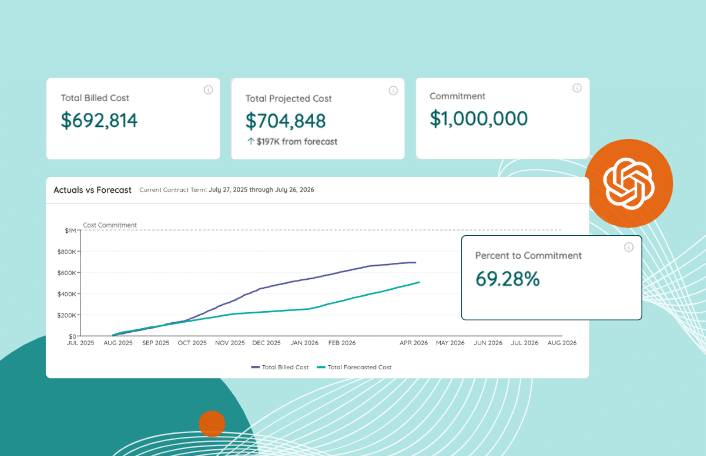
Table of Contents
Consumption cost management has become a requirement as AI and usage-based pricing make SaaS costs unpredictable and difficult to control.
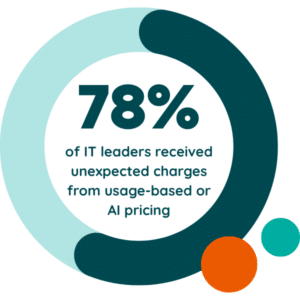
Consumption-based pricing and AI usage have introduced a level of cost volatility that most organizations are not equipped to manage. According to Zylo’s 2026 SaaS Management Index, 78% of IT leaders experienced unexpected charges tied to consumption and AI in the past year.
Costs now accumulate in real time, often without visibility into how usage translates to spend until it’s too late to take action.
Traditional SaaS management was built for fixed, seat-based pricing. That model no longer applies. AI consumption, APIs, and hybrid pricing have changed how software is bought, used, and billed.
Most organizations are reacting to costs instead of controlling them.
That’s why we built Zylo’s Consumption Cost Management Solution. In 2026, it marks an important step for organizations to finally gain visibility and control of their most volatile spend category yet.
Zylo’s Consumption Cost Management Solution gives IT, Software Asset Management (SAM), and FinOps teams a centralized system to manage consumption-based SaaS and AI costs with clear visibility that maps usage to financial impact.
License, usage, and spend data are unified into a single system of record, providing a complete view across seat-based, hybrid, and consumption-based pricing models. With this foundation, your team can track consumption in regularly and understand how it translates to cost.
Modern pricing models require visibility into AI and API-driven consumption. With Zylo, organizations gain direct insight into token, credit, and usage-based cost drivers.
Integrations with OpenAI API, Anthropic API, Snowflake, Databricks, and Google Vertex (Gemini) provide visibility into tokens, credits, API calls, and compute-based cost drivers.
With Zylo, usage, cost, and accountability are connected across the SaaS portfolio, enabling proactive control over consumption spend.
Consumption cost management requires continuous visibility, control, and accountability across usage—not periodic reviews after costs occur. Each capability is designed to help teams act on consumption regularly and avoid unnecessary spend.
| Capability | Description | Value |
|---|---|---|
| Monitoring | Tracks daily/monthly burn rates of AI token (OpenAI/Anthropic) or credit (Snowflake) costs. | Removes the end-of-month billing surprises. |
| Alerting | Automated notifications when usage hits specific thresholds (e.g., 80% of commitment) or spikes. | Risk Mitigation: Enables IT to scale down or optimize usage before a costly overage occurs. |
| Forecasting | Uses historical trends to project usage through the end of the contract term. | Strategic Renewals: Allows teams to buy additional discounted capacity before being forced into list-price overages. |
| Observability | Breaks down consumption data by dimensions like team or project. | Accountability: Identifies specific cost drivers and ensures departments stay within budget. |
Monitoring tracks consumption as it happens, including daily and monthly cost burn rates for AI tokens (OpenAI, Anthropic) and credits (Snowflake, Databricks).
With consistent visibility into usage trends, you can understand how quickly consumption is increasing and how it impacts cost over time. This reduces the risk of end-of-month billing surprises and supports ongoing cost avoidance.

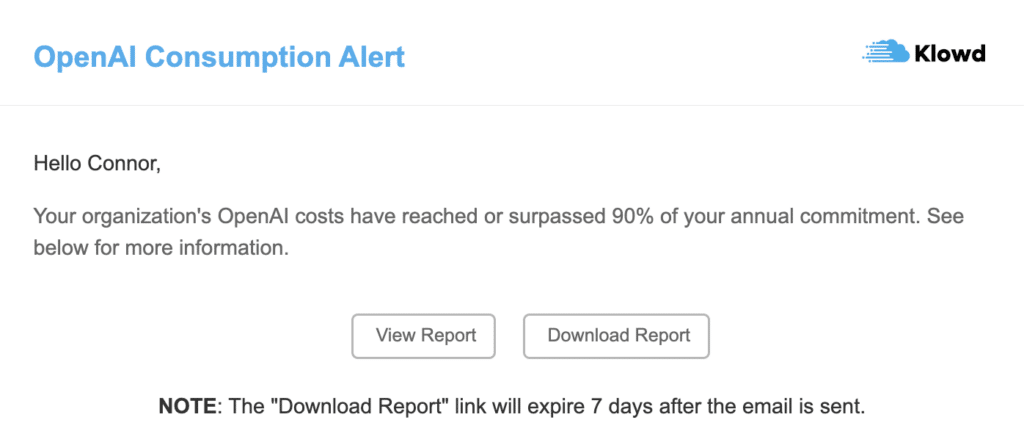
Alerting introduces automated notifications when usage reaches defined thresholds or spikes unexpectedly.
With Zylo, teams can set triggers to take action before overages occur. For example, you may want to know when you’ve reached 80% of committed usage or if a single day’s usage exceeds $1,000. This allows IT and FinOps to scale down usage, adjust workloads, or reallocate resources before costs exceed budget.
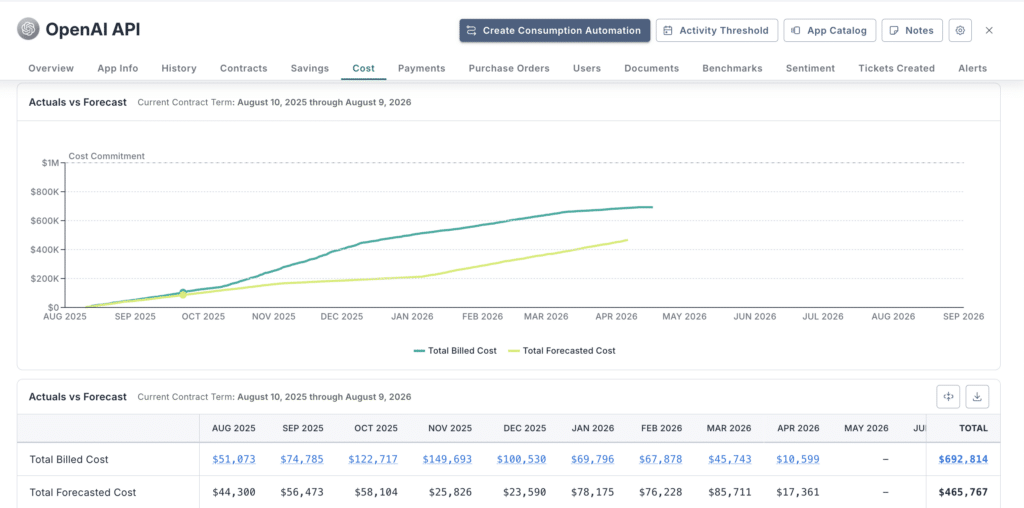
Forecasting uses historical consumption data, powered by Meta AI, to project future usage through the contract term.
With this visibility, you can anticipate when consumption will exceed commitments and make informed decisions ahead of time. In addition, it supports more strategic renewals, including the ability to secure additional capacity at discounted rates instead of defaulting to higher-cost overages.
Observability connects consumption to the teams, projects, and activities driving usage.
By breaking down consumption data across dimensions, organizations gain clarity into where costs originate. Identifying cost drivers creates accountability across departments and helps ensure usage aligns with budget expectations.
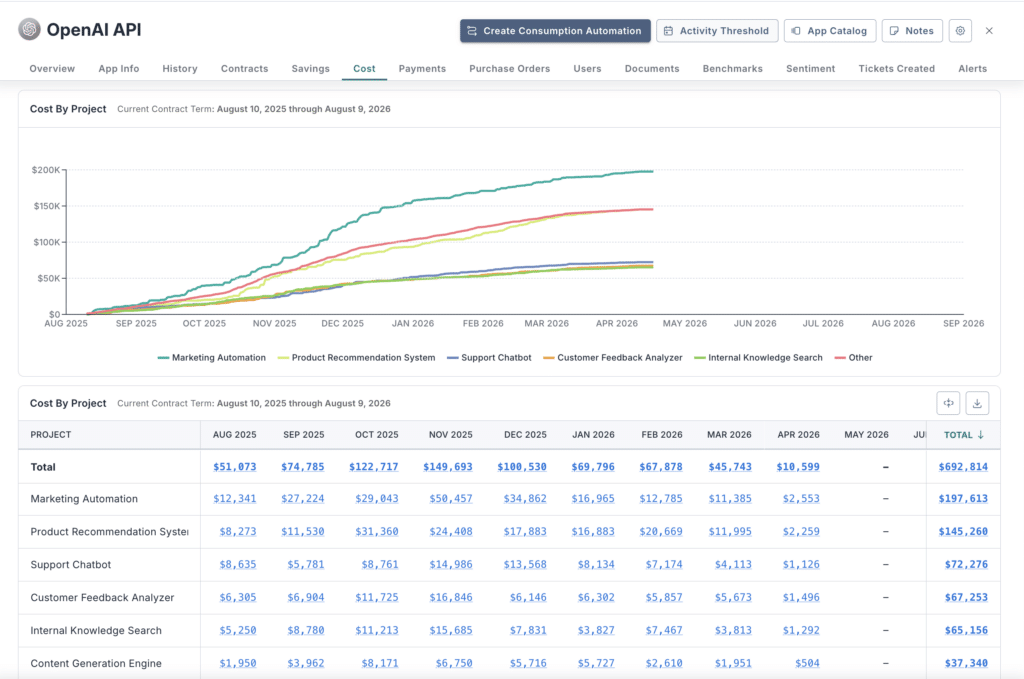
Each of these capabilities work together to shift consumption cost management from reactive tracking to proactive control. Instead of waiting for invoices to surface issues, you can monitor, adjust, and optimize usage continuously.
Consumption cost management is the practice of tracking, forecasting, and controlling SaaS and AI costs tied to usage-based and hybrid pricing models.
It connects usage visibility, cost attribution, forecasting, and governance within a single operating model to show how consumption translates to spend—and enables action before costs escalate.
The need for consumption cost management is now urgent, as AI and usage-based pricing—now becoming standard—escalate spend at an unpredictable pace.
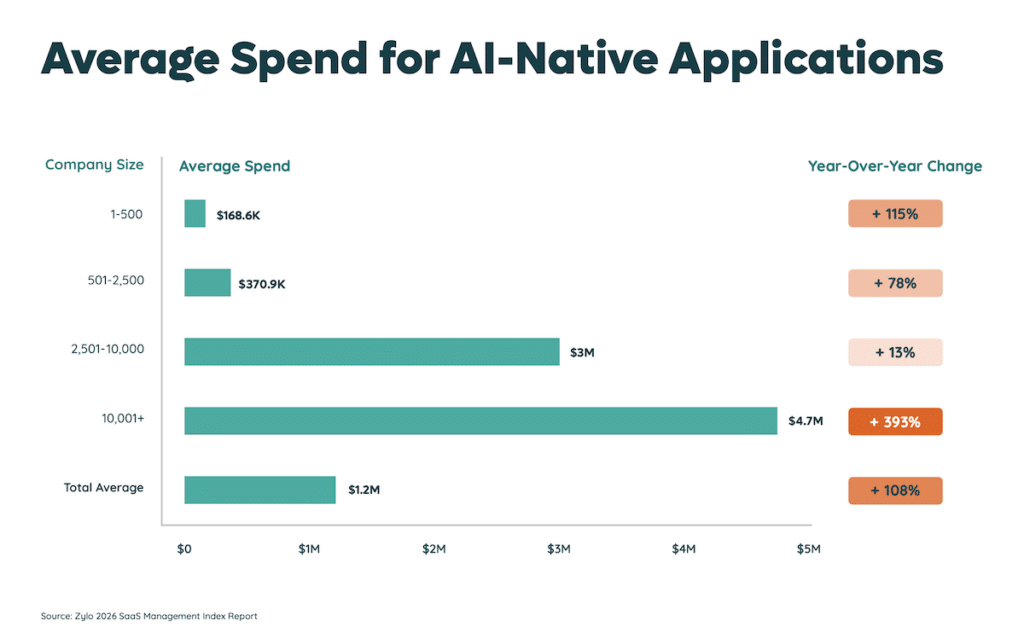
According to Zylo’s 2026 SaaS Management Index, AI-native application spend increased 108% year over year, with large enterprises seeing nearly 400% growth. Consumption-based pricing scales with activity—API calls, tokens, compute, or data processing—introducing continuous cost variability. Hybrid models combine fixed and variable spend, making costs harder to predict and control.
Most organizations lack a unified way to connect usage and cost. Data remains fragmented across systems, limiting visibility and delaying action.
Costs are often identified after invoices arrive, reducing the ability to prevent overages or improve forecasting. As a result, organizations make reactive decisions and miss cost avoidance opportunities.
Traditional cost control models are struggling to keep up with consumption-based pricing because costs now change continuously with usage. The breakdown is a result of:
Consumption-based pricing is designed to align cost with usage, but it also introduces variability that is easy to underestimate.
Usage—especially AI-driven usage—can scale quickly. Without clear visibility and guardrails, costs increase faster than expected, and adjustments tend to happen after the impact is already felt. What starts as flexibility often becomes difficult to manage in practice.
Most organizations still manage SaaS data across separate systems. IT manages access, SAM tracks entitlements, and FinOps monitors spend.
You may have visibility into each of these areas individually, but not in a way that clearly connects usage to cost. That gap makes it harder to attribute spend, align teams, and take coordinated action.
Hybrid pricing models combine seats, usage, and add-ons into a single contract.
Invoices reflect total spend, but they don’t clearly show what’s driving it. Fixed and variable costs are blended together, which makes it difficult to isolate usage patterns or understand where overages originate.
Many teams still identify consumption issues after invoices arrive.
At that point, the focus shifts to responding:
By taking a reactive approach, you limit your ability to prevent overages or improve forecasting accuracy.
Consumption-based pricing continues to expand as AI becomes more embedded in SaaS. Without a more proactive approach to consumption cost management, cost variability will continue to outpace traditional methods of control.
Consumption-based pricing isn’t what creates risk. The issue is operating without visibility into how usage turns into cost.

Most organizations cannot see all AI usage across their environment or how that usage translates to cost.
That lack of visibility is already widespread. According to Zylo’s 2026 SaaS Management Index, 60% of IT leaders report they lack visibility into all generative AI tools in use, and 77% have discovered AI-powered tools operating without IT’s awareness.
As AI tools are adopted across teams, usage grows without a unified way to track it consistently or connect it to spend.
You can see total spend. You can see usage in individual tools. What’s missing is the connection between the two.
Without that visibility, teams operate with partial context:
Consumption cost management becomes effective when visibility is established first.
Once visibility is in place, organizations can:
Teams can act earlier, make informed decisions, and maintain control as usage scales.
AI and consumption-based pricing have changed how SaaS costs behave, shifting spend from fixed to variable—and often volatile. Without clear visibility into how usage translates to cost, overruns become difficult to prevent and even harder to explain.
Consumption cost management addresses this by connecting usage, cost, and accountability. With this visibility, teams can monitor consumption continously, identify key cost drivers, and take action before spend escalates.
Zylo’s Consumption Cost Management Solution gives you the visibility and control needed to stay ahead of rising SaaS and AI costs before they impact your budget. Request a demo to take control of your consumption-based SaaS and AI spend.
Consumption cost management tracks and controls SaaS and AI costs tied to usage, not just licenses. Traditional SaaS cost management focuses on seat-based pricing and renewals. Consumption cost management connects real-time usage (API calls, tokens, compute) to spend, enabling teams to act before costs escalate instead of reacting after invoices arrive.
Consumption-based pricing ties cost directly to usage, while hybrid pricing combines fixed and variable charges. Consumption models charge based on activity like API calls or data processing. Hybrid models layer usage costs on top of base subscriptions. Both introduce variability, making costs harder to predict without visibility into usage patterns.
Consumption-based costs are harder to predict because they scale with real-time usage. Unexpected overages are often caused by increased API activity, AI consumption spikes, or lack of visibility into how teams consume tools. Without monitoring and alerts, usage can exceed commitments before action is taken.
Real-time tracking requires integrating usage and spend data into a single system. Platforms like Zylo provide visibility into metrics such as API calls, tokens, and compute alongside cost data. This enables continuous monitoring, helping teams identify trends and take action before usage leads to overages.
Mapping usage to cost requires connecting consumption metrics directly to pricing models. Solutions like Zylo align units such as tokens, credits, or API calls with contract rates. When usage and spend data are unified, organizations can attribute costs to teams, projects, or activities and understand what drives spend.
Accurate forecasting requires historical usage data and trend analysis. With a platform like Zylo, organizations can analyze consumption patterns, project future usage, and estimate costs. Continuous tracking improves accuracy, allowing teams to adjust before exceeding budget.
Preventing overages requires visibility, alerts, and usage controls. Tools like Zylo enable real-time monitoring, threshold-based alerts, and ownership tracking. These capabilities help teams identify spikes early, adjust usage, and avoid exceeding committed spend.
Consumption cost management requires a platform that connects usage, cost, and ownership. Traditional SAM tools focus on licenses, while FinOps tools focus on cloud spend. Platforms like Zylo unify SaaS usage and cost data, enabling full visibility into consumption-based and hybrid pricing models.
A system of record centralizes usage, spend, and license data in one platform. Solutions like Zylo provide real-time visibility into consumption, map usage to cost, and track ownership across teams. This supports monitoring, forecasting, and governance, enabling proactive consumption cost management.

Table of Contents ToggleIntroducing Zylo’s Consumption Cost Management SolutionSystem of Record...

Table of Contents ToggleIntroducing Zylo’s Consumption Cost Management SolutionSystem of Record...

Table of Contents ToggleWhat Is Subscription-based Pricing?Characteristics of Subscription-based PricingAdvantages of...

Table of Contents ToggleWhat Is Usage-Based Pricing, and Why Now?How Usage-Based...