



Table of Contents
TL;DR: The Most Important SaaS Predictions for 2026
- AI is now performing operational work and billing the business through SaaS. Costs are rising as usage-based pricing replaces traditional license models.
- SaaS leaders must prove value, not just track usage. AI spend is accelerating, but most organizations lack visibility into whether that spend delivers results.
- Usage-based pricing will expose low-value tools. Renewals will require outcome data to justify ongoing investment.
- SaaS velocity is outpacing governance. Apps are entering and exiting the stack faster than most teams can track, increasing risk and complexity.
- 2026 demands new SaaS Management strategies. IT, Finance, and Procurement must align around real-time visibility, proactive ownership, and AI-specific cost control.
2026 SaaS Management Index
Learn MoreAI Is Reshaping the SaaS Cost Structure
AI is fundamentally changing the way enterprises consume software—and how IT manages it.
As generative and embedded AI capabilities scale across applications, organizations are seeing a shift in where and how work happens. What used to be done by people is now increasingly handled by AI. That transition is accelerating software consumption, fueling a surge in operational costs tied to usage-based pricing models.
At the same time, AI tools are entering environments faster than most teams can track. Line-of-business leaders and employees are testing and buying AI-powered apps with minimal oversight, creating new forms of shadow spend and risk.
These shifts form the foundation of this year’s most important SaaS predictions. Spend is rising. Surprise charges are more common. And the traditional models of governance—centered on renewals and license counts—no longer capture the full picture.
Zylo’s 2026 SaaS Management Index examines these trends with a clear message for IT: lead with visibility, usage intelligence, and proactive management. Because AI isn’t just another feature. It’s changing the fundamentals of SaaS.
SaaS Prediction #1: AI Becomes the Most Expensive “Invisible Worker”
In 2026, AI will absorb a growing share of enterprise work—shifting labor from payroll to software budgets and making operational costs harder to track, forecast, and govern.
AI is now performing tasks that once required human effort—generating documents, responding to service tickets, writing code, and more. These tools are embedded in the stack, running continuously, and increasingly acting as digital labor. But unlike headcount, the cost of this work doesn’t show up on a payroll report. It accumulates silently in your SaaS invoices.
AI-native applications are those where AI is core to the product, like ChatGPT or Perplexity.
AI Costs Are Replacing Labor Budgets
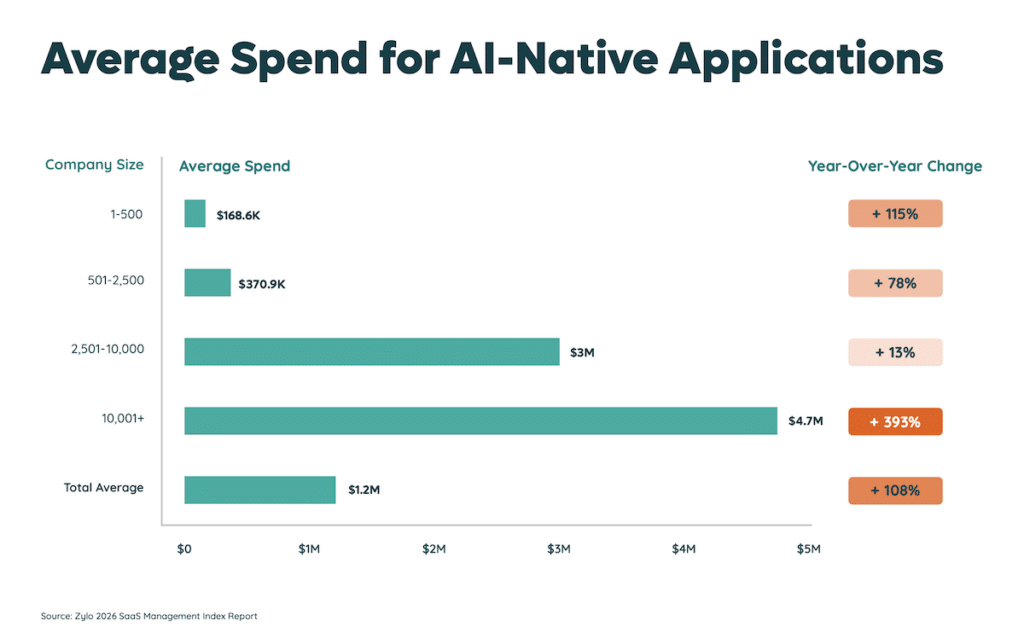
The 2026 SaaS Management Index highlights the impact of this shift. Organizations are rapidly increasing their investment in AI-powered tools, with AI-native app spend more than doubling in the past year. Large enterprises are seeing growth rates near 400%, and many leaders report facing unplanned charges related to AI usage. In some cases, those charges have forced project delays or budget reallocations.
Untracked Usage Is Driving Budget Surprises
This signals a structural change in how work gets funded. Payroll costs are fixed and forecastable. AI-powered SaaS costs are dynamic, distributed, and often invisible until it’s too late. As usage increases, so does financial exposure—without the accountability that typically governs labor costs.
What This Means for SaaS Management:
- AI usage must be tracked like labor, with cost attribution at the feature or task level.
- Ownership must be assigned at intake to monitor performance and justify spend.
- AI spend should be integrated into budget forecasting and governance workflows.
AI is performing work—and charging for it. Managing that cost requires the same level of visibility, accountability, and planning as any other part of your workforce.
SaaS Prediction #2: AI Will Create a Value Crisis, Not Just a Cost Problem
AI spend will demand new levels of justification—forcing IT, finance, and procurement to connect usage to measurable business outcomes.
AI Spend Is Outpacing Value Measurement
As AI features become embedded in more enterprise tools, organizations are accelerating adoption—but not always tracking value. Workflows powered by AI are now common, but the costs behind them often grow faster than the ability to measure impact.
Leaders Are Struggling to Defend Renewals
The result is mounting pressure to defend budgets. Leaders are navigating fragmented pricing models, variable consumption, and decentralized ownership—while trying to explain the business case behind growing SaaS invoices.
The 2026 SaaS Management Index points to a clear trend: teams are investing heavily in AI tools, but few have visibility into how those tools contribute to performance, productivity, or cost savings. When outcomes aren’t clear, even widely used apps can feel expensive.
What This Means for SaaS Management:
- Value metrics must go beyond adoption, focusing on business outcomes.
- Cost center alignment is essential, especially for AI usage that spans departments.
- Renewals should reflect performance, not just activity or tool popularity.
SaaS Prediction #3: Paying for Usage Will Expose How Little Value Some AI Actually Delivers
Our third SaaS prediction is all about value. As AI pricing shifts to usage-based models, organizations will scrutinize whether that usage creates enough value to justify the spend.
Usage-Based Pricing Is Changing Expectations
AI is becoming a standard layer in enterprise software. Across nearly every category, vendors are rolling out generative and embedded AI capabilities—quickly, broadly, and often without a clear business case.
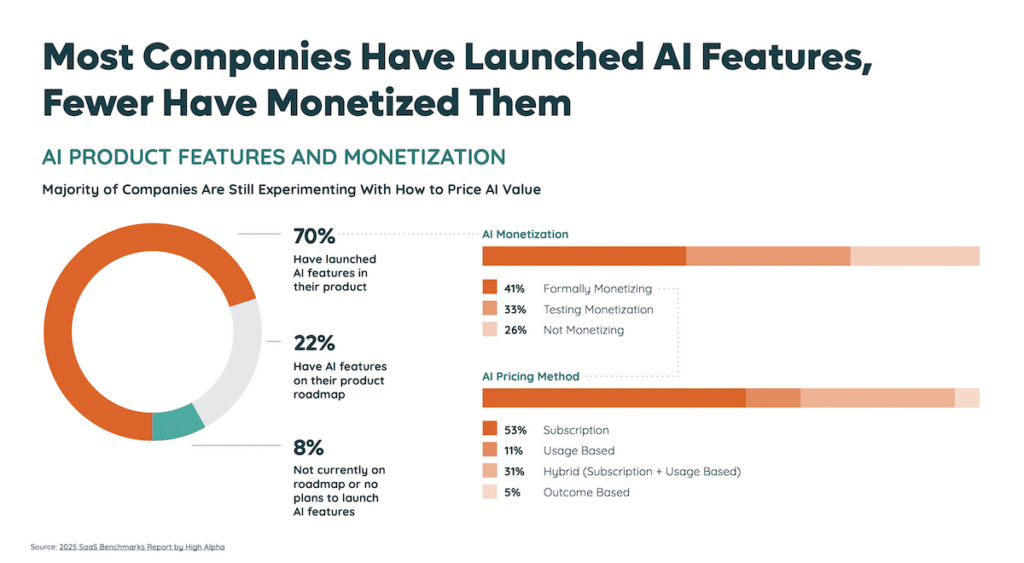
According to the 2025 SaaS Benchmarks Report by High Alpha, 64% of SaaS companies say AI is now a supporting feature in their tools, and 36% say AI is core to the product itself. Nearly every vendor—92% overall—has either launched AI features or has them on their roadmap. That level of saturation confirms what enterprise IT already sees: AI is everywhere.
Frequent Use Doesn’t Guarantee ROI
But as AI becomes table stakes, usage alone won’t be enough to justify its cost. Activity is now metered—by task, token, prompt, or resolution. That means every interaction incurs a charge. And with usage-based pricing on the rise, tools with high activity but low business impact will quickly face scrutiny at renewal.
When cost and usage are tightly coupled, renewals become performance reviews. Instead of asking “Are people using it?”, leaders will ask:
- “What measurable impact did this application have?”
- “How much time, effort, or cost did it reduce?”
- “Did this tool improve outcomes—or just create more output?”
These questions are operational requirements. Business leaders expect line-item accountability, especially as SaaS spend continues to rise. AI-driven tools that can’t tie usage to outcomes risk being replaced—regardless of how innovative or widespread they may be.
What This Means for SaaS Management:
- Frequent use doesn’t guarantee ROI. It invites questions about effectiveness.
- KPIs must shift from login counts to business outcomes.
- Vendors will need to help buyers quantify impact, not just promote feature releases.
AI adds capability. But spend must still be aligned to measurable results. The tools that deliver value will stay. The ones that don’t will cycle out—fast.
SaaS Prediction #4: SaaS Velocity Is the New Governance Frontier
In 2026, the pace at which SaaS applications are adopted and retired will pose a greater risk than overall app volume.
SaaS Stacks Are Growing More Dynamic, Not Just Bigger
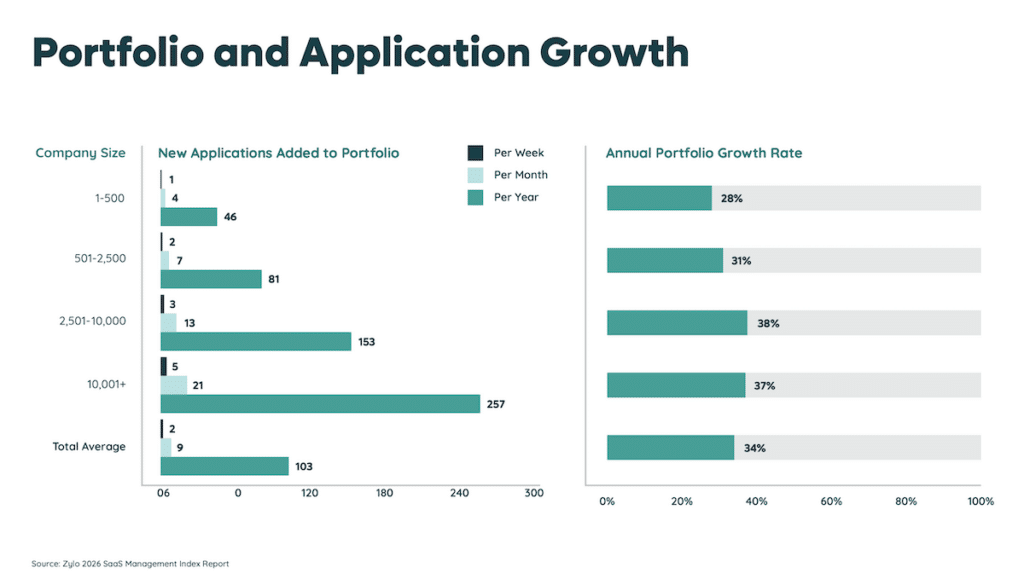
The number of SaaS applications in the enterprise has reached a point of saturation. Most companies now manage hundreds of tools, and for large enterprises, that number often stretches into the thousands. But the bigger challenge is how fast that stack is changing rather than how many apps are in it.
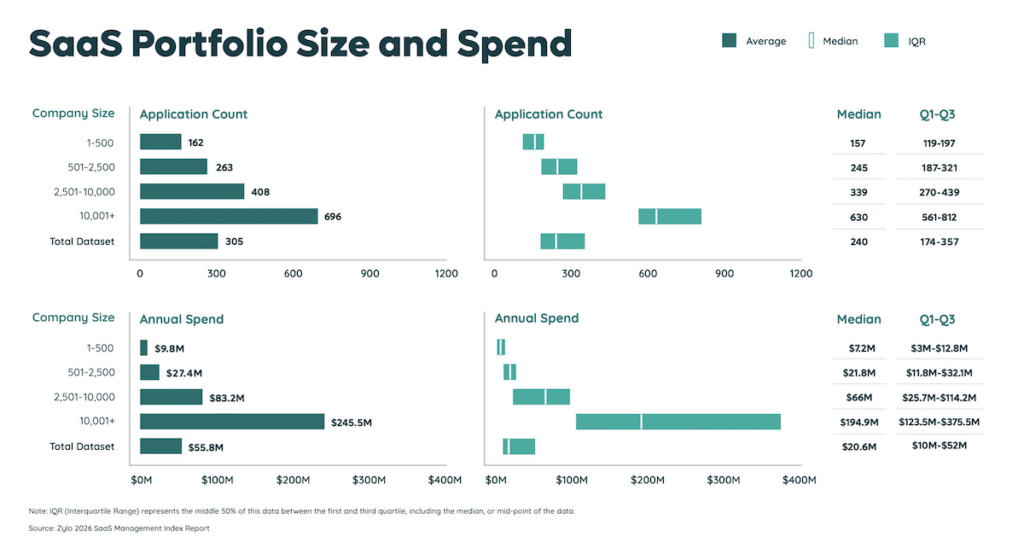
According to the 2026 SaaS Management Index, the average company manages 305 applications, with large enterprises operating portfolios as high as 1,000. Yet average total portfolio size barely moved year over year. What changed dramatically was the rate of turnover: organizations are adding more than eight tools each month on average, resulting in annualized growth of over 34%.
Speed of Change Is the New Source of Risk
This constant motion—tools entering, being piloted, rolled out, and then quickly retired—is what defines SaaS velocity. And it’s exposing a new layer of governance complexity.
Without proper intake and offboarding processes:
- Tools get adopted without security reviews or contract oversight
- Employee access persists long after apps are no longer in use
- Orphaned licenses continue to generate cost
- Sensitive data is scattered across tools no longer actively managed
The governance challenge has shifted from controlling app sprawl to managing application motion. Risk no longer stems solely from the size of the portfolio, but from the speed of change within it. In this environment, slow governance is ineffective governance.
What This Means for SaaS Management:
- Governance must start at intake, with workflows that vet, document, and assign ownership for every new tool.
- Offboarding should be automated to ensure licenses are reclaimed and access is revoked.
- Systems of record should reflect change over time, not just current inventory.
- Rationalization strategies need to account for churn, not just sprawl.
Managing SaaS in 2026 requires real-time awareness and dynamic processes. Governance must move at the speed of the stack.
What IT Leaders Should Focus On in 2026: Control AI, Prove Value, Govern at Speed
IT leaders are in the driver’s seat, despite the fluctuating and unpredictable SaaS landscape. However, it demands a shift in how they manage spend, governance, and value delivery.
To stay in control, IT teams must prioritize:
- Operationalizing AI spend as a new, dynamic cost category
- Validating value over usage to defend renewals and budgets
- Governing app velocity, not just sprawl
- Building alignment across IT, Finance, and Procurement
1. Operationalize AI Spend
AI tools charge by the task, prompt, or user action—creating dynamic costs that are easy to miss.
- Set notifications to flag new app purchases.
- Assign ownership at intake with clear accountability for performance.
- Build AI spend forecasts into renewal timelines and budget cycles.
2. Move from Usage Monitoring to Value Validation
Adoption is no longer a strong enough indicator. IT must show whether apps are improving outcomes.
- Pair usage data with business KPIs.
- Tie SaaS renewals to performance.
- Flag tools with high cost and low return early.
3. Govern SaaS Velocity
Risk increases as apps enter and exit faster than they’re managed. Governance must be continuous.
- Standardize app intake workflows with centralized tracking.
- Identify risky licenses tied to former or unauthorized users to reclaim unused access and reduce compliance risk.
- Monitor licenses and usage over time to identify risk and waste.
4. Make SaaS Management a Shared Discipline
SaaS touches every function. But without alignment, visibility disappears.
- Collaborate with Finance to monitor spend trends and variance.
- Support Procurement with usage and outcome data for better terms.
- Give business owners app-level responsibility with ongoing reporting.
Get the Full Report for More Insight on these SaaS Predictions
The risks are growing. The costs are rising. The time to take control is now.
The 2026 SaaS Management Index is your essential guide to what’s happening inside the modern SaaS stack and what to do about it. Backed by data from more than $75B in SaaS spend, it exposes the new economics of SaaS, the operational impact of AI, and the governance gaps putting enterprises at risk.
Whether you’re leading IT, Procurement, or Finance, this is the intelligence you need to make faster decisions, avoid budget surprises, and stay ahead of unmanaged growth. Download the 2026 SaaS Management Index now.
FAQs on 2026 SaaS Predictions
What are the top SaaS predictions for 2026?
Key SaaS predictions for 2026 include rising AI-driven costs, usage-based pricing, pressure to prove value, and increased SaaS churn. These shifts require IT, Finance, and Procurement teams to rethink how they manage spend, renewals, and governance across a faster-moving, AI-enabled software environment.
How much are organizations spending on SaaS in 2026?
The 2026 SaaS Management Index reports that annual SaaS spend is rising steadily by 8%, with the average organization spending $55M annually—and $245M for large enterprises. This includes core productivity tools, department-specific platforms, and a growing share of AI-powered applications.
How much is being spent on AI in the SaaS stack?
AI-native and embedded AI tools are now a major driver of SaaS spend. Zylo’s 2026 SaaS Management Index reports a 108% surge in AI-native app spending. However, costs will increase as organizations consume more task-based automation and pay per action or token.
What does “SaaS velocity” mean?
SaaS velocity refers to how quickly apps are added to and removed from the tech stack. On average, Zylo’s 2026 SaaS Management Index reports an app churn rate of 33%. Even if portfolio size stays flat, rapid churn increases security risks, hidden costs, and operational complexity.
Why is SaaS Management important now?
Traditional IT models can’t keep up with the speed and complexity of modern SaaS adoption. With AI driving unpredictable spend and tools constantly entering and exiting the stack, SaaS Management has become essential for controlling cost, mitigating risk, and demonstrating value.
Is SaaS dead due to AI?
No. AI is expanding SaaS, not replacing it. But it is changing how SaaS behaves. With usage-based pricing and embedded AI features, costs are harder to predict. That makes SaaS Management essential for tracking spend, proving value, and reducing risk in real time.

Related Blogs
Webinar
ON DEMAND: SaaS Trends No One Can Ignore in 2026
Join Zylo leaders Ben Pippenger and Michelle Baker for an exclusive...

Blog
Usage-Based Pricing Is Reshaping SaaS—Here’s How to Stay in Control
Table of Contents ToggleWhat Is Usage-Based Pricing, and Why Now?How Usage-Based...