 —
—  —
— 
Blog
The Essential SaaS Compliance Checklist for 2026
Table of Contents ToggleTL;DR: SaaS Compliance Is a Visibility and Governance...


Back

Back

Search for Keywords...
Blog

Table of Contents
SaaS spend management software helps IT, FinOps, and procurement teams optimize software spend by discovering all applications, tracking license utilization, managing renewals, and controlling costs across a decentralized software portfolio. The best platforms combine automated discovery, usage analytics, contract management, and benchmark pricing into a single system of record.
Top tools for 2026 include:
SaaS spend management is the practice of gaining complete visibility into every software and AI subscription an organization pays for, understanding how those tools are used, and taking deliberate action to reduce waste, control costs, and govern purchasing.
Getting SaaS spend under control gives IT, FinOps, and procurement teams real visibility into their software portfolio. Organizations that build strategic programs:
The result? You can make informed decisions about which tools to keep, consolidate, or renegotiate, rather than managing a growing software portfolio through disconnected spreadsheets and manual processes.
SaaS spend is rising faster than portfolios are growing, and the gap between what organizations pay and what they actually manage is still widening.
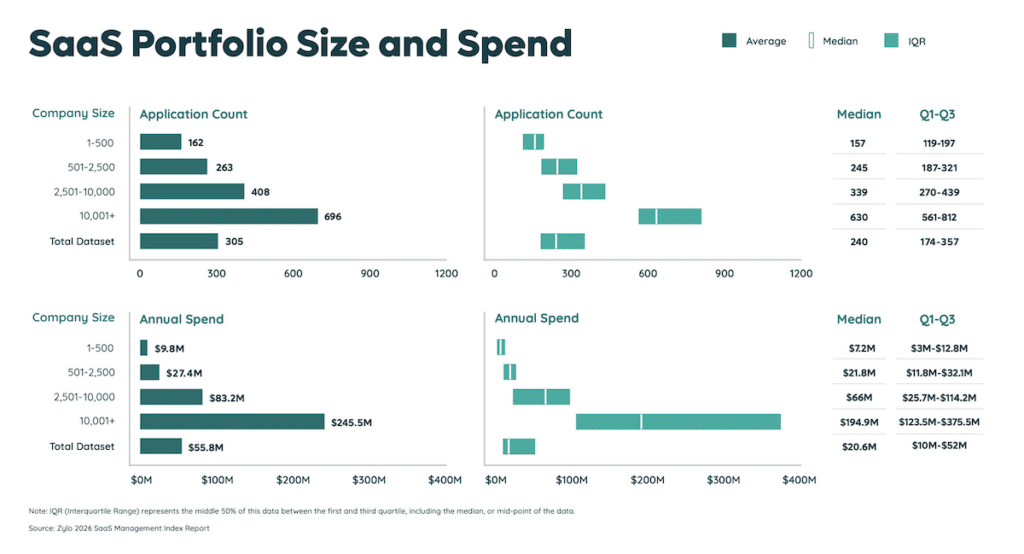
The average organization now spends $55M annually on SaaS, an 8% year-over-year increase, according to Zylo’s 2026 SaaS Management Index. Application counts have largely plateaued, but spend continues to climb driven by consumption-based pricing and AI.
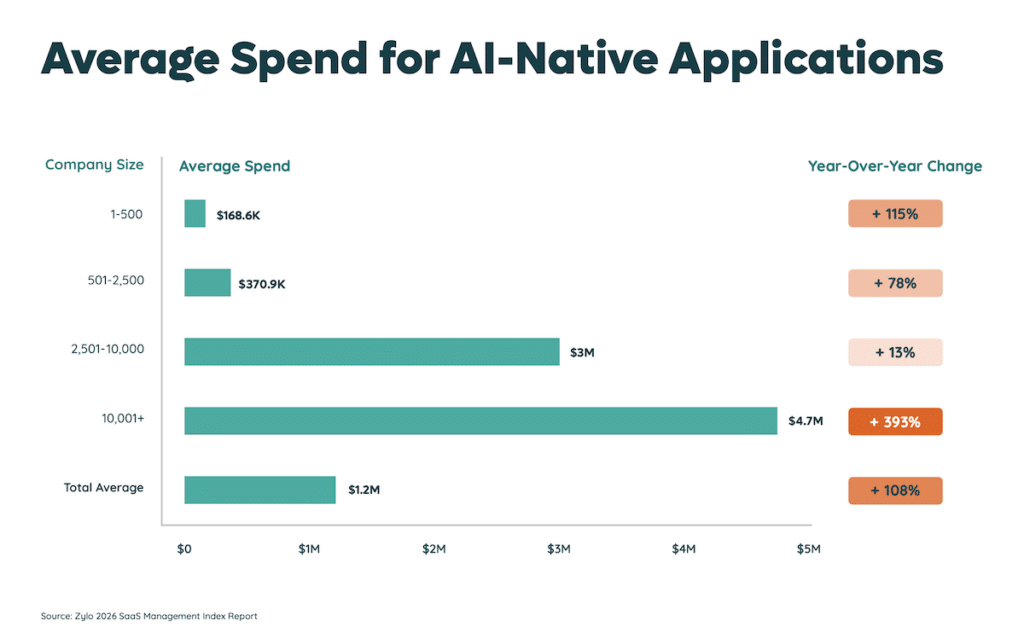
In addition, spending on AI-native applications rose 108% in 2025, with the average organization allocating $1.2M to tools such as Claude.ai, Perplexity, and the OpenAI API. Meanwhile, AI features are now embedded in nearly every software category, meaning organizations are paying for capabilities bundled into tools they may not fully track or evaluate.
Decentralized purchasing compounds the pressure on budgets. IT now owns just 15% of SaaS spend., while the remaining 85% is driven by lines of business and individual employees expensing tools without oversight. The consequences are significant:
The upside is equally clear. Organizations that realize savings through SaaS management reinvest in innovation and growth initiatives (34%), new software or technology (33%), and expanded team capabilities (19%).
SaaS spend management software is a platform built for IT, FinOps, and procurement teams. It centralizes every software subscription, contract, and usage data point across the organization so teams can:
To surface all applications in use, even shadow IT purchased outside standard procurement channels, SaaS spend management tools integrate with:
From this foundation of visibility, you and your team can track license utilization, manage renewal timelines, benchmark pricing, and identify redundant or underused applications.
This software category is sometimes referred to as SaaS management platforms (SMP) or SaaS operations software. The tools vary in depth. Some are primarily spend- and procurement-oriented, while others focus more on IT automation and lifecycle management. A growing segment combines both.
Key capabilities to evaluate when choosing SaaS spend management software include:
Effective SaaS spend management starts with knowing what apps you have and what you’re spending on them. Discovery identifies every application in use across the organization, including tools purchased by IT, business units, and individual employees.
Platforms take different approaches to discovery. When evaluating a tool for its discovery and inventory capability, look for:
“Once you follow the money, you see where the biggest opportunities to save are.”
— Shravya Ravi, Manager of Asset Management at LinkedIn
You also need to understand whether the tools in your portfolio are being used, by whom, and at what cost. Look for SaaS spend management tools that:
Organizations manage hundreds of renewals per year—305 on average per Zylo’s 2026 SaaS Management Index. Without a system of record to track contract terms, renewal dates, and ownership, it is easy to miss renewal windows and auto-renew with unfavorable terms.
A strong contract management capability:
Automation is an increasingly important capability for spend visibility, forecasting, and renewals. SaaS spend management software should include automation for use cases such as:
Forecasting extends this further, allowing FinOps teams to model spend forward and account for consumption-based pricing and license changes. Given that 79% of IT leaders experienced price increases at renewal in the past year, the ability to anticipate cost changes matters more than ever.
As SaaS purchasing decentralizes, FinOps teams increasingly need to understand which departments own which tools and how spend breaks down across the organization. Cost allocation by department:
One of the most direct ways SaaS spend management platforms generate ROI is by giving procurement teams access to pricing benchmarks. Knowing what peer organizations pay for the same tool changes the negotiation dynamic entirely. The quality of that data depends on the breadth and recency of the underlying database. Vendors managing substantial SaaS spend across enterprise customers have a meaningful advantage here.
Every unmanaged application is a potential risk. Expense-purchased tools and shadow AI consistently introduce higher-risk applications into the environment, a pattern that intensifies as organization size increases. Look for platforms that:
To come up with the list of best SaaS spend management software for 2026, we evaluated the following criteria:
Here’s a quick overview of the best SaaS spend management tools to consider.
| Tool | Best For | Target Users | Key Capabilities | Financial Discovery | Ideal Company Size |
|---|---|---|---|---|---|
| Zluri | Identify governance with integrated SaaS management | IT, Security | Discovery, Optimization, Access, Automation | Partial | Mid-market |
| Zylo | Enterprise SaaS spend optimization with full spend visibility and benchmarking | IT, Procurement, FinOps | Discovery, Optimization, Renewal, Procurement | Full | Enterprise |
| CloudEagle | SaaS procurement with vendor management and pricing transparency | Procurement | Discovery, Optimization, Procurement | Partial | Mid-market, Enterprise |
| Vendr | SaaS purchasing with expert-led negotiation and support | Procurement | Procurement, Renewal | None | Mid-market, Enterprise |
| BetterCloud | SaaS operations with advanced lifecycle automation and policy control | IT, Security | Discovery, Optimization, Access, Automation | Partial | Small business, Small enterprise |
| Lumos | Access management with automated SaaS provisioning workflows | IT | Discovery, Access, Automation | None | Mid-market, Enterprise |
| Torii | SaaS lifecycle management with identity and access control | IT | Discovery, Optimization, Access, Automation | Partial | Mid-market |
| FlexeraOne | Hybrid IT and SaaS management across complex environments | IT, SAM | Discovery, Optimization, Renewal | Partial | Enterprise |
| ServiceNow SAM Pro | SaaS management embedded in ServiceNow ITSM workflows | IT SAM | Discovery, Optimization, Renewal, Automation | Partial | Enterprise |
| Productiv | SaaS usage analytics and engagement insights for optimization | IT | Discovery, Usage, Optimization | Partial | Enterprise |
Not all SaaS spend management tools are built the same. Some manage the full SaaS lifecycle, while others specialize in procurement, automation, identity, or AI visibility. The categories below reflect where each provider delivers the most value, so you can compare tools based on what actually matters to your organization.
SaaS management platforms are purpose-built to manage SaaS end-to-end, combining visibility, license optimization, and renewal management in a single system. They are the strongest fit for cross-functional teams spanning IT, SAM, and procurement that need a complete system of record.
Zluri is a SaaS management platform that serves FinOps, IT, and security teams with a single interface for managing applications, spend, user lifecycle workflows, and access reviews. The company is actively positioning itself as a next-generation Identity Governance and Administration (IGA) platform, giving it a broader footprint than pure spend management tools.
Zylo is an enterprise SaaS management platform designed to help IT, FinOps, and procurement teams discover applications, optimize license utilization, and manage renewals through a centralized system of record. A core capability of the platform is financial discovery, which captures SaaS spend across accounts payable and expense data to provide a more complete and continuously updated view of the software portfolio, including shadow IT and employee-expensed tools.
The platform is supported by a large dataset comprising more than 40M SaaS licenses and $75B in managed SaaS spend. This dataset underpins its benchmark pricing and renewal analysis capabilities, which are used to inform vendor negotiations and identify cost optimization opportunities.
In 2025, Zylo introduced several AI-driven features, including automated contract data extraction, natural-language reporting, and administrative controls for managing AI usage within the platform. It also expanded support for consumption-based pricing models, reflecting the increasing variability in SaaS cost structures. In addition, Zylo offers optional professional services that focus on cost savings and program execution for organizations seeking operational support.
SaaS procurement platforms focus on buying software efficiently and reducing costs through negotiation, rather than managing the full SaaS lifecycle. They are a strong fit for procurement-led organizations that want structured buying workflows and aggregated pricing intelligence.
CloudEagle is a SaaS management platform with strong coverage for procurement, vendor management, and license optimization. It provides transparent, tiered pricing, which distinguishes it from many competitors in this category that require a sales consultation to obtain pricing information.
Vendr is a SaaS procurement platform that helps organizations reduce software costs and simplify vendor negotiations. With over $15B in SaaS pricing data processed, Vendr brings aggregated buying data and expert negotiation support to its platform.
IT automation platforms focus on operational execution inside SaaS applications, especially onboarding, offboarding, and policy enforcement. They are the strongest fit for IT and security teams that need granular workflow automation across the SaaS stack.
BetterCloud is a SaaS management platform that covers discovery, spend optimization, security policy enforcement, and workflow automation from a single interface. The platform is particularly strong in lifecycle management, including onboarding, offboarding, and access provisioning for Google Workspace and Microsoft 365.
BetterCloud expanded its spend management and data security capabilities through its acquisitions of G2 Track and Tricent, broadening coverage into contract and license management alongside its core IT automation strength.
Identity governance and access (IG&A) platforms prioritize who has access to what, with SaaS management as a supporting capability rather than the core design. They are the strongest fit for security and IT teams where access governance and SaaS visibility are part of the same conversation.
Lumos is an Autonomous Identity Platform, with SaaS management capabilities reframed as a subset of its broader identity governance offering. For organizations where shadow IT discovery, access control, and license optimization are the primary drivers, Lumos covers those use cases within a platform built around identity, rather than spend or procurement. Teams that need a purpose-built SaaS spend management program will likely find the coverage limited outside of the identity governance context.
Torii is a SaaS management platform that combines automated discovery with identity governance and administration (IGA) capabilities. It identifies applications across SSO, APIs, browser extensions, and network logs, giving teams a near-complete view of the SaaS environment without requiring manual input. Torii’s IGA functionality extends this visibility into access controls, user lifecycle management, and provisioning workflows, making it a useful option for mid-market IT teams managing both spend and identity governance from a single platform.
ITAM and SAM platforms extend traditional software asset management into SaaS, making them well-suited for large enterprises that need compliance, audit tracking, and hybrid asset visibility from a single platform. SaaS management capabilities are present but sit within a broader platform rather than as a dedicated focus.
Flexera (now FlexeraOne, formerly including Snow Software) is a broad IT asset management platform with SaaS management capabilities embedded within a wider cloud cost management and software asset management suite. It is particularly well-suited for large enterprises managing mixed environments.
ServiceNow Software Asset Management (SAM Pro) runs on the Now Platform and provides software license tracking, compliance management, and usage analytics for organizations managing assets across IT, procurement, and operations. It is best positioned as an addition to an existing ServiceNow deployment rather than a standalone SaaS management solution.
This emerging category focuses on understanding how SaaS and AI tools are actually used across the organization, particularly across shadow IT and accelerating AI adoption. These platforms are strongest for portfolio-level insight and engagement analytics, rather than lifecycle management or procurement execution.
Productiv is a SaaS management platform that combines engagement-level usage analytics with SaaS discovery and governance functionality. It measures how applications are actually used across an organization through more than 50 engagement dimensions, giving IT and business leaders a detailed picture of software value beyond license counts. Productiv also surfaces shadow IT and supports governance workflows, making it broader in scope than a pure analytics tool.
Note: Productiv exited the 2025 Gartner Magic Quadrant for SaaS Management Platforms because it did not fully meet the workflow orchestration criterion for that cycle.
The right SaaS spend management tool varies depending on where your organization starts. A team building visibility for the first time has different needs than one with an established SaaS operations program and defined renewal workflows already in place.
The platforms in this category vary significantly in how they balance spend visibility, IT automation, procurement intelligence, and security governance. Getting aligned internally on your maturity level, program ownership, and top priorities before engaging with vendors will save significant time during the evaluation process.
SaaS spend management platforms are cross-functional tools, and the right stakeholders need to be in the evaluation process from the beginning. The core buying group typically includes:
In larger organizations, software asset management teams and business unit leaders who own significant application portfolios should also be involved.
To do a proper software evaluation, follow these steps:
Start by documenting your current state:
From there, define your must-have capabilities and prioritize them before opening vendor conversations.
Request demos with specific scenarios from your own environment, not generic use case walkthroughs. Ask vendors to show you how they handle expense-based SaaS discovery, how benchmark pricing surfaces, and what the renewal management workflow looks like end-to-end.
Confirm integration coverage before shortlisting. The value of any SaaS spend management platform depends on its ability to pull data from the systems you actually use—your SSO provider, ERP, HRIS, expense system, and direct app integrations.
Finally, evaluate the support model, asking questions such as:
You can also explore questions to ask when evaluating a SaaS management platform to build out a more complete RFP framework.
Adobe Drives Innovation and Massive Savings with Zylo
In the past 4 years, Adobe has rapidly scaled from $9B to $18B. This growth has made an already complex environment even more complex. Learn how they leveraged Zylo to get complete visibility into their SaaS portfolio, unlock millions in cost savings and avoidance and improve the employee experience.
Having the right tool matters, but having the right operating model matters even more. The organizations that consistently realize savings from SaaS management do so because they follow these best practices:
SaaS spend management is most effective when it is connected to a business goal, not just an IT initiative. Framing objectives in terms that resonate with finance—reducing unplanned cost variance, improving renewal predictability, or funding a specific initiative through savings—creates alignment that sustains the program over time.
Define measurable targets at the start, such as:
SaaS portfolios change continuously as new applications are added, business units evolve, and pricing models shift. To address this dynamic environment, conduct quarterly audits of your application inventory, with a focus on high-spend and high-renewal-volume categories to keep the portfolio from drifting toward waste. Audits should examine application redundancy, underutilization, and whether current license tiers still match actual usage.
Organizations that treat renewals as a strategic lever for spend management realize millions in cost savings. To build a savings pipeline, start with a full inventory of your upcoming renewals prioritized by contract value. Then, move each application through a repeatable process:
Preparing for renewals at least 120 days in advance consistently produces better outcomes because the window to reclaim licenses and negotiate is time bound. Once a contract is signed, that opportunity doesn’t reopen until the next term.
“This isn’t just about budget planning. It’s a continuous process that plays out through the whole year.”
Monitor license usage frequently so that license reclamation is done on a rolling basis—not just at renewal. To avoid missing high-turnover periods when employees depart, change roles, or stop using a tools without surrendering access, make sure that utilization is up to date.
License utilization data is only valuable if it is current. Monthly or quarterly snapshots may miss the high-turnover periods when employees depart, change roles, or stop using a tool without surrendering access. Continuous usage monitoring, tied to your HRIS and SSO data, enables license reclamation on a rolling basis rather than only at renewal.
The most effective way to prevent unmanaged SaaS from accumulating is to outline a specific purchasing process for the organization. Create intake workflows that give business units access to approved tools quickly, without requiring months of evaluation for every new request.
Good governance also means establishing clear ownership for every application in your portfolio. When ownership is assigned, renewals get managed. When no one owns an application, it renews by default.
2025 Gartner® Peer Insights™ Voice of the Customer Report
Learn MoreSaaS spend is becoming harder to control as purchasing shifts to employees, pricing moves to consumption-based models, and AI introduces new cost volatility. Most teams are still operating with incomplete data—making optimization reactive and inconsistent.
Zylo is built for IT, FinOps, and procurement teams that need to manage SaaS spend across complex, decentralized environments.
It delivers three core outcomes:

Unlike many SaaS management tools that rely primarily on SSO or direct integrations, Zylo is built on financial discovery. It captures SaaS spend across accounts payable and expense data, ensuring visibility into how software is actually purchased—not just what is connected.
This distinction matters. Without financial discovery, expensed applications, duplicate vendors, and unmanaged AI tools remain invisible. Zylo provides a continuously updated view of the full SaaS portfolio so teams can make decisions based on complete data.

Zylo’s benchmark dataset—built from $75B in managed SaaS spend—provides context for every negotiation. Procurement teams can evaluate pricing against the market, reduce license counts with confidence, and avoid overpaying at renewal.
Teams also operate more efficiently with built-in capabilities:
AI and usage-based pricing are introducing new cost patterns that traditional SaaS management approaches were not designed to handle. Spend can increase mid-contract, and renewal costs are becoming less predictable.
Zylo provides visibility into these consumption-based models, helping teams track changing usage, identify cost drivers, and prepare for renewal with fewer surprises.

Zylo supports large, distributed environments where visibility, governance, and cost control must operate continuously—not just at renewal.
Organizations with complex SaaS portfolios rely on Zylo to bring structure and consistency to how software is managed:
See how other Zylo customers are realizing results.
Request a demo to see how Zylo delivers complete spend visibility, improves renewal outcomes, and helps you manage SaaS cost volatility in your own environment.
Table of Contents ToggleTL;DR: SaaS Compliance Is a Visibility and Governance...

Table of Contents ToggleTL;DR: What to Look for in SaaS Spend...
Table of Contents ToggleTL;DR: What to Look for in SaaS Spend...

Table of Contents ToggleWhat Is SaaS Compliance?Why SaaS Compliance MattersKey Types...