Blog
5 Industry Experts Weigh In on the 2026 SaaS Management Index
Table of Contents ToggleTL:DR: True Cloud Cost Control Requires SaaS Spend...


Back

Back

Search for Keywords...
Blog

Table of Contents
Ask most IT or Finance leaders what they mean by “cloud budgeting,” and you’ll get a familiar answer: tracking compute, storage, and networking spend on AWS, Azure, or Google Cloud Platform.
That answer is correct. Managing cloud infrastructure costs is essential, and a thriving ecosystem of tools helps organizations do exactly that.
But that answer is no longer the complete picture.
SaaS has quietly become one of the largest and fastest-growing categories of cloud spend. Large enterprises now average $246M in annual SaaS spending, according to Zylo’s 2026 SaaS Management Index. Yet most cloud budgets treat SaaS as an afterthought, or don’t address it at all.
That gap is costing organizations millions.
In this article, you’ll learn:
Cloud budgeting started with infrastructure, but the definition has expanded significantly as SaaS has become a dominant share of enterprise software spending.
Cloud budgeting, in its original form, refers to the process of planning, monitoring, and controlling spending on cloud infrastructure. That includes resources like:
The above resources run on platforms like Amazon Web Services, Microsoft Azure, and Google Cloud Platform.
Tools purpose-built for this category, including AWS Cost Explorer, Azure Cost Management, CloudZero, and CloudBolt, give IT and engineering teams visibility into:
This category of cloud budgeting is important, as infrastructure spend is significant, variable, and requires technical context to manage well. The FinOps Foundation has built an entire practice framework around it, and organizations with mature FinOps programs have demonstrated meaningful cost savings as a result.
When organizations moved workloads to the cloud, they also began buying software differently. Instead of purchasing on-premises licenses, teams started subscribing to cloud-delivered SaaS tools, including:
These aren’t infrastructure costs, but they are absolutely cloud spending.
SaaS now represents the single largest category of software spending for most enterprises, and it’s growing faster than ever. Our data shows that large enterprises with 10,000 or more employees spend an average of $246M on SaaS annually, with portfolio sizes averaging 696 applications.
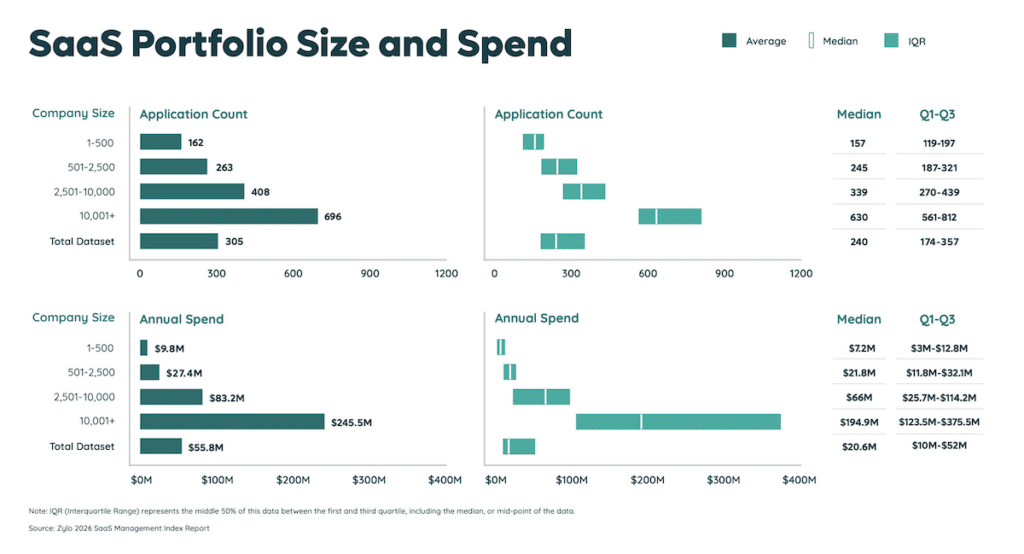
That’s a staggering amount of cloud spending that falls entirely outside the scope of traditional infrastructure budgeting tools.
A cloud budget that only manages infrastructure can tell you what your servers cost, but not what your software costs. And in today’s environment, software is often the larger line item.
2026 SaaS Management Index
Learn MoreComprehensive cloud budgeting requires visibility into all cloud-based spending. Spending falls into two distinct categories, each with different purchasing patterns, stakeholders, and management tools:
While they cannot be managed by the same tool, they do need to be managed with the same rigor.
Each category has purpose-built solutions:
Together, they close the loop on cloud spending. Missing either half means your cloud budget has a blind spot.
When SaaS is left out of the cloud budgeting conversation, the consequences are predictable and expensive. Here are the three most common failure points.
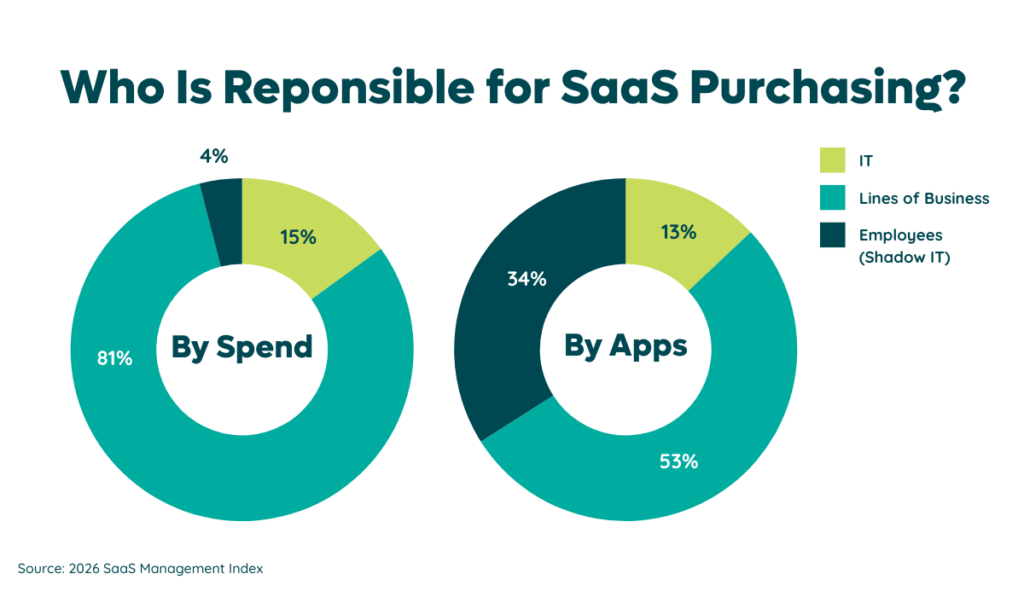
According to Zylo’s 2026 SaaS Management Index, IT is responsible for only 15% of SaaS spend. The remaining 85% of spend—driven by business units and individual employees—is a material blind spot where unknown spend quietly grows and drains budgets.
Today, organizations invest heavily in SaaS, with the average large enterprise spending $246M annually. Year over year, that’s a 16% increase in spend, while enterprise app counts grew just 8%. Vendor price increases, variable consumption models, and artificial intelligence act as hidden cost accelerators that further illustrate this growth—and the financial risk of SaaS.
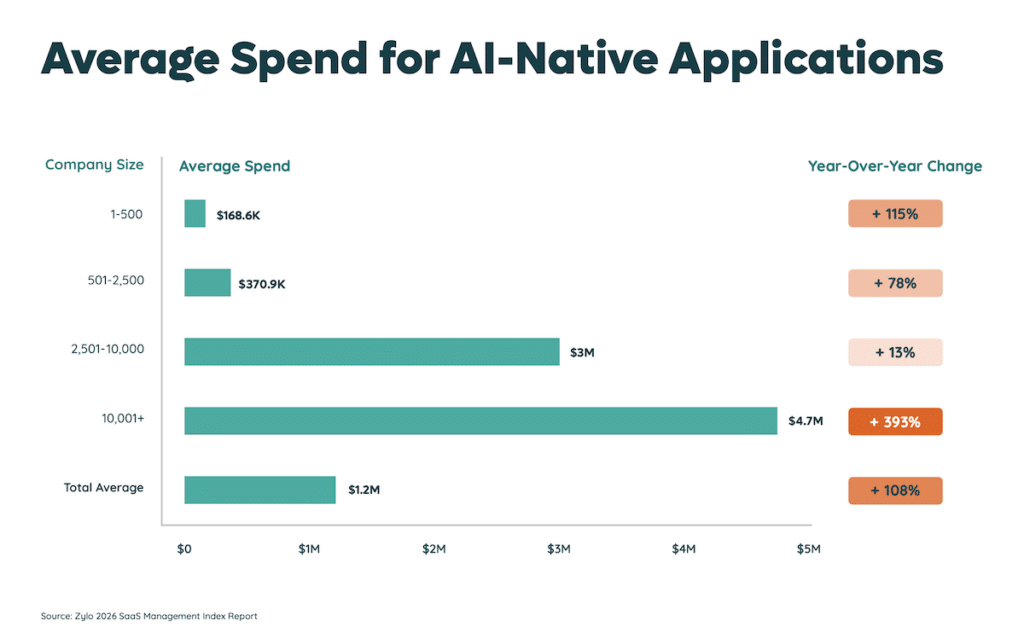
In 2025, expense-based shadow IT spend grew 267%. Meanwhile, spending on AI-native applications skyrocketed nearly 400% for large enterprises. Shadow AI is widening the gap between what organizations believe is in use and what’s actually being adopted.
Without complete visibility into cloud-based software spend, budgeting accurately at scale will be fundamentally impossible.
Decentralized software purchasing drives SaaS sprawl, the quick expansion of applications in enterprise portfolios. Each year, portfolios expand by 37% on average, contributing new tools to the stack—along with duplication and overlapping functionality.
With nearly 700 applications in the average enterprise stack, redundancy is inevitable. Multiple teams subscribe to different tools that perform the same function, whether that’s project management platforms, video conferencing tools, or design applications. Every redundant subscription is money that could be eliminated or consolidated.
Without visibility into the full SaaS portfolio, identifying and eliminating that waste is nearly impossible.
Infrastructure costs fluctuate month to month, while SaaS costs are locked into contract renewal dates that come once a year (unless multi-year). According to the 2026 SaaS Management Index, enterprises face an average of 467 SaaS renewals per year—roughly 41 per month or 2 per business day.
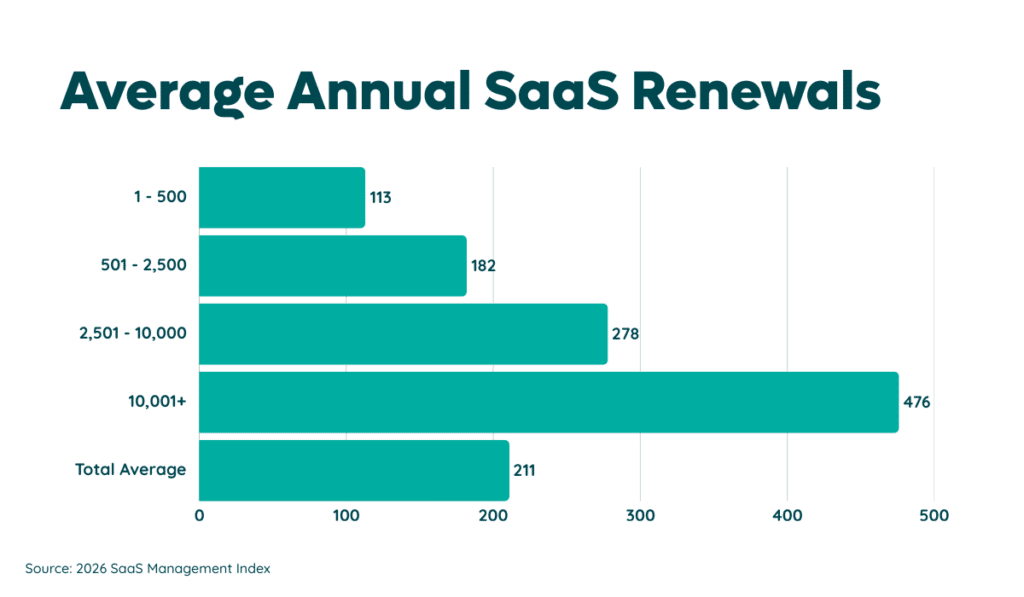
Each renewal is an opportunity to rightsize licenses, renegotiate pricing, or eliminate tools that no longer serve the business. But only if you know they’re coming.
Without a proactive renewal management process, teams are perpetually behind:
The FinOps discipline of continuous cost monitoring makes sense for infrastructure, where spending fluctuates daily. SaaS requires a different rhythm, one built around contract timelines, renewal preparation, and proactive license reclamation. Without it, you’re budgeting reactively.
FinOps has become the gold standard for cloud infrastructure cost management, but its original scope wasn’t built to handle SaaS. Here’s where the two disciplines meet, and what happens when you connect them.
FinOps was built for infrastructure, and that’s where its tools and workflows excel. When applied to SaaS, the gaps become clear. The differences are fundamental:
These distinctions mean that even a mature FinOps program can carry significant blind spots when it comes to managing SaaS spend.
To that end, the FinOps Foundation has recognized the need to expand. According to the 2025 State of FinOps report:
As SaaS pricing models shift from flat seat-based fees toward consumption-based and hybrid structures, the financial management challenges look increasingly similar to cloud infrastructure management. Usage spikes, variable billing, and AI add-on charges all introduce the kind of volatility FinOps was designed to handle, but SaaS requires its own purpose-built layer on top.
FinOps brings analytical rigor to the cloud spend conversation. SaaS Management brings the contract visibility, license governance, and renewal infrastructure that FinOps alone can’t provide.
The most forward-thinking enterprises are already connecting these disciplines. At The Home Depot, ITAM and FinOps were consolidated under a single leader to unify forecasting, governance, and spend management across both cloud infrastructure and SaaS, a model that our index data identifies as where the market is heading.
The two disciplines each bring something the other lacks:
As Ridge Fussell, Senior Manager of FinOps at The Home Depot, put it: “We saved a lot of money at renewal because we were able to see what we actually had, what we were using, and reduce license counts.”
That’s the advantage of SaaS Management in a single sentence: complete visibility that makes every renewal decision data-driven.
Getting SaaS into your cloud budgeting strategy requires building a parallel SaaS management capability that operates with equal discipline and feeds into the same financial planning process.
SaaS budgeting looks like:
Effective SaaS budgeting starts with discovery. You need to know what applications your organization has before you can budget for them intelligently.
This can be harder than it sounds. Because SaaS purchasing is decentralized, happening through IT procurement, business unit budgets, P-cards, and individual expense reports, no single source of truth typically exists. A SaaS Management Platform like Zylo solves this by ingesting data from financial systems, SSO, and expense platforms to create a complete, centralized SaaS inventory of every application in the portfolio.
With full portfolio visibility, you can:
That foundation is what makes any meaningful cloud budgeting conversation possible.
Infrastructure costs require daily or monthly monitoring because they fluctuate with usage. SaaS costs require a different forecasting model, one built around contract renewal dates.
Because SaaS savings only happen at renewal, your budget planning needs to map out what’s renewing when, and what each renewal opportunity is worth. With an average of 476 renewals per year at large enterprises, that’s a substantial pipeline of potential savings to manage proactively.
The most successful organizations begin renewal preparation at least 120 days in advance. Here’s the cadence that consistently drives results:
This cadence eliminates the reactive scramble and ensures you’re never caught by an auto-renewal you didn’t see coming.

One of the most common and costly SaaS budgeting mistakes is planning license counts based on current headcount rather than actual usage, and then failing to adjust as the business evolves.
Roles change. Teams restructure. Applications get adopted by some departments and ignored by others. Without continuous license utilization data, organizations end up over-licensed across dozens of applications, paying for seats that no one uses. In fact, according to Zylo’s 2026 SaaS Management Index, 43% of licenses sit unused, driving $80.5M in wasted spend for enterprises annually.
Effective SaaS budgeting means aligning your license footprint to real usage and business plans. If you’re expanding headcount in one department, you need additional licenses. If you’re contracting or switching tools, you need to reclaim them before the next renewal. Getting that alignment right is how you convert license waste into budget savings. Zylo’s SaaS spend management capabilities make that alignment continuous rather than a once-a-year exercise.
The most mature SaaS budgeting programs need to go beyond reacting to current usage data. They anticipate future needs, which requires connecting SaaS planning to HR and finance planning cycles.
Consider the questions that only get answered well when SaaS is treated as a first-class budget line item:
These questions require SaaS to be planned proactively alongside infrastructure, headcount, and capital expenditures, rather than reconciled after the fact. Organizations that make this shift stop reacting to SaaS costs and start planning around them. For a deeper look at how IT leaders are approaching this shift, the CIO playbook for navigating cloud, SaaS, and AI covers the governance structures making this possible.
Cloud budgeting has always required discipline. What’s changed is the scope.
With SaaS representing hundreds of millions of dollars in annual spending at large enterprises, a cloud budget that stops at infrastructure is missing a growing share of total spend. The organizations with the most accurate cloud budgets treat SaaS with the same rigor they apply to infrastructure: building a complete inventory, tracking licenses against actual usage, and connecting software spending to business plans and headcount forecasts.
When you’re ready to see what’s actually in your SaaS portfolio, request a demo to see how Zylo surfaces spend that most cloud budgets never account for.
Cloud budgeting is the process of planning, allocating, and controlling spending on cloud-based services. Traditionally, this meant infrastructure costs on platforms like AWS, Azure, and Google Cloud. Today, comprehensive cloud budgeting must also include SaaS spending. With SaaS representing the largest category of cloud spend at most enterprises, a budget that accounts only for IaaS costs misses a significant share of total cloud costs.
Cloud budgeting covers infrastructure: compute, storage, and networking costs that fluctuate with usage and require continuous monitoring. SaaS budgeting covers software subscriptions that renew on fixed contract cycles and require license governance, contract visibility, and proactive renewal management. The two are complementary. Organizations that apply both have a complete view of their total cloud spending.
Three structural reasons keep SaaS out of most cloud budgets:
For Infrastructure Cost Management: AWS Cost Explorer, Azure Cost Management, CloudZero, CloudBolt, and Apptio Cloudability provide visibility into compute and storage spending, rightsizing recommendations, and cost allocation by team or workload.
For SaaS Cost Management: A dedicated SaaS Management Platform is required. Zylo provides a complete system of record for every SaaS application, license, contract, and renewal across the enterprise, helping IT, Procurement, and Finance teams surface hidden spend and manage renewals proactively.
Infrastructure Budgeting Features:
SaaS Budgeting Features:
Avoiding surprise SaaS renewals starts with a centralized contract inventory that flags upcoming dates well in advance. Work a structured timeline: validate business case at 120 days out, execute license reclamation at 90 days, benchmark pricing at 60 days, and finalize your negotiation strategy at 30 to 45 days. That cadence turns renewals from surprises into planned savings events.
SaaS budgeting complements FinOps by extending financial discipline into the software layer. FinOps covers consumption patterns and unit economics for infrastructure. SaaS Management covers contract governance, license entitlements, and renewal execution. According to the 2025 State of FinOps report, SaaS is now the fastest-growing area of FinOps responsibility, confirming these disciplines are increasingly managed together.
SaaS spend forecasting starts with a complete inventory of active subscriptions, including contract values, renewal dates, and license counts. Layer in planned headcount changes, known vendor price increases, upcoming renewals likely to be rightsized, and new software requests in the pipeline. The result is a contract-driven spend model that makes SaaS costs as predictable as any other budget line item.
For infrastructure, the primary levers are rightsizing resources, utilizing reserved instances, and eliminating idle compute.
For SaaS, focus on:
For large enterprises carrying an average of $80.6 million in annual license waste, SaaS optimization is often the faster path to savings.
Table of Contents ToggleTL:DR: True Cloud Cost Control Requires SaaS Spend...

Table of Contents ToggleTL:DR: True Cloud Cost Control Requires SaaS Spend...

Table of Contents ToggleTL:DR: True Cloud Cost Control Requires SaaS Spend...

Table of Contents ToggleWhat FinOps Means in the Modern Cloud EnvironmentWhy...