



Table of Contents
Updated on March 17, 2026 with new data and IT budget allocation tips
TL;DR: Allocating IT Budgets in the Age of AI and Volatile SaaS Pricing
- AI and consumption-based pricing are destabilizing IT budget planning. SaaS spend rose 8% year over year, with AI-native applications increasing 108% on average—forcing CIOs to rethink how they allocate IT budgets and forecast software costs.
- Unexpected SaaS charges are now the norm, not the exception. The majority of IT leaders faced surprise consumption fees, post-contract costs, and renewal price increases—undermining traditional SaaS budget management models.
- Business units control 81% of SaaS spend, limiting IT visibility. Allocating IT budgets effectively now requires stronger governance, cross-functional alignment, and financial discovery across decentralized software purchases.
- Rationalization funds innovation. With 34% of applications newly added while total app count remains flat, leading organizations are eliminating redundant and low-value tools to redirect budget toward AI, cybersecurity, and modernization initiatives.
- Disciplined SaaS cost control is the new growth strategy. Complete inventory visibility, license optimization, cost allocation, and proactive renewal management are essential to improve IT budget forecasting and prevent software overages.
Unexpected SaaS cost increases have become more commonplace. In fact, 61% of the IT leaders Zylo surveyed were forced to cut projects or initiatives as a result. By canceling or delaying initiatives, organizations may limit their ability to remain competitive, innovate, and serve clients. In addition, surprise costs make it difficult to allocate IT budgets appropriately and forecast spend.
The more AI adoption grows and vendors adopt usage-based pricing, CIOs will continue to see increased pressure on their budgets. In this article, we’ll explore what’s influencing budgets, what investments IT leaders are prioritizing, and tips to control your budget in 2026.
“I think the important thing is to use technology to innovate as a business. To do that, you need to manage the cost as aggressively as you can so that you can divert your resources to the things that make a difference.”
— Keith Sarbaugh, CIO at Zoetis
 —
— Volatile SaaS and AI Costs Are Increasing Pressure on IT Budgets
AI has not reduced reliance on SaaS—in fact, it has intensified it. As a result, IT leaders are witnessing a level of cost volatility that is disrupting budgets across the enterprise.
According to Zylo’s 2026 SaaS Management Index, overall SaaS spending increased 8% year over year. Meanwhile, the number of applications organizations have has effectively flattened.
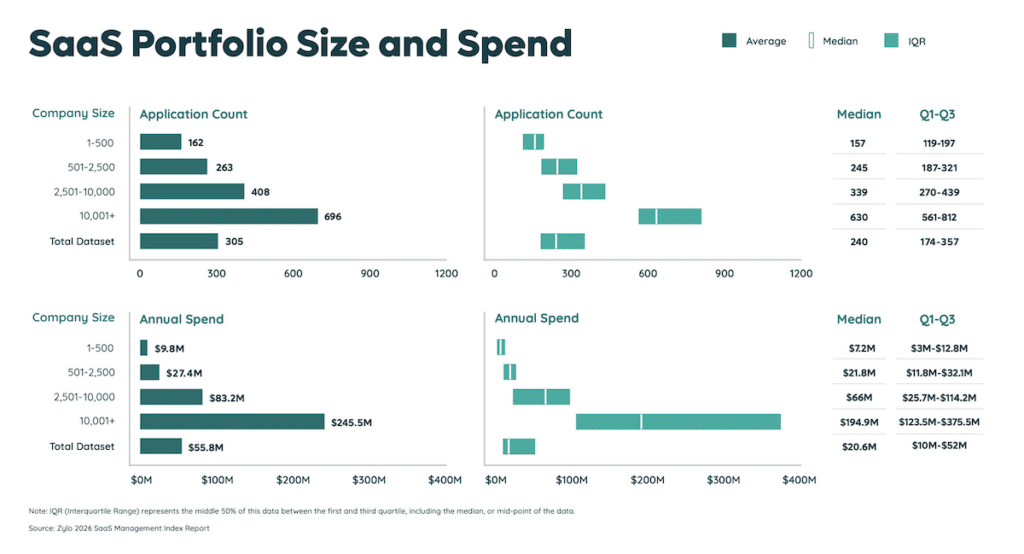
Under the surface, AI spend is accelerating. The Index reveals that spending on AI-native applications rose 108% on average—and an alarming 393% in large enterprises.
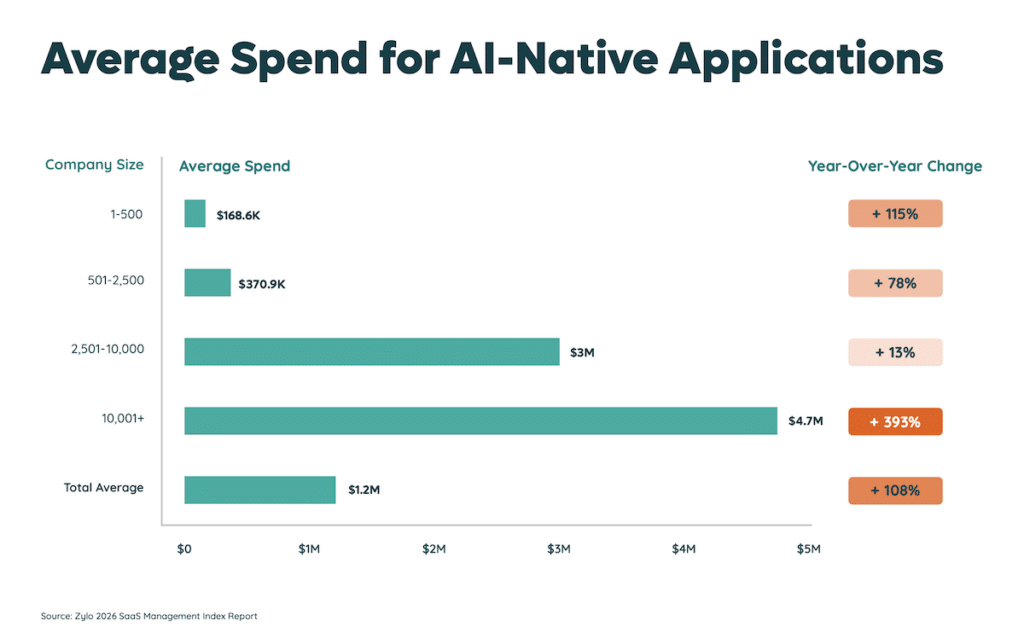
What’s driving this increase in spend and budgetary pressure?
Factors driving cost volatility include:
- New pricing mechanics (e.g., usage-based and hybrid pricing)
- AI feature monetization
- Increasing vendor prices
- Inflationary pressures
Unexpected Costs Put Budgets at Risk
In 2025, IT leaders saw unexpected costs throughout the contract lifecycle, not just at renewal. Zylo’s survey of 218 IT leaders showed that:
- 78% experienced unexpected charges on a SaaS bill due to consumption-based or AI pricing models.
- 77% faced unexpected costs that surfaced after a contract was signed.
- 79% encountered price increases at renewal in the past 12 months.
When costs are incurred unexpectedly at regular intervals throughout the year, it disrupts budgets and hinders forecasting accuracy. As more vendors adopt variable pricing models, IT leaders need to change how they monitor usage and costs proactively. And do so before renewal.
Business Units Now Drive the Majority of SaaS Spend
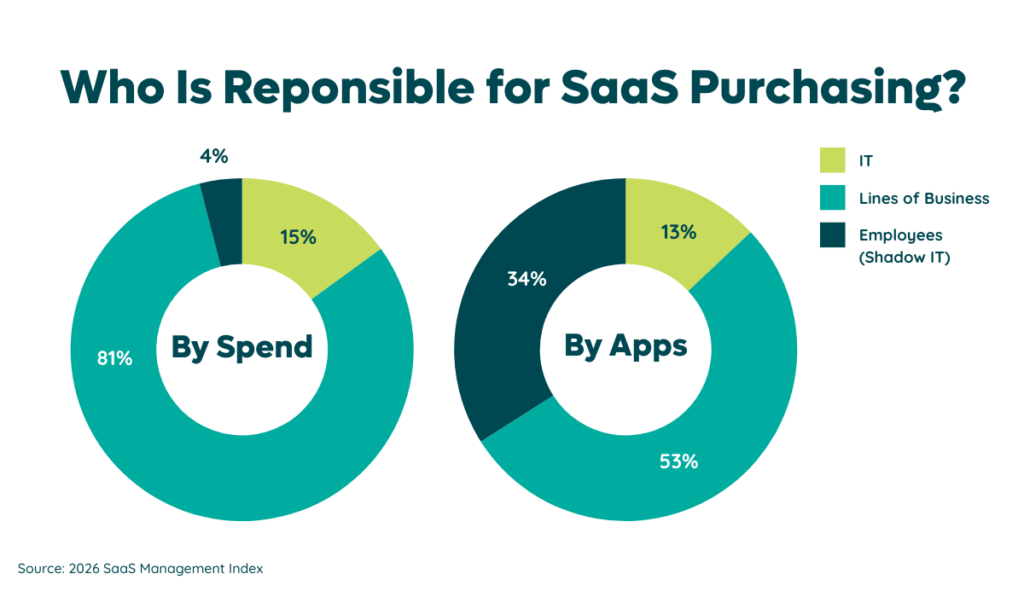
Lines of business, now more than ever, drive the majority of SaaS investment, responsible for 81% of total spend. In contrast, IT is responsible for just 15% of SaaS spend.
As a result, IT teams have limited visibility into and control of what software is purchased and used. Decentralized SaaS ownership isn’t going away. IT leadership must adapt how it governs a distributed environment to ensure costs don’t outpace budgets.
Other Factors Impacting IT Budgets
While SaaS has a significant impact on IT budgets in 2026, it is not the only factor affecting them. According to CIO.com’s 2025 State of the CIO, the top five reasons for tech budget increases are:
- Additional investments in AI/ML projects and/or products/services (31%)
- Need for security improvement (27%)
- Infrastructure modernization/migration (26%)
- Keep pace with rising costs of technology and services (25%)
- Investment in new skills/talent (25%)
How Organizations Are Allocating IT Budgets
In 2026, CIOs must re-evaluate how they’re allocating IT budgets to account for AI and consumption-based growth. According to the McKinsey Global Tech Agenda 2026, the majority of IT leaders plan to increase tech spend. Fifty-six percent plan to increase their budget by equal to or less than 10%, while 28% plan to increase by more than 10%.
What Initiatives Are CIO Investing In?
McKinsey’s survey revealed that the top technology investments leaders are pursuing over the next two years include:
- Transforming IT function using AI
- Strengthening cyber resilience and data privacy defenses
- Modernizing infrastructure
- Transforming talent management and sourcing partnerships
- Redesigning tech organization and operating model
- Scaling data as a service
- Shaping a tech-backed business strategy
- Focusing IT’s delivery model on core engineering principles
- Overhauling IT architecture
Kris Van Riper, Practice Vice President at Gartner, reiterates the growing prioritization of AI in IT budgets. “We are seeing a significant prioritization of AI investments, which are expected to grow by more than 35% year-over-year. This is in the context of a very constrained IT budget environment.”
Ongoing Rationalization Enables Reinvestment in High-Value Software
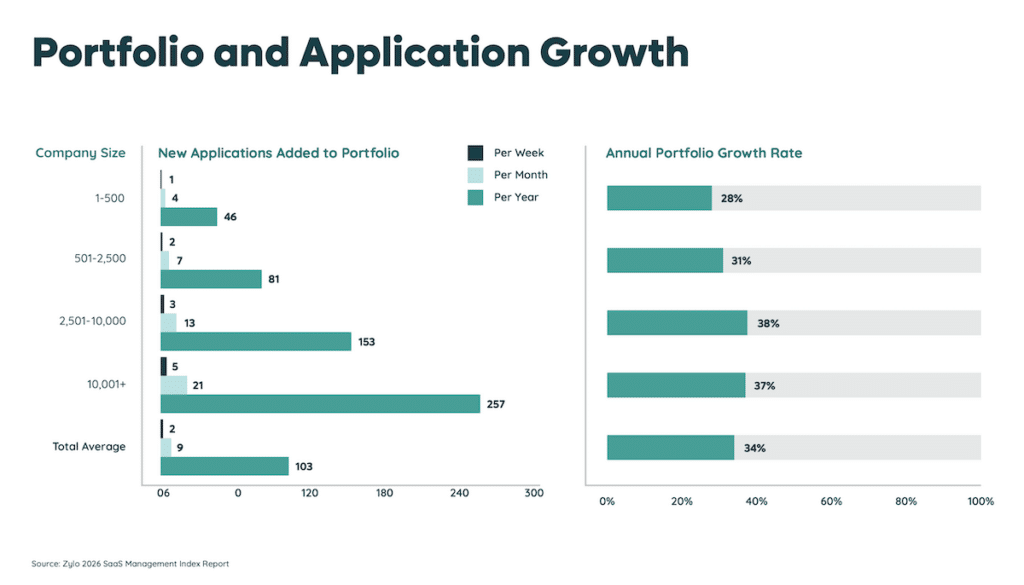
According to Zylo’s 2026 SaaS Management Index, 34% of applications in the average software portfolio are new, yet app count remained flat year over year. This indicates that, across the business, teams are intent on using tools that drive value and ROI. Organizations are strategically rationalizing their SaaS portfolios to ensure low-value and unused tools are sunsetted to accommodate.
The Future of IT Budgets
Gartner analysts predict that, by the end of 2026, worldwide IT spending will increase by 10.8% from 2025. Worldwide software spending is expected to grow 14.7% to $1.4T.
For CIOs in 2026 and beyond, ignoring SaaS costs is out of the question. Unmanaged SaaS spend will result in:
- Increasing pressure on IT budgets, as more SaaS vendors adopt consumption-based pricing models and introduce AI to their products.
- A widening gap between planned and actual spend, creating an unstable cost environment.
- Less funds to invest in innovation and other strategic initiatives
To stay ahead of the most volatile costs—software—organizations must proactively manage their SaaS portfolios and spend.
Tips to Prevent Software Budget Overages
To prevent software budget overages, IT leaders should follow these five tips:
- Get complete visibility into your software inventory
- Increase cross-functional alignment and collaboration
- Track license usage and consumption
- Improve spend accountability with cost allocation
- Treat SaaS renewals as a savings engine
Get Complete Visibility into Your Software Inventory
Controlling SaaS spend requires visibility into every application in your portfolio. Without it, costs quietly accumulate under IT’s radar.
Organizations frequently underestimate the size of their portfolios and spend by nearly 2X and 3X, respectively. In addition, 60% of the IT leaders Zylo surveyed reported they lack visibility into all generative AI tools in use. The lesson: don’t assume you know everything.
To get complete visibility into your software inventory, start with discovery via a SaaS Management Platform (SMP). For better SaaS spend management and optimization, choose a provider that prioritizes financial discovery—like Zylo.
“Once you follow the money, you see where the biggest opportunities to save are.”
 — Shravya Ravi, Manager, Asset Management at LinkedIn
Increase Cross-Functional Alignment and Collaboration
Managing SaaS spend in silos prevents you from realizing the full potential of your business outcomes. Instead, IT must partner with Procurement and Finance to:
- Ensure software is driving value for the business
- Effectively manage SaaS spend
- Budget and forecast more accurately
Track License Usage and Consumption
Unused software licenses drive wasted spend—$19.8M annually on average—while unmonitored consumption can result in unexpected budget overages. Track license usage and consumption on a regular cadence with a SaaS Management Platform to avoid unnecessary costs.
Proactive IT leaders should:
- Centralize usage data in a system of record
- Set up automated alerts to flag apps approaching usage thresholds
- Review current and forecasted consumption weekly or monthly
- Evaluate license positioning 90-120 days ahead of renewal
Improve Spend Accountability with Cost Allocation
As IT budgets and overall spending increase, allocating costs for software shared by departments becomes more critical. In addition to providing budget relief for IT, it increases accountability among business leaders to be more responsible with software spending.
Use cost allocation to:
- Reclaim IT budget by charging departments for use
- Ensure teams are aware of what software costs they’re driving most
- Inform spend-related decisions
- Improve budget accuracy
- Increase spending efficiency
Treat SaaS Renewals as a Savings Engine
Software renewals provide the greatest concentration of leverage with vendors and represent the only opportunity to reduce contracted SaaS spend. However, only 38% of the IT leaders we surveyed consider SaaS renewals a key opportunity to reduce software costs. This reveals a significant gap between where value is created and where teams are currently focused.
Implement operational rigor to manage and drive predictable value with renewals, following these steps.
- Review SaaS spend. Build a centralized record of SaaS contracts, owners, spend, and usage to create a baseline for identifying savings opportunities.
- Prioritize applications to maximize savings. Focus on the highest-impact contracts to create early momentum and allocate your team’s time where the savings potential is greatest.
- Define process and change management. Clear processes define how renewal and license reclamation should work.
- Execute renewals and reclaim licenses. Early preparation is critical for capturing savings. Follow a proactive cadence with 120, 90, 60, and 30-day renewal milestones.
- Report on value. Close the loop with leadership on your results to ensure the program remains aligned with organizational goals.
Rigor in SaaS renewal management drives the cost savings IT teams need to control their budget, fund innovation, and drive business outcomes.
Keep Your IT Budget on Track with Zylo
In 2026, CIOs must have full visibility into all applications, usage, and spend to improve budgeting, increase forecasting accuracy, and avoid unnecessary costs. While ownership is now decentralized, it still frequently falls upon IT to pinpoint each tool’s cost, ownership, and effectiveness for the business.
Powered by the world’s largest dataset of 75B+ in SaaS invoices and 40M+ licenses, Zylo is the only platform for financial truth at enterprise scale, purpose-built to drive savings, optimize cost, and strengthen compliance. Learn more about Zylo’s SaaS Renewal and Spend Management solution, or connect with our SaaS experts for a personalized demo.
FAQs About Allocating IT Budgets
Why is allocating IT budgets more difficult in the AI era, and how should CIOs adapt?
Allocating IT budgets is harder because AI-driven pricing introduces consumption variability, feature upcharges, and mid-cycle cost changes. CIOs must shift from static annual planning to continuous SaaS budget management, prioritizing real-time visibility, usage monitoring, and proactive renewal governance to maintain cost predictability.
How does consumption-based pricing impact IT budget forecasting?
Consumption-based pricing makes IT budget forecasting less predictable by tying costs to usage instead of fixed licenses. As AI features meter tokens, credits, or API calls, expenses fluctuate monthly. CIOs must track consumption trends continuously and align forecasting models with real usage data.
How does decentralized SaaS purchasing by business units impact IT budget control?
When business units control most SaaS purchasing, IT loses visibility into total spend, contracts, and usage, weakening forecasting accuracy and reducing negotiating leverage. Without centralized governance and financial discovery, allocating IT budgets becomes reactive rather than strategic.
How can CIOs improve SaaS budget management, license optimization, and spend visibility?
CIOs improve SaaS budget management by building a centralized system of record, monitoring license utilization, reclaiming unused seats, and allocating costs to departments. Combining usage insights with renewal planning strengthens spend visibility and reduces preventable overages across the enterprise.
What causes unexpected SaaS costs during the contract lifecycle?
Unexpected SaaS costs typically stem from consumption-based pricing, AI feature monetization, mid-term contract expansions, and renewal price increases. Without proactive monitoring, usage spikes and vendor-driven adjustments create budget gaps that traditional IT planning models fail to anticipate.
What metrics should CIOs track to improve IT budget forecasting accuracy?
CIOs should track cost per user, license utilization rates, renewal timelines, consumption growth trends, redundant application counts, and departmental spend allocation. These metrics provide early indicators of budget variance and enable more accurate IT budget forecasting.
How can proactive renewal management reduce SaaS spend?
Proactive renewal management reduces SaaS spend by helping IT leaders identify savings opportunities 90-120 days before contract expiration. Reviewing usage data, eliminating redundant tools, and negotiating from a position of visibility allows organizations to reduce contracted spend rather than simply renew it.