Why Zylo Is the Enterprise Engine for SaaS Savings (+ Importance of Spend Discovery)
Table of Contents
12/03/2025
Table of Contents
Updated January 30, 2026 with new data
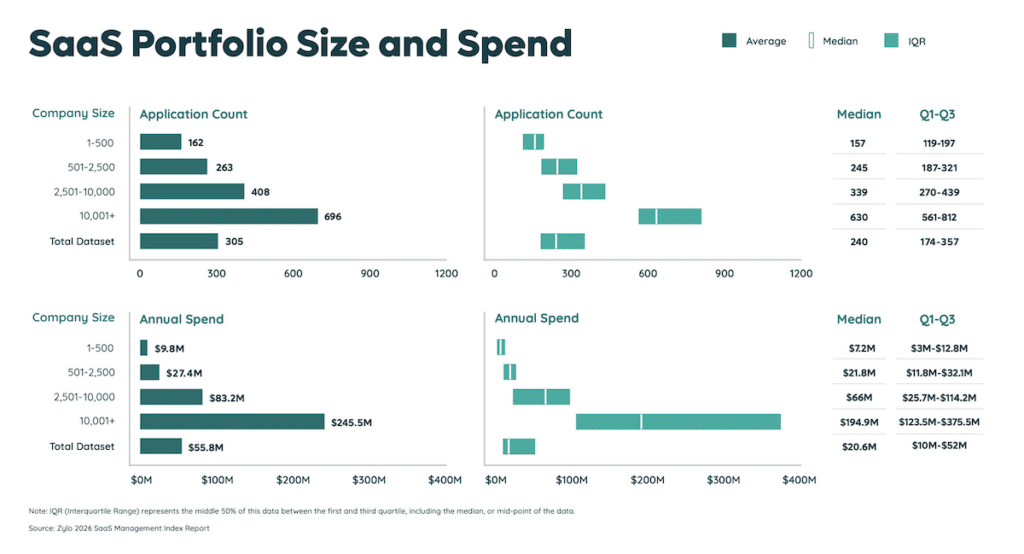
Enterprise SaaS costs keep climbing, and organizations are feeling the impact. The average organization now spends $55.8M a year on SaaS, and companies with more than 10,000 employees spend an average of $245.5M. Gartner expects this number to reach $299B by the end of 2025, showing just how quickly software spend continues to grow.
For IT leaders, CIOs, and FinOps teams, the challenge goes beyond growth in tools. Visibility erodes as software becomes harder to track. This expanding complexity is due to:
These forces make it harder to see what you’re actually paying for, which is why most enterprises underestimate their real SaaS spend by more than 300%. As spend disappears into expense reports, you lose your ability to control renewals, eliminate redundant apps, or rightsize licenses.
Because renewal is a critical moment to truly reduce software costs, scattered processes leave you reacting instead of managing. That’s where accurate spend visibility and consistent SaaS renewal management become essential. With the right foundation, you can uncover hidden spend, bring renewals into focus, and build a repeatable process for SaaS savings year after year.
6 Common SaaS Challenges for Enterprises
Today, the following challenges define enterprise-scale SaaS environments and shape why these organizations require purpose-built governance tools.
Siloed portfolios and fragmented visibility
Mergers, acquisitions, and accelerated shadow IT
Global compliance, privacy, and residency requirements
Slow procurement workflows and intake-to-procure bottlenecks
Decentralized buying and extreme SaaS sprawl
Vendor proliferation and contract overload
Enterprises operate in software environments where decisions happen across regions, business units, and teams simultaneously. As portfolios grow more distributed, visibility breaks down and IT, Finance, Procurement, and Security no longer share a consistent view of what the organization owns, uses, or risks.
Siloed Portfolios and Fragmented Visibility
Decentralized purchasing gets amplified in large enterprises due to regions and departments acquiring SaaS independently—not just individuals. As a result, it leads to duplicate tools, inconsistent data, and a lack of unified visibility. Without a single source of truth, leaders struggle to answer foundational questions about usage, ownership, and upcoming renewals.
Mergers, Acquisitions, and Accelerated SaaS Sprawl
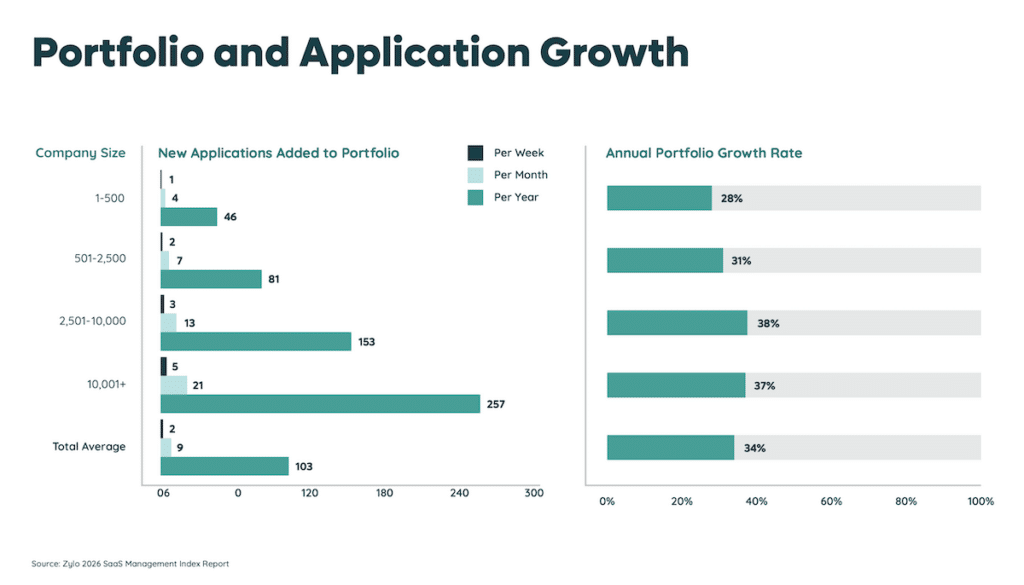
When enterprises grow through acquisition, they inherit entire SaaS stacks—multiple HR tools, project trackers, security platforms, and redundant licenses. Zylo’s 2026 SaaS Management Index shows that the portfolios for companies with more than 10,000 employees grow by an average of 37% annually. M&A activity significantly accelerates that sprawl. Newly combined organizations frequently discover conflicting contracts, unknown tools, and unvetted applications brought in by acquired teams.
Global Compliance, Privacy, and Residency Requirements
Enterprises must comply with overlapping international and regional laws, including GDPR, HIPAA, and CCPA. Different jurisdictions impose unique data residency rules, breach notification timelines, and audit requirements. Validating that every application meets all relevant compliance standards across every location is a level of governance that smaller organizations simply do not face.
Slow Procurement Workflows and Intake-To-Procure Bottlenecks
Enterprise procurement is lengthy and highly regulated. Multi-step risk reviews, security assessments, legal evaluations, and stakeholder approvals further slow the process. To keep work moving, employees often bypass formal procurement, which increases shadow IT and reduces compliance control.
Decentralized Buying and Extreme SaaS Sprawl
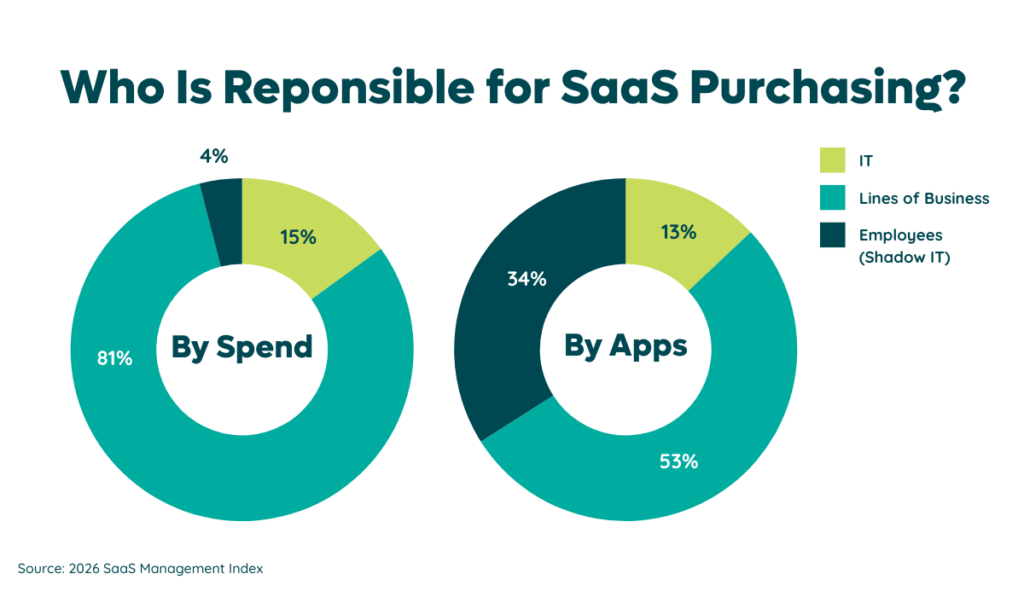
A 10,000-employee enterprise uses an average of 660 SaaS applications—more than triple the number used by smaller organizations. In addition, IT manages only around 15% of software spend. Meanwhile, business units and individuals are responsible for the remaining 85%. With departments managing their own tools and budgets, visibility erodes quickly, creating redundant apps, inconsistent renewals, and gaps in governance.
Vendor Proliferation and Contract Overload
Enterprise teams often manage hundreds of SaaS vendors and contracts at once, each with unique renewal dates, pricing models, compliance risks, and terms. Overlapping contracts for the same software across regions are common. Missed auto-renewals, inconsistent contract clauses, and region-specific obligations introduce unnecessary spend and operational risk.
SaaS Spend Discovery Is Step One
Because enterprise environments are fragmented across regions, systems, and purchasing channels, traditional discovery methods are unreliable. Instead, starting with financial data becomes the most dependable discovery approach.
Why Starting with Spend Gives You a Strategic Advantage
Many tools begin with app-level detection, which often misses:
Instances purchased by different regions or business units
By surfacing spend first, you can see the full SaaS footprint. This positions you to rightsize licenses, prepare for renewals, and build a repeatable SaaS cost optimization motion grounded in accurate data.
The Importance of SaaS Spend Discovery for Cost Savings
Cost savings depend on understanding where spend is happening, so clear visibility into SaaS purchases becomes the natural starting point. In most large organizations, SaaS spend is scattered across:
This clarity gives you the foundation you need to prepare for renewals, negotiate effectively, and uncover meaningful savings opportunities.
How Zylo’s AI-Powered Financial Discovery Works
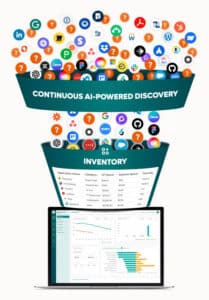
Zylo’s discovery model uses financial data—instead of relying solely on app detection or authentication logs—because it is the most reliable source of truth for identifying SaaS. First, it determines which purchases are SaaS, based on Zylo’s analysis of $2T in cloud and SaaS spend. Then, it identifies the application by matching it against Zylo’s vast application catalog and learned models.
You gain a complete, accurate inventory of every subscription tied to real dollars.
Establish a Foundation for Long-Term Savings with SaaS Operations
Long-term SaaS savings don’t come from one-time cleanup efforts. They come from operational consistency. SaaS Operations gives you the structure, visibility, and governance needed to manage hundreds of applications, dozens of stakeholders, and a nonstop stream of renewals. When you establish this foundation, you shift from reacting to surprises to running a predictable savings engine.
What SaaS Operations Means for Enterprise Teams
SaaS Operations (SaaS Ops) is the practice of running software management as a structured, repeatable function rather than an ad hoc set of tasks. For IT, CIOs, and FinOps leaders, it becomes the connective tissue that aligns usage data, contracts, ownership, and renewal workflows.
In large organizations, this work includes:
Centralizing application, spend, and contract data
Assigning and maintaining app ownership
Tracking license usage across authentication, integrations, and user-level signals
Coordinating renewals across IT, procurement, finance, and business units
Enforcing consistent review points before every renewal
Maintaining a reliable system of record
Monitoring changes in usage, ownership, and contract terms over time
With SaaS Ops, your data stays accurate, your owners accountable, and your renewal process predictable—even as new tools, pricing models, and AI features enter the environment.
“There is a need for a controlling and governing body to run all processes as smoothly as possible. Not having an ops team for SaaS makes it more complicated for the business to grow and introduces the risk of shadow IT.”
— Vlad Tsapko, AVP, Business Operations at Insurity
How SaaS Operations Drive Measurable Cost Savings
Savings come from repeatable behaviors, not isolated actions. SaaS Operations establishes the discipline you need to realize savings at scale by organizing every renewal around a single set of data and decisions.
With the right SaaS Ops motion in place, you can:
Identify redundant or overlapping tools before they renew
Rightsize licenses based on actual utilization
Prevent true-ups and overages tied to unmonitored usage
Reduce spend tied to auto-renewing or unmanaged contracts
Align pricing expectations with benchmarks and historical data
Operational rigor turns renewals into opportunities for savings rather than risks of overspend. It ensures that every contract goes through the same checkpoints:
Determine whether the application is still needed
Know how many licenses are actually required
Understand whether the price aligns with market standards
When SaaS Operations becomes part of your day-to-day operations, you create a sustainable path to ongoing SaaS cost optimization. It sets the stage for building a full savings pipeline, where every renewal becomes predictable, actionable, and measurable.
How to Build a SaaS Savings Pipeline
In 2026, Zylo data shows that large enterprises (10k+ employees) average 476 renewals and $245M in spend annually. Assuming 50% of annual SaaS spend is up for renewal each year, that’s a savings opportunity pipeline of $122.5M. Each renewal becomes a discrete opportunity to eliminate waste, rightsize licenses, and consolidate applications.
You can move these opportunities forward the same way you guide deals through a high-value pipeline:
Each renewal enters at a known stage
Each stage requires specific actions
Progress through each step creates a measurable financial impact
With hundreds of applications feeding into this flow, structuring renewals like a pipeline helps you manage them predictably, stage by stage, with a process designed to consistently drive savings:
Step 1: SaaS spend review
Step 2: Application prioritization to maximize cost savings
Step 3: Process definition and change management
Step 4: Renewal execution and license reclamation
Step 5: Value reporting
DP Poole, COO at Zylo, and Delainey Trost, Manager of Services at Zylo walk through how to build a savings pipeline at a recent webinar.
Step 1: SaaS Spend Review
A savings pipeline starts with an accurate system of record. Establish this by unifying spend, contracts, and ownership in one place.
Centralize app contract and spend details
Identify, document, and maintain app owners on an ongoing basis
Outcome: An up-to-date inventory of applications, owners, and contract details that becomes the foundation for renewal planning.
Step 2: Application Prioritization to Maximize Cost Savings
Not every app demands the same level of attention. Prioritize your applications by the greatest spend, renewal urgency, or savings potential.
Prioritize apps by total spend
Sort apps by renewal date
Select the source for utilization data—SSO, direct integration, or other signals—and track it for your prioritized applications
Outcome: A defined list of high-impact applications to run through a prescriptive renewal process, whether that’s 20 apps, 50 apps, or more.
120 days: Validate renewal strategy with the app owner
90 days: Execute license reclamation based on usage
60 days: Assess pricing using benchmarks, usage insights, and licensing position
45 days: Leverage license and pricing intelligence in renewal discussions
Ask yourself these three questions at every renewal:
Do we need this application?
Do we need to pull back licenses?
Are we getting a fair price?
Outcome: Hard cost savings and avoided spend achieved through consistent, data-driven renewal decisions.
Step 5: Value Reporting
A savings pipeline isn’t complete without visibility into outcomes. Show stakeholders where savings were created and how the program is performing through regular reporting.
Build dashboards to show wins and progress toward goals
Track and share realized cost savings and cost avoidance
Outcome: Clear, shared visibility into the financial impact of your SaaS Management program across all stakeholders.
Enterprises Generating Notable Cost Savings Wins
Enterprise teams like yours are already using Zylo to turn complex SaaS environments into measurable savings. Their results show what becomes possible when you pair accurate discovery with a structured savings pipeline.
Adobe Realized $60M in Savings and Avoidance
Adobe needed to control a fast-growing SaaS portfolio spread across multiple systems and business units. By using Zylo to centralize spend, usage, and contract data, the team uncovered far more titles than expected and went on to realize more than $60 million in cost savings and avoidance, along with thousands of hours in time savings.
Adobe Drives Innovation and Massive Savings with Zylo
In the past 4 years, Adobe has rapidly scaled from $9B to $18B. This growth has made an already complex environment even more complex. Learn how they leveraged Zylo to get complete visibility into their SaaS portfolio, unlock millions in cost savings and avoidance and improve the employee experience.
AbbVie manages one of the largest software portfolios in pharma, with a SaaS portfolio of 1,500+ apps and ~US $200 million in SaaS spend. Partnering with Zylo, they focused on shadow IT, rationalization, and license optimization, canceling more than 60 unauthorized subscriptions, reducing expensed software spend by 47%, and achieving $2.2 million in Salesforce cost avoidance.
Netflix Reports 7-Figure Savings on One Renewal
Netflix needed better alignment between license counts, usage, and contracts across its SaaS estate. Using Zylo to rightsize licenses and match entitlements to actual demand, its ITAM leader reports saving over seven figures while improving how the organization evaluates and manages SaaS tools over time.
The Home Depot Built Structured Renewal Cadence
The Home Depot initially assumed SaaS spend was under control until Zylo’s discovery revealed unknown tools, owners, and contracts. By bringing FinOps discipline to SaaS with Zylo, they gained centralized data, clearer ownership, and a structured renewal cadence of 120, 90, 60, and 30 days. The team moved from reactive renewals to a governed, repeatable savings motion that continues to surface new optimization opportunities each cycle.
Zylo For Enterprises: Built for Complexity, Governance, and Scale
Large enterprises need a SaaS Management solution that supports the scale and complexity of their business operations. Enter Zylo.
Why Zylo for the Enterprise
Zylo is designed to reflect the organizational realities of enterprises, including:
Multi-instance application environments: Enterprises frequently run multiple instances of the same application across regions or business units. Zylo provides a unified view across them while maintaining necessary separation.
High data volumes: Zylo processes massive datasets reliably, ensuring that large enterprises can track usage, spend, renewals, and compliance across hundreds of applications without performance slowdowns.
Enterprise-Grade Capabilities That Reinforce This Foundation
Zylo’s enterprise capabilities make it easier to manage software amidst these challenges. Capabilities include:
Advanced access controls and audit logging: Enterprises can gain precise governance through user-based access controls and detailed logs that track changes, activity, and approvals across teams.
High-performance data processing: Zylo ingests and normalizes data from large, distributed environments without bottlenecks that slow down insight generation.
Robust enterprise API: Zylo’s API allows you to connect your SaaS Management data to other systems across the organization for extended reporting and operational workflows..
How Zylo Delivers Outcomes at Enterprise Scale
With these capabilities, global organizations finally gain a shared system of record for SaaS while preserving the autonomy required across regions and teams. This unified foundation strengthens governance, accelerates savings, and supports a shift from tactical cost-cutting to strategic SaaS Management aligned with how modern enterprises operate.
Turn Your Renewal Pipeline into Real Savings
SaaS operates across every corner of your business, and your renewals do the same. Each renewal creates a moment where you can reduce software spend. When you treat those moments as a structured savings pipeline, you can capture meaningful value year after year. That level of control requires clear visibility, defined ownership, and a consistent renewal motion.
Zylo has spent nearly a decade helping enterprise teams build these systems, turning distributed SaaS portfolios into predictable savings and long-term governance. Ready to bring this structure to your environment?
Explore how the Zylo platform supports discovery, rightsizing, and renewal execution.
Understand what this could look like for your organization by scheduling a personalized demo.
Frequently Asked Questions About SaaS Savings
How to reduce software costs?
You reduce software costs by acting early in the renewal cycle and using accurate data to guide decisions. The most effective levers include:
Removing duplicate or redundant tools
Reclaiming unused or inactive licenses
Consolidating contracts across teams
Negotiating with validated usage and spend insights
A consistent renewal process ensures these steps happen every time—not only when someone flags an issue.
How can Zylo help me save money on software?
Zylo helps organizations save money at scale. Combining its enterprise-ready platform and industry expertise, Zylo ensures you:
Know what apps you have, who’s using it, or what it costs
Stop paying for seats no one touches
Prevent last-minute renewal scrambles that lead to overspending
Find tools people buy without telling you so you don’t overspend
What is the IT cost optimization strategy?
IT cost optimization aligns spend with real usage and business value. For SaaS, this usually involves:
Reviewing entitlements and usage trends
Identifying overlapping applications
Adjusting license levels before renewal
Coordinating decisions across IT, finance, and procurement
This approach helps you keep the tools your teams rely on while eliminating unnecessary cost.
What is the purpose of a software renewal?
A renewal is your chance to evaluate whether a tool still meets business needs. It’s also when you determine:
How many licenses you actually require
Whether your pricing aligns with benchmarks
Whether the contract still fits your environment
It is the most opportune moment for spend to formally go down.
How much is wasted on SaaS spend?
Many enterprises underestimate their SaaS spend by 300%. Hidden waste usually comes from:
Unused or underutilized licenses
Redundant applications
Shadow IT purchases
Auto-renewing contracts that never receive review
Accurate discovery and a structured renewal pipeline surface this waste and turn it into measurable savings.
How do I build a SaaS renewal calendar?
A renewal calendar consolidates everything you need to plan ahead, including:
Contract end dates and notice periods
Application and business owners
Usage and entitlement details
Renewal milestones and dependencies
Most enterprise teams rely on a SaaS Management Platform like Zylo to keep this calendar accurate as contracts and ownership change.
What data do I need to optimize a SaaS contract?
The most important data inputs for contract optimization include:
Current license counts and entitlements
Actual user-level utilization
Total cost, contract terms, and renewal dates
Pricing benchmarks and historic spend trends
With these details aligned, you can rightsize licenses and negotiate from a stronger position.
When should I start reviewing a SaaS application before renewal?
Teams should begin a renewal review 90–120 days in advance from the contract end date. This window allows time to:
Validate utilization
Reclaim unused or low-use licenses
Evaluate contract terms and pricing
Consider alternatives or consolidation opportunities
Starting early increases leverage and helps avoid last-minute renewals that lock in unnecessary cost.
What is a SaaS savings pipeline?
A SaaS savings pipeline is a prioritized view of upcoming SaaS renewals that shows where you can reduce software spend. It works like a sales pipeline, but instead of forecasting revenue, you’re forecasting cost-savings opportunities, enabling IT and procurement to consistently execute savings throughout the year.
Zylo is the leading enterprise SaaS management platform that transforms how companies manage and optimize the vast and accelerating number of cloud-based applications organizations rely on today. The platform provides one system of record for all cloud-based software purchased across a company, enabling customers to discover, manage, measure and optimize cloud investments with real-time insights into spend, utilization and feedback data.
We use cookies on our website to give you the most relevant experience by remembering your preferences and repeat visits. By clicking “Accept All”, you consent to the use of ALL the cookies. However, you may visit "Cookie Settings" to provide a controlled consent.
This website uses cookies to improve your experience while you navigate through the website. Out of these, the cookies that are categorized as necessary are stored on your browser as they are essential for the working of basic functionalities of the website. We also use third-party cookies that help us analyze and understand how you use this website. These cookies will be stored in your browser only with your consent. You also have the option to opt-out of these cookies. But opting out of some of these cookies may affect your browsing experience.
Necessary cookies are absolutely essential for the website to function properly. These cookies ensure basic functionalities and security features of the website, anonymously.
Cookie
Duration
Description
cookielawinfo-checkbox-analytics
11 months
This cookie is set by GDPR Cookie Consent plugin. The cookie is used to store the user consent for the cookies in the category "Analytics".
cookielawinfo-checkbox-functional
11 months
The cookie is set by GDPR cookie consent to record the user consent for the cookies in the category "Functional".
cookielawinfo-checkbox-necessary
11 months
This cookie is set by GDPR Cookie Consent plugin. The cookies is used to store the user consent for the cookies in the category "Necessary".
cookielawinfo-checkbox-others
11 months
This cookie is set by GDPR Cookie Consent plugin. The cookie is used to store the user consent for the cookies in the category "Other.
cookielawinfo-checkbox-performance
11 months
This cookie is set by GDPR Cookie Consent plugin. The cookie is used to store the user consent for the cookies in the category "Performance".
viewed_cookie_policy
11 months
The cookie is set by the GDPR Cookie Consent plugin and is used to store whether or not user has consented to the use of cookies. It does not store any personal data.
Functional cookies help to perform certain functionalities like sharing the content of the website on social media platforms, collect feedbacks, and other third-party features.
Performance cookies are used to understand and analyze the key performance indexes of the website which helps in delivering a better user experience for the visitors.
Analytical cookies are used to understand how visitors interact with the website. These cookies help provide information on metrics the number of visitors, bounce rate, traffic source, etc.
Advertisement cookies are used to provide visitors with relevant ads and marketing campaigns. These cookies track visitors across websites and collect information to provide customized ads.




 The discovery engine uses:
 —
—