Understanding SaaS Procurement: A Complete Process & Best Practices


Updated January 30, 2026 with new data.
Key Takeaways
- Effective SaaS procurement reduces wasted spend, avoids duplicate tools, and improves overall cost efficiency.
- SaaS Management tools support procurement workflows, governance, renewals, and cost reduction goals.
- A structured procurement process strengthens security, compliance, and vendor accountability.
- Clear governance and ongoing monitoring help organizations maintain control over their SaaS stack as they scale.
- Cross-functional collaboration ensures SaaS purchases align with business needs and long-term strategy.
SaaS plays a bigger role in your organization every year, and that growth can make purchasing and managing these tools feel overwhelming. Decentralized buying, shifting pricing models, and rising security expectations all add pressure to keep costs under control and maintain a clear picture of what’s in your environment.
A structured SaaS procurement process helps you bring order to that complexity. With the right approach, you can streamline how new tools are evaluated, prevent unnecessary purchases, and ensure every application truly supports your goals. This guide will help you understand what SaaS procurement entails, why it’s worth investing in, and how to build a scalable process for choosing and managing the tools your teams rely on.
What Is SaaS Procurement?
SaaS procurement is a strategic function that helps an organization evaluate, select, purchase, and manage software applications. It establishes standard processes that help:
- Clarify what the business needs.
- Check whether a tool already exists in your stack.
- Bring the right stakeholders into the decision.
- Review security and compliance risks.
- Negotiate fair contract terms.
- Monitor usage once the tool is live.
When you approach SaaS procurement intentionally, you can:
- Make decisions that balance cost, functionality, and risk
- Reduce duplicate tools
- Avoid unexpected charges
- Create a clear path for requesting and approving new applications.
- Keep spend under control
- Improve governance
- Maintain visibility into the tools your employees use every day
Key Benefits of Effective SaaS Procurement
Strong SaaS procurement gives you clearer control over cost, smoother operations, and fewer surprises across your tech stack. Key benefits include:
- Cost optimization and spend control
- Greater agility and scalability
- Better security, compliance, and risk management
- Negotiation expertise
When you formalize how tools are requested, evaluated, and purchased, you set yourself up for better decision-making and more predictable outcomes. You also gain the visibility needed to manage risk and keep your SaaS environment aligned with your organization’s goals.
Cost Optimization and Spend Control
Structured procurement gives organizations visibility into their full SaaS portfolio, making it easier to identify duplicate tools, unused licenses, and unmonitored renewals. By validating needs upfront and reviewing usage data, teams avoid unnecessary spending and shift licenses to the right users at the right time.
Centralized processes also streamline vendor evaluation and negotiation, ensuring pricing aligns with actual consumption. Benchmark data and usage insights help buyers strengthen their position, reduce waste, and improve long-term ROI.
Greater Agility and Scalability
A defined procurement workflow allows teams to adopt new tools quickly without sacrificing control. Business units benefit from a consistent request path, faster approvals, and clear expectations around documentation and requirements.
As organizations grow, scalable procurement practices prevent SaaS overload by maintaining standards for evaluating new applications and consolidating tools when possible. This process improves efficiency and ensures technology evolves in step with strategic objectives.
Better Security, Compliance, and Risk Management
A thoughtful SaaS procurement process gives you a clearer way to assess each vendor’s security posture, data-handling practices, and compliance commitments before you sign anything. Doing so helps you avoid tools that could expose sensitive information or create unnecessary risk.
When you build regular security checks into your workflow, you also reduce the chances of shadow IT slipping into your environment. Over time, this creates a stronger, more consistent governance baseline that protects your organization as your SaaS footprint grows.
Negotiation Expertise
Centralizing SaaS negotiations puts you in a stronger position at the contract table. With a clear view of pricing models, renewal structures, usage rights, SLAs, and exit terms, you can negotiate with more confidence and avoid committing to terms that don’t serve your long-term needs.
When you come to the table with solid data—such as market benchmarks or insights into how your teams actually use each tool—you can push back on price increases, ask for more flexible terms, and secure predictable costs year after year.
Common Challenges and Risks in SaaS Procurement
Even the most capable teams struggle to manage the rapid growth and complexity of SaaS environments. The most common pitfalls from decentralized buying to hidden costs can hinder visibility, inflate spend, and increase organizational risk.
- Shadow IT and decentralized buying
- SaaS sprawl and license underutilization
- Security, privacy, and compliance gaps
- Weak or minimal vendor evaluation
- Unclear pricing and hidden costs
- Risk of vendor lock-in
- User adoption and onboarding
Shadow IT and Decentralized Buying
Unmanaged purchasing by individual teams creates duplication, inconsistent contract terms, and significant security blind spots. Employees often expense tools without notifying IT or procurement, making it challenging to maintain accurate inventories or enforce standards. According to the 2026 SaaS Management Index, lines of business and employees are responsible for purchasing 84% of spend and 87% of applications.

This level of decentralization expands risk exposure and leads to a fragmented stack. A clear procurement pathway—and visibility into existing tools—reduces unauthorized purchasing and helps teams select approved, secure applications.
SaaS Sprawl and License Underutilization
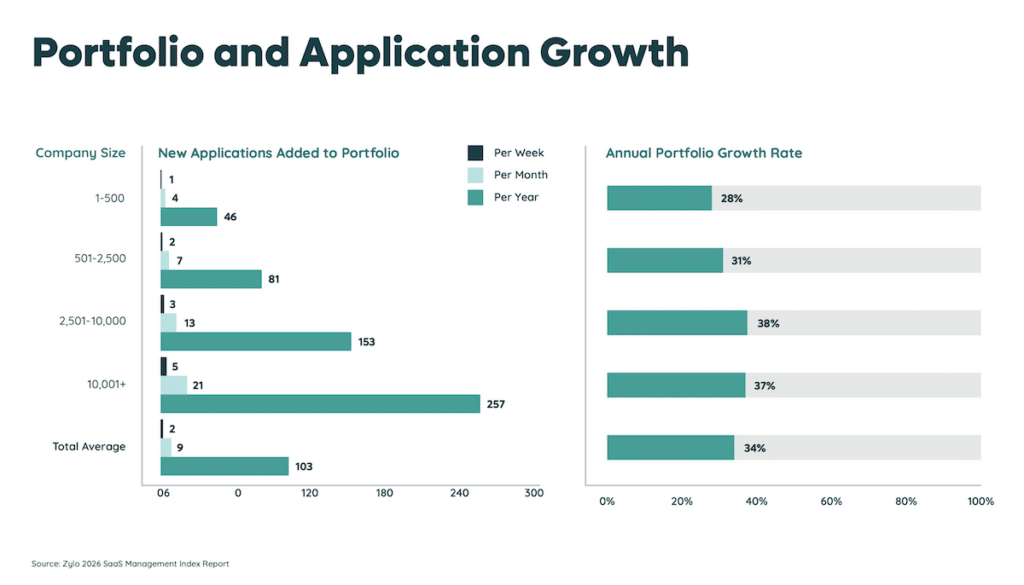
Without centralized oversight, your organization will accumulate overlapping tools that provide similar functionality. Sprawl occurs quickly: the average company adds 9 net-new applications each month, contributing to more than 34% annual portfolio growth. At the same time, underutilization is widespread, with 46% of licenses unused.
This combination results in overspending, redundant subscriptions, and missed opportunities to optimize entitlements. Consistent governance and usage monitoring help organizations identify where tools can be consolidated, renegotiated, or retired.
Security, Privacy, and Compliance Gaps
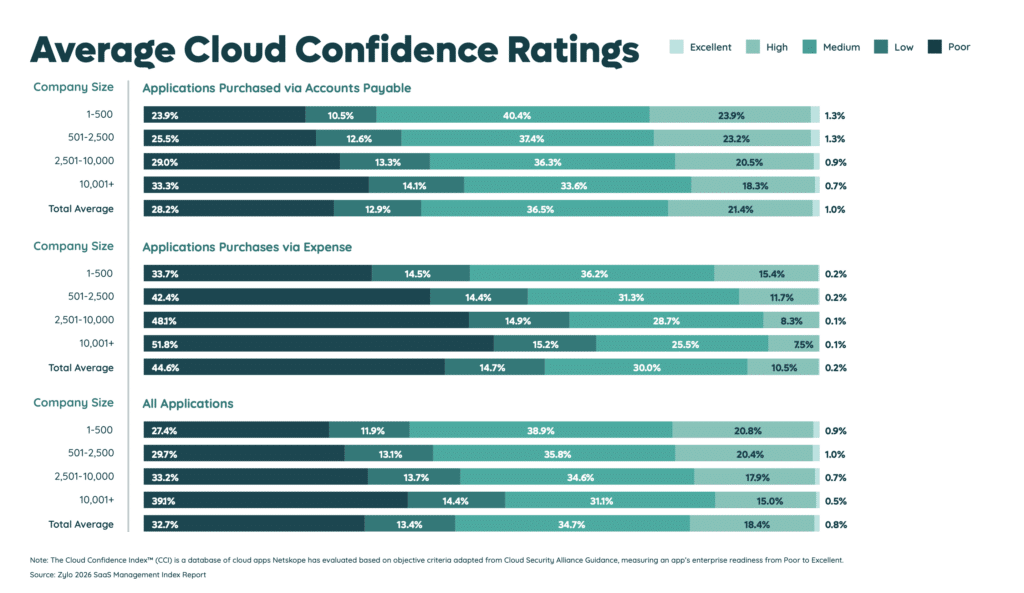
Every new SaaS purchase introduces potential exposure—especially when evaluations are rushed or inconsistent. Due diligence is critical for tools that process sensitive data, integrate with core systems, or support regulated workflows. The 2026 SaaS Management Index reports that 46% of applications in the average portfolio have a Poor or Low risk score, meaning they pose meaningful security and compliance concerns.
A formal procurement process ensures security reviews are embedded early, reducing the chance of adopting high-risk or non-compliant vendors that could create regulatory or operational issues later.
Weak or Minimal Vendor Evaluation or Misalignment
Teams often select tools based solely on features, without validating long-term fit, scalability, financial stability, or roadmap alignment. Limited vendor assessment increases the likelihood of selecting tools that cannot support future needs, integrate properly, or maintain performance over time.
A balanced evaluation that considers functionality, technical compatibility, security posture, support quality, and pricing helps prevent misalignment and ensures tools evolve with the business.
Unclear Pricing and Hidden Costs

Modern SaaS pricing models—particularly consumption-based and AI-driven models—introduce cost unpredictability. The average organization spends roughly $55M on SaaS, yet 78% of IT leaders report unexpected charges tied to variable or usage-based billing.
Without clear visibility into how pricing scales, organizations risk exceeding budgets, misconfiguring entitlements, or paying for costly overages. Thorough contract review and usage monitoring reduce the chance of financial surprises.
Risk of Vendor Lock-In
Vendor lock-in becomes a real challenge when long-term contracts, proprietary integrations, or limited data portability make it difficult to move away from a tool that no longer fits your needs. When that happens, you lose negotiating power and face higher switching costs, which can slow your ability to adjust your stack as the business evolves.
You can protect yourself by reviewing exit terms, data ownership rights, and integration flexibility early in the procurement process. A little extra attention upfront gives you far more freedom and leverage down the road.
User Adoption and Onboarding
A SaaS tool only delivers value when people actually use it. If onboarding is too rushed or training isn’t clear, employees may struggle to understand the tool’s purpose or how it improves their work. That often leads to stalled adoption, underutilized licenses, and unnecessary spend.
You can avoid these issues by planning onboarding from the start of the procurement process. Clear guidance, accessible training, and ongoing support help your teams understand how to use the tool effectively and why it matters. When employees feel confident, adoption increases, and the tool becomes a meaningful part of your workflow.
The Step-by-Step SaaS Procurement Process
A consistent, repeatable procurement workflow helps teams evaluate SaaS tools objectively, reduce duplication, and ensure every purchase supports business goals. The subsections below walk through the full lifecycle—from defining needs to managing contracts after purchase.
- Needs identification and requirements gathering
- Stakeholder alignment and governance setup
- Vendor research and evaluation
- Business case development and ROI justification
- Security and compliance review
- Contract negotiation and vendor selection
- Approval workflow and purchase authorization
- Implementation and integration
- Usage monitoring and optimization
- Vendor relationship and contract lifecycle management
1. Needs Identification and Requirements Gathering
Every successful SaaS purchase starts with a clear understanding of the problem the business is trying to solve. Teams should outline several key elements before comparing vendors, including:
- Functional needs
- Technical considerations
- Integration points
- Data requirements
- Financial constraints
This process prevents reactive purchasing and ensures requests align with real priorities rather than individual preferences.
At this stage, it is also helpful to review the current SaaS environment to determine whether an existing tool already meets the need. Usage insights can show you underutilized licenses or overlapping applications, so you can avoid unnecessary spending and extend the value of tools already in the stack.
2. Stakeholder Alignment and Governance Setup
SaaS decisions often span multiple departments:
- IT
- Security
- Finance
- Legal
- Procurement
- The requesting team
Aligning stakeholders early clarifies expectations, reduces surprises during review, and ensures each group can weigh in on requirements, risks, and constraints.
Governance frameworks outline who is involved, what documentation is required, and how decisions are made. This structure helps maintain consistency and prevents decentralized purchasing from creating shadow IT.
3. Vendor Research and Evaluation
Once your company establishes clear requirements, teams can compare solutions based on several factors, including:
- Functionality
- Usability
- Cost
- Scalability
- The vendor’s long-term viability
This stage should also include evaluating:
- Security posture
- Data handling practices
- Customer support responsiveness
- Integration options
Collecting demos, trial access, or pilot programs helps confirm whether vendors can meet expectations in real-world scenarios. Clear scoring criteria allow procurement teams to evaluate options objectively and transparently.
4. Business Case Development and ROI Justification
Before purchasing, stakeholders need a well-supported business case. This includes estimating:
- Expected productivity gains
- Cost savings
- Operational improvements
- Risks associated with the status quo
Cost-benefit analysis affects budget allocation and executive approval.
You can use spend and usage data from the existing stack to help organizations quantify consolidation opportunities or benchmark the proposed solution against current costs. Data-backed analyses strengthen credibility and show why the purchase is justified.
5. Security and Compliance Review
Security teams assess whether the tool meets organizational standards before contract negotiation begins. Review areas include:
- SOC 2, GDPR, or HIPAA compliance
- Data retention and deletion policies
- Encryption standards
- Access controls
- Vendor incident response practices
Applications that access sensitive data require heightened scrutiny. This step ensures you avoid high-risk vendors and maintain compliance with internal and regulatory requirements.
6. Contract Negotiation and Vendor Selection
With security clearance and a preferred vendor identified, procurement negotiates several key elements, including:
- Pricing
- Usage rights
- Renewal terms
- SLAs
- Implementation support
- Data ownership
Clear exit terms and predictable renewal structures reduce the risk of unexpected cost increases or long-term lock-in. Your negotiation outcomes significantly affect the total cost of ownership, making this one of the most critical steps in the process.
7. Approval Workflow and Purchase Authorization
Once you’ve selected a vendor and completed the required reviews, the purchase usually needs formal approval. This step protects your organization financially and reduces the risk of surprise spend or unapproved tools entering your environment. Many companies use a tiered approval structure, so higher-risk or higher-cost purchases receive the right level of scrutiny. You might need additional sign-off depending on factors such as:
- Spend thresholds
- Data sensitivity
- Integration complexity
A clear approval workflow also helps requests move efficiently through the right channels. Instead of wondering who needs to review what, you can route each request to the appropriate teams, such as:
- Finance
- Legal
- IT
- Security
This structure makes the process more predictable for everyone involved and ensures key details—like contracts, risk assessments, and cost justifications—are recorded and easy to reference later. Strong documentation becomes especially valuable during audits, renewals, or vendor evaluations down the line.
8. Implementation and Integration
After approval, IT and the requesting team collaborate to:
- Configure the tool
- Integrate it with existing systems
- Set up user access
- Effective onboarding includes:
- Technical setup
- User training
- Clear communication to support adoption
This kind of structured implementation plan prevents delays and helps users gain value quickly.
9. Usage Monitoring and Optimization
After a solution is deployed, teams must monitor adoption, usage patterns, and license needs. This ongoing attention ensures entitlements match real demand and prevents waste. When usage drops or teams shift priorities, licenses may need to be reallocated, downsized, or consolidated. Partnering with IT and finance helps maintain visibility into spend and system usage, enabling continuous optimization.
10. Vendor Relationship and Contract Lifecycle Management
SaaS procurement continues long after implementation. Ongoing responsibilities include:
- Managing renewals
- Tracking contract terms
- Scheduling reviews
- Evaluating performance
These activities help organizations maintain control over long-term costs. Contract lifecycle management ensures renewals are negotiated proactively rather than occurring unnoticed or automatically. Historical usage, spend, and performance data help organizations make informed renewal decisions and maintain strong vendor relationships.
Best Practices for SaaS Procurement
Strong SaaS procurement practices help organizations control spend, reduce risk, and make informed buying decisions. There are several practical methods for you and your team to improve consistency, strengthen governance, and maximize the value of your SaaS investments. Here’s how to begin:
- Define clear requirements before evaluating solutions
- Build a cross-functional buying committee
- Compare multiple vendors and request demos or pilots
- Negotiate more than just price
- Track usage continuously and reduce waste
- Using SaaS management platforms
Define Clear Requirements Before Evaluating Solutions
Use clear requirements to help you and your team avoid reactive purchasing. This will ensure every request aligns with a defined business need. Before reviewing vendors, document:
- Functional goals
- Integration needs
- User groups
- Financial constraints
- Expected outcomes
Laying this groundwork prevents misalignment, accelerates vendor comparisons, and reduces the risk of selecting tools that don’t scale.
Build a Cross-Functional Buying Committee
Create a collaborative buying process that brings together IT, finance, security, legal, and business stakeholders to evaluate the tool from multiple angles. Each group can contribute unique insights:
- IT reviews technical fit and integrations
- Finance assesses cost structure and budget
- Security evaluates data handling and risk
- Business units confirm usability and expected outcomes
Using this shared decision-making model reduces blind spots and ensures selected tools serve long-term organizational goals.
Compare Multiple Vendors and Request Demos or Pilots
Evaluate several vendors for a thorough comparison of product capabilities, pricing structures, and implementation requirements.
Request hands-on evaluation through demos, pilots, or trial access so stakeholders can validate usability, confirm performance expectations, and uncover limitations that may not appear in marketing materials.
Collect structured feedback to help your teams objectively evaluate vendors and maintain transparency throughout the selection process.
Negotiate More Than Just Price
Price is one component of a much larger negotiation strategy. You also need to evaluate and negotiate:
- Data ownership
- Service-level agreements
- Exit terms
- Price caps on annual increases
Address these elements to retain control over organizational data, maintain predictable cost structures, and avoid restrictive terms that lead to vendor lock-in. Negotiate holistically for a more favorable long-term partnership.
Track Usage Continuously and Reduce Waste
SaaS optimization is an ongoing process. Monitor usage trends, license allocation, and application adoption to determine whether tools still align with needs. Continuous review helps:
- Reclaim unused licenses
- Reduce or resize subscriptions
- Consolidate redundant tools
Real-world data shows how much you can save by monitoring usage and cleaning up underutilized tools.
Adobe uncovered about $60 million in savings and avoidance after gaining full visibility into its SaaS stack, while Talkdesk completed 24 negotiations in six months, resulting in $347,000 in annual savings and $561,000 in total savings. Clear insights make these kinds of outcomes possible for you.
Use a SaaS Management Platform
You need visibility into applications, spend, contracts, and usage. A SaaS Management Platform (SMP) helps you and your team:
- Monitor renewals
- Track adoption
- Identify waste
- Simplify reporting
- Enforce governance
- Negotiate contracts and renewals with accurate usage data and benchmarks
Bringing an SMP into your procurement workflow makes it easier to see what’s happening across your stack and make informed decisions without the heavy administrative lift. They give you clearer insights and free up time for IT and procurement teams to focus on higher-value work.
Tools and Technology Supporting SaaS Procurement
Modern procurement teams rely on technology to:
- Gain visibility into their SaaS environments
- Streamline evaluations
- Manage renewals effectively
What Are SaaS Management Platforms?
A SaaS Management Platform is a system of record for SaaS that provides automated insights and workflows that help procurement teams manage software intake and renewals.
SMPs provide:
- Unified application, contract, spend, and usage data
- Automated tools to support renewal processes
- Customizable reporting on KPIs
With an SMP, procurement, IT, and finance teams stay more aligned. It allows you to govern purchasing more effectively, enforce standards consistently, and keep your stack tied to your organization’s goals.

The Benefits of SaaS Management Platforms
An SMP helps procurement teams improve operational efficiency and reduce wasted spend. Key benefits include:
- Comprehensive, ongoing software discovery and inventory
- Data-backed purchasing and renewal decisions (e.g., usage metrics, benchmarks)
- Proactive renewal and contract lifecycle management
- Improved spend analysis and forecasting
- Reduction in software spending
- More consistent governance and policy adherence
SaaS Management Platforms are especially helpful when you’re facing rapid application growth, rising SaaS costs, or a lot of decentralized purchasing. By adopting an SMP into your procurement stack, you gain a smoother, more modern way to manage procurement, reduce manual work, and make confident decisions grounded in real data.
Building a SaaS Procurement Governance Model
A strong governance model provides the structure you need to manage SaaS purchases with confidence. It requires you to:
- Establish policies and a standard procurement workflow
- Define stakeholder roles and approval requirements
- Train employees and communicate expectations
When expectations are clear and the right people are involved at the right time, you can reduce risk, avoid unnecessary tools, and help your organization make smarter decisions.
Establish Policies and a Standard Procurement Workflow
Begin your governance process with clear, accessible policies that show your teams exactly how to request and evaluate new SaaS tools. A standard procurement workflow helps:
- Eliminate confusion, which can lead to duplicate purchases or shadow IT.
- Teams understand whether a tool already exists in your stack before making a new purchase.
- Ensure security and finance reviews happen early rather than at the last minute.
- Protect your time and speed up approvals by enabling teams on expectations.
Define Stakeholder Roles and Approval Requirements
Since SaaS decisions touch multiple parts of the business, it helps to define each stakeholder’s role before requests start flowing in. This structure prevents bottlenecks and helps your teams give every tool the right level of scrutiny:
- Technical teams confirm compatibility and integration needs.
- Finance reviews budget fit and long-term cost impact.
- Security validates data handling practices and risk.
- Business leaders confirm usability and expected outcomes.
When responsibilities are clear, you avoid confusion about who approves what and ensure no purchase slips through without proper review.
Train Employees and Communicate Expectations
Governance only works when everyone understands how it helps them. The right training gives your teams a clear picture of why the process exists and what can go wrong when they ignore it—from security gaps to unnecessary spend. It will also help them see how a consistent workflow actually speeds things up and gets them the right tools with less friction.
Use clear, ongoing communication to reinforce these expectations and guide employees toward approved purchasing paths. Once people understand that the process protects both the organization and its budget, they’re much more likely to follow it.
SaaS Procurement Checklist
- Confirm the business need and document requirements. Clarify the problem, the desired outcome, and who will use the tool so you avoid unnecessary or misaligned purchases.
- Check whether an existing tool already solves the problem. Review your current SaaS stack and usage data to determine whether you can repurpose or expand an existing solution rather than buy a new one.
- Align with IT, security, finance, and business stakeholders. Bring the right people into the process early to avoid delays, assess risks, and confirm the purchase supports broader goals.
- Research and compare qualified vendors. Evaluate product fit, maturity, usability, and long-term viability to ensure the tool can support current and future needs.
- Request demos, trials, or pilot access. Validate the user experience, performance, and feature set in real workflows before committing.
- Validate security posture, certifications, and data practices. Confirm compliance standards, data handling policies, and access controls to ensure the vendor meets your organization’s risk requirements.
- Build the business case and outline expected ROI. Estimate productivity gains, cost reductions, and operational improvements to justify the purchase.
- Review pricing models, contract terms, and renewal structures. Look closely at usage-based pricing, potential overages, and renewal terms to avoid future surprises.
- Negotiate data ownership, SLAs, and exit terms. Protect your organization’s data rights, service expectations, and flexibility to switch tools if needed.
- Route the request through the proper approval workflow. Ensure the purchase follows all review steps so documentation, risk assessments, and budget approvals are captured correctly.
- Plan implementation and integration with IT. Prepare for configuration, data migration, access setup, and system connections that will support a smooth rollout.
- Train users and communicate adoption expectations. Show teams how and why to use the tool to improve engagement and accelerate time-to-value.
- Continuously monitor usage, adoption, and spend. Track how the tool performs over time and adjust license counts or plans as demand changes.
- Prepare proactively for renewals using usage and contract data. Review performance, negotiate terms, and eliminate waste before automatic renewals lock in unnecessary spend.
Gain Control Over SaaS
If you’re looking for a clearer way to manage your SaaS footprint, gain visibility into renewals, and reduce the waste hidden across your stack, a purpose-built platform can simplify the work. Zylo gives you a centralized view of your applications, usage, contracts, and vendors so you can make better decisions at every stage of procurement.
With that level of visibility, you can:
- Select tools that support real work
- Eliminate overlapping or underused applications
- Reduce security and compliance risk
- Approach renewals with greater confidence
If you want to see how a centralized system of record can support your goals, request a demo to explore what’s possible.
Frequently Asked Questions About SaaS Procurement
What are the best procurement practices for IT?
Effective IT procurement focuses on visibility, consistency, and cross-functional collaboration. Teams see the best results when they:
- Maintain a complete SaaS inventory
- Standardize intake, evaluation, and renewals
- Align procurement, IT, and finance
- Use real usage and contract data in negotiations
These practices strengthen control and improve decision quality.
Why do we need an IT procurement policy?
An IT procurement policyensures teams follow a consistent, efficient process. It clarifies:
- Required security and compliance checks
- Ownership and approval responsibilities
- Renewal timelines and documentation
This structure reduces delays, avoids duplicate purchases, and makes decisions more predictable.
Who owns SaaS Management—IT, Procurement, SAM, or FinOps?
SaaS Management is a shared responsibility that spans multiple teams, each accountable for a critical part of the SaaS lifecycle.
- IT: Owns application strategy, access control, governance, security, and integration.
- Procurement: Owns contracts, vendor relationships, renewals, and negotiation strategy.
- SAM: Manages license entitlements, optimization, and audit defense.
- FinOps: Monitors spend, enables forecasting, and drives unit economics across business units.
Ownership should be distributed but coordinated, with shared visibility and aligned KPIs across all functions.
How can procurement enforce better SaaS purchasing policies?
Procurement can enforce stronger SaaS policies by establishing clear approval workflows, setting spend thresholds, and educating employees on approved tools. Providing pre-vetted alternatives and centralizing contract ownership helps reduce off-channel purchases while maintaining business agility.
Why do employees buy SaaS and AI tools outside of procurement?
Employees often purchase SaaS and AI tools independently because they are easy to access, inexpensive to start, and deliver immediate value. Lengthy approval processes or unclear purchasing policies can also encourage teams to expense tools directly to move faster.
Effective IT procurement focuses on visibility, consistency, and cross-functional collaboration. Teams see the best results when they:
- Maintain a complete SaaS inventory
- Standardize intake, evaluation, and renewals
- Align procurement, IT, and finance
- Use real usage and contract data in negotiations
These practices strengthen control and improve decision quality.
An IT procurement policy ensures teams follow a consistent, efficient process. It clarifies:
- Required security and compliance checks
- Ownership and approval responsibilities
- Renewal timelines and documentation
This structure reduces delays, avoids duplicate purchases, and makes decisions more predictable.
SaaS Management is a shared responsibility that spans multiple teams, each accountable for a critical part of the SaaS lifecycle.
- IT: Owns application strategy, access control, governance, security, and integration.
- Procurement: Owns contracts, vendor relationships, renewals, and negotiation strategy.
- SAM: Manages license entitlements, optimization, and audit defense.
- FinOps: Monitors spend, enables forecasting, and drives unit economics across business units.
Ownership should be distributed but coordinated, with shared visibility and aligned KPIs across all functions.
Procurement can enforce stronger SaaS policies by establishing clear approval workflows, setting spend thresholds, and educating employees on approved tools. Providing pre-vetted alternatives and centralizing contract ownership helps reduce off-channel purchases while maintaining business agility.
Employees often purchase SaaS and AI tools independently because they are easy to access, inexpensive to start, and deliver immediate value. Lengthy approval processes or unclear purchasing policies can also encourage teams to expense tools directly to move faster.